

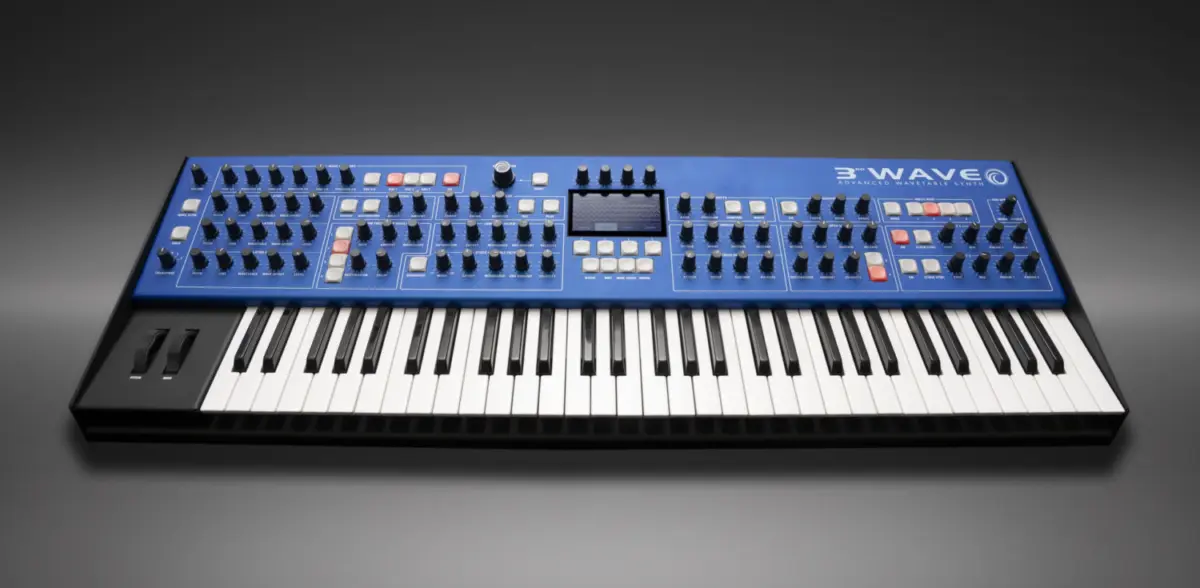
Groove Synthesis, the California-based synthesizer manufacturer, has officially announced the release of 3rd Wave Terminal, a sophisticated desktop application designed to provide a comprehensive software interface for the 3rd Wave synthesizer. Compatible with both macOS and Windows operating systems, the application marks a significant expansion of the 3rd Wave ecosystem, offering users a centralized hub for patch management, deep parameter editing, and advanced sound design capabilities. The 3rd Wave Terminal is being offered at no additional cost to registered owners of the hardware, reflecting a commitment to ongoing product support and user experience enhancement.
The 3rd Wave synthesizer itself has gained significant traction in the professional audio industry since its debut, praised for its modern interpretation of the classic wavetable synthesis popularized by the PPG Wave series in the 1980s. With the introduction of the Terminal application, Groove Synthesis addresses the complexities inherent in managing a 24-voice, multi-timbral instrument. By transitioning deep-level editing and file management to a high-resolution computer screen, the company aims to bridge the gap between hardware tactile control and software-driven precision.
The Evolution of Groove Synthesis and the 3rd Wave Project
To understand the significance of the 3rd Wave Terminal, one must look at the pedigree of the development team at Groove Synthesis. The company was founded by industry veterans, including Bob Coover, Taiho Yamada, and Mark Wilcox, many of whom have histories with legendary brands such as Sequential and Avid. Their collective experience in digital signal processing and hardware design led to the creation of the 3rd Wave, which features three oscillators per voice, analog filters, and a hybrid architecture that allows for both vintage and contemporary textures.
Since its initial release as a 61-key keyboard, and the subsequent launch of the 3rd Wave Desktop module, the instrument has been lauded for its ability to replicate the "aliasing" and grit of early digital synths while maintaining the warmth of modern analog circuitry. The 3rd Wave utilizes a Dave Rossum-designed SSI 2144 filter, providing a 24dB/octave resonant low-pass response that defines much of its character. However, as the instrument’s feature set expanded through firmware updates—including the addition of user-sampling capabilities and expanded modulation matrices—the need for a robust software editor became increasingly apparent to the user base.
Comprehensive Librarian and Patch Management
One of the primary pillars of the 3rd Wave Terminal is its Librarian module. In a professional studio environment, managing thousands of presets across various banks can be a logistical challenge. The Librarian provides a streamlined graphical user interface (GUI) that allows users to organize their program libraries with drag-and-drop functionality.
The Librarian interface permits users to view all 500 factory programs alongside user-created banks simultaneously. This global view facilitates the quick reorganization of sounds for specific projects or live performances. Furthermore, the software provides an essential backup utility, allowing users to save their entire internal memory state to a computer drive. This ensures that custom sound design work is protected against hardware failure or accidental overwrites. The ability to categorize sounds by genre, type, or project-specific tags within the software environment significantly reduces the time spent navigating the hardware’s internal menu system.
Deep-Level Program Editing
While the 3rd Wave hardware is known for its "one-knob-per-function" philosophy for primary parameters, the instrument contains a vast array of "under-the-hood" settings that are traditionally accessed via a smaller OLED screen. The 3rd Wave Terminal’s Program Editor brings every single parameter into a single, cohesive view.
The Program Editor provides a visual representation of the synthesizer’s 24-voice architecture. Users can manipulate oscillator shapes, envelope stages, and LFO (Low-Frequency Oscillator) rates with mouse precision. Perhaps most importantly, the modulation matrix—a core component of the 3rd Wave’s sound design power—is fully visualized within the Terminal. This allows users to see complex routing paths at a glance, making it easier to track how a specific source, such as a velocity or an aftertouch message, is influencing multiple destinations like filter cutoff or wavetable position.
The editor also facilitates the management of the synth’s four-part multi-timbral capabilities. Users can define keyboard splits and layers, assign MIDI channels to each part, and balance output levels across the four parts within a single window. This level of oversight is particularly beneficial for film composers and electronic music producers who require intricate, multi-layered textures.
Advanced Wavetable and Sample Creation
The most technically advanced aspect of the 3rd Wave Terminal is its dedicated Wavetable and Sample Editors. Wavetable synthesis relies on cycles of single-cycle waveforms that the synth "scans" through to create evolving timbres. Traditionally, creating custom wavetables was a laborious process involving third-party software and manual file conversions.
The 3rd Wave Terminal simplifies this by allowing users to build wavetables directly from audio files, including the widely used MP3 format. The software analyzes the incoming audio and extracts the necessary data to create smooth, interpolating wavetables that can be sent directly to the hardware. This "Wavemaker" technology is a direct descendant of the innovative features found in the original PPG systems but updated for the 21st century with modern algorithms.
In addition to wavetables, the Sample Editor provides a robust toolset for managing multisamples. Since a recent firmware update enabled user-sample support, the 3rd Wave can function as a high-fidelity sampler. The Terminal application allows users to map samples across the keyboard, set root notes, and define loop points with visual feedback. This transforms the 3rd Wave from a purely synthesis-based instrument into a hybrid machine capable of blending real-world recordings with digital wavetables and analog filtering.
Technical Specifications and System Integration
The 3rd Wave Terminal is designed to function as a "thin client" for the hardware, meaning it communicates in real-time via USB-MIDI. Changes made in the software are instantly reflected on the hardware, and vice versa, ensuring a seamless bidirectional workflow.
Key technical features of the Terminal include:
- Platform Support: Native installers for macOS (Intel and Apple Silicon) and Windows 10/11.
- Audio Format Support: Capability to import WAV, AIFF, and MP3 files for wavetable and sample generation.
- Connectivity: High-speed USB-MIDI communication.
- Visual Feedback: High-resolution rendering of envelope curves, filter slopes, and waveform cycles.
The release of the Terminal comes at a time when the "hybrid" studio—combining the tactile feel of hardware with the organizational power of software—has become the industry standard. By providing a free, first-party tool, Groove Synthesis ensures that the integration is tighter than what could typically be achieved by third-party MIDI editors.
Chronology of Development
The journey to the 3rd Wave Terminal has been marked by several key milestones:
- May 2022: Groove Synthesis officially unveils the 3rd Wave Keyboard at the NAMM Show, garnering immediate attention for its 24-voice polyphony and PPG-inspired heritage.
- Late 2022: The first production units ship to customers, establishing a community of early adopters.
- August 2023: Groove Synthesis releases the 3rd Wave Desktop Module, providing a more compact and affordable entry point into the ecosystem.
- Early 2024: A major firmware update introduces expanded sampling capabilities, allowing users to import their own audio directly into the synth’s memory.
- Present: The launch of 3rd Wave Terminal completes the vision of a fully integrated hardware-software workstation.
Market Context and Industry Implications
The release of the 3rd Wave Terminal reflects a broader trend in the high-end synthesizer market. Manufacturers such as Waldorf, Sequential, and Arturia have increasingly relied on software "companions" to enhance their flagship hardware. For a boutique company like Groove Synthesis, providing such a robust tool for free is a strategic move to solidify its position against larger competitors.
Industry analysts suggest that the addition of a dedicated editor increases the "residual value" of hardware instruments. When a manufacturer provides tools that make the instrument easier to use and more versatile, the product remains relevant in professional studios for a longer duration. Furthermore, by allowing the import of MP3s and other consumer audio formats for wavetable creation, Groove Synthesis is lowering the barrier to entry for complex sound design, making the 3rd Wave accessible to a wider range of producers beyond just synthesis enthusiasts.
The ability to create custom multisamples also places the 3rd Wave in competition with high-end workstations and software samplers. By routing these samples through the instrument’s SSI analog filters, users can achieve a sonic character that is difficult to replicate in a purely digital environment (In-The-Box).
Conclusion and Availability
The 3rd Wave Terminal represents a significant leap forward for Groove Synthesis. It is not merely a utility but an extension of the instrument’s creative potential. By centralizing the librarian, program editing, and wavetable creation processes, the software allows users to focus more on the creative aspects of music production and less on the technical hurdles of hardware management.
The application is available for download via the official Groove Synthesis website. It is free for all registered owners of the 3rd Wave, whether they own the original keyboard version or the newer desktop module. As the company continues to refine the 3rd Wave’s firmware, the Terminal application is expected to receive regular updates, ensuring that it remains a vital part of the Groove Synthesis ecosystem for years to come.
For the professional audio community, the message is clear: the 3rd Wave is no longer just a standalone synthesizer, but a fully integrated sound design platform capable of handling the demands of modern music production, film scoring, and live performance with unprecedented ease.
