

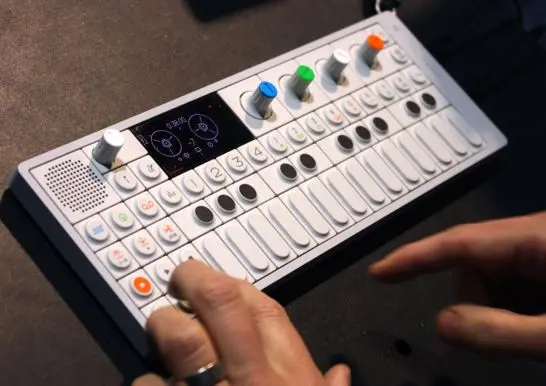
The landscape of portable music production has been significantly altered by the release of a comprehensive, community-driven firmware modification for the original Teenage Engineering OP-1. Developed by synthesist and programmer Justin Joe, this third-party update introduces a suite of features previously absent from the decade-old hardware, including a brand-new synthesis engine, a dedicated chord mode, and six additional audio effects. The release marks a pivotal moment for the "OG" OP-1 community, offering a substantial functional expansion for a device that many believed had reached its final developmental plateau following the release of the OP-1 Field in 2022.
The modification is built upon the foundation of firmware version 246, which was the final official update provided by Stockholm-based Teenage Engineering for the original unit. By utilizing this stable architecture, the custom firmware ensures a high degree of compatibility while unlocking the latent potential of the device’s internal hardware. This development is part of a broader trend in the electronic music community where independent developers revitalize "legacy" digital instruments through creative coding and reverse engineering, effectively extending the lifecycle of hardware that manufacturers may have transitioned away from in favor of newer iterations.
Historical Context and the Evolution of the OP-1
To understand the significance of this firmware modification, one must look back at the trajectory of the original OP-1. Released in 2011, the OP-1 was a radical departure from traditional synthesizer design. It featured a compact, aluminum chassis, a high-contrast OLED display, and a unique "four-track tape" workflow that eschewed traditional MIDI sequencing in favor of a more tactile, destructive recording process. Over the next decade, it became one of the most iconic pieces of music technology in the world, used by high-profile artists ranging from Jean-Michel Jarre to Childish Gambino.
Throughout its lifespan, Teenage Engineering provided several significant updates, adding engines like "CWO" and "Voltage," and introducing features like the "Arpeggio" sequencer. However, as the hardware aged—specifically the Analog Devices Blackfin processor and the limited RAM overhead—the frequency of updates slowed. In May 2022, Teenage Engineering announced the OP-1 Field, a significantly more powerful successor featuring stereo signal paths, 32-bit audio, and multiple tape styles. This transition led many users to assume that the original hardware had reached its technical limits.
The arrival of Justin Joe’s firmware mod challenges this assumption. By optimizing the existing code and identifying unused resources within the original system’s architecture, Joe has demonstrated that the 2011 hardware still possesses the capacity for significant growth. This development provides a bridge for users who prefer the specific "lo-fi" character and form factor of the original unit but desire some of the modern conveniences found in contemporary synthesizers.
Technical Analysis of New Features
The modification introduces several core enhancements that fundamentally change the user experience of the OP-1. The most notable additions are the new synthesis engine and the expanded effects library, which integrate seamlessly into the existing four-encoder interface.
The New Synthesis Engine
While the specific mathematical model of the new engine remains a subject of technical interest, it provides a distinct sonic palette that complements the existing digital, FM, and string synthesis models found in the stock firmware. Early testing suggests the engine focuses on versatile wave-shaping capabilities, allowing users to generate complex timbres that sit between the clinical precision of the "Phase" engine and the chaotic nature of "DSynth." This addition is particularly valuable for users who have exhausted the possibilities of the original presets over years of use.
The Chord Mode
One of the most requested features throughout the OP-1’s history has been a dedicated "Chord" mode. While the OP-1 featured several sequencers—such as "Endless" and "Pattern"—manually inputting complex harmonic structures often required significant menu diving or external controllers. The new firmware mod introduces a dedicated chord function that allows users to trigger complex voicings with a single key press. This enhancement drastically improves the device’s utility as a songwriting tool, particularly for musicians who may not have a formal background in piano theory but wish to explore sophisticated harmonic progressions.
Six New Audio Effects
The original OP-1 was known for its "quirky" effects, such as the "Cow" (a frequency shifter/delay) and "Phone" (a telephonic distortion). The mod expands this library by six, offering new ways to process audio both on individual synth tracks and on the master output. These effects include enhanced spatial processors and modulation tools that take advantage of the OP-1’s unique LFO (Low-Frequency Oscillator) routing system. By adding these effects, the mod allows the OG OP-1 to compete more effectively with the "Field" version’s expanded effects rack, at least in terms of creative variety.
Community Development and the "Right to Repair" Ethos
The release of this firmware is not an isolated event but rather the culmination of years of community-led research into the OP-1’s operating system. Platforms like "OP-1.fun" and various GitHub repositories have long hosted tools for modifying the device’s graphics, changing the "drum" samples, and altering the boot screens. However, a full-scale functional modification of this complexity is a rare achievement.
This project aligns with the broader "Right to Repair" and "Software Longevity" movements. In an era where digital instruments are often rendered obsolete by software incompatibility or the cessation of manufacturer support, the work of independent developers like Justin Joe ensures that expensive hardware remains viable. By providing the mod for free, Joe has positioned the project as a contribution to the global community of "OP-1ers," reinforcing a culture of shared knowledge and technical empowerment.
Comparative Performance: OG OP-1 vs. OP-1 Field
The introduction of these features inevitably leads to comparisons between the modified original unit and the newer OP-1 Field. While the Field remains the superior machine in terms of raw specifications—boasting 24-hour battery life, a high-resolution screen, and a full stereo signal path—the modified original unit narrows the functional gap.
| Feature | Original OP-1 (Stock) | Original OP-1 (Modded) | OP-1 Field |
|---|---|---|---|
| Audio Path | Mono | Mono | Stereo |
| Synth Engines | 13 | 14 | 15+ |
| Effects | Standard Set | Standard + 6 New | Full Stereo Set |
| Chord Mode | No | Yes | Yes |
| Connectivity | USB-Mini | USB-Mini | USB-C / BLE |
For many users, the "mono" nature of the original OP-1 is actually a stylistic choice, lending a specific "vintage digital" punch to recordings that the cleaner, more polished OP-1 Field sometimes lacks. The firmware mod allows these users to retain the sonic character they enjoy while gaining access to modern sequencing and synthesis tools.
Installation, Risks, and Safety Procedures
As with any third-party firmware modification, the installation process carries inherent risks. Justin Joe has provided detailed instructions on his project site, emphasizing that the mod is a "use at your own risk" endeavor. Because the firmware interacts directly with the device’s bootloader, a failed installation could potentially "brick" the unit, rendering it unusable without specialized hardware recovery tools.
The installation typically involves:
- Backing up all user data (Tapes, Albums, and Presets) via USB.
- Booting the OP-1 into "Teardown" or "Function" mode.
- Uploading the custom
.te-firmwarefile. - Allowing the device to verify and flash the new OS.
Industry analysts note that while such mods are popular, they generally void any remaining manufacturer warranties. However, given that most original OP-1 units are well past their warranty period, this is a negligible factor for the majority of the user base.
Broader Implications for the Music Technology Industry
The success of the Justin Joe firmware mod may serve as a signal to other manufacturers in the music technology space. It demonstrates that there is a significant appetite for continued support of legacy products. In a market often driven by "Planned Obsolescence," the enduring popularity of the original OP-1—further bolstered by this mod—suggests that high-quality industrial design combined with a flexible software architecture can lead to a product lifespan of decades rather than years.
Furthermore, this event highlights the shifting relationship between manufacturers and their "power users." While some companies have historically taken a litigious or restrictive stance toward firmware modification, others have begun to embrace it. While Teenage Engineering has not officially commented on the Justin Joe mod, the company has historically maintained a degree of "benign neglect" toward the hacking community, provided the modifications do not facilitate piracy or hardware damage.
Conclusion and Future Outlook
The release of the free firmware mod for the original Teenage Engineering OP-1 represents a landmark achievement in the world of boutique synthesizers. By adding a new synth engine, chord functionality, and six new effects, Justin Joe has effectively granted a "second life" to a device that remains a staple in studios worldwide.
As the community continues to test and refine the modification, it is likely that further iterations will emerge, potentially unlocking even more hidden features within the Blackfin processor’s architecture. For now, owners of the original OP-1 have a compelling reason to dust off their units and explore new sonic territories, proving that in the world of digital synthesis, the end of official support is often just the beginning of a new chapter of innovation.
