

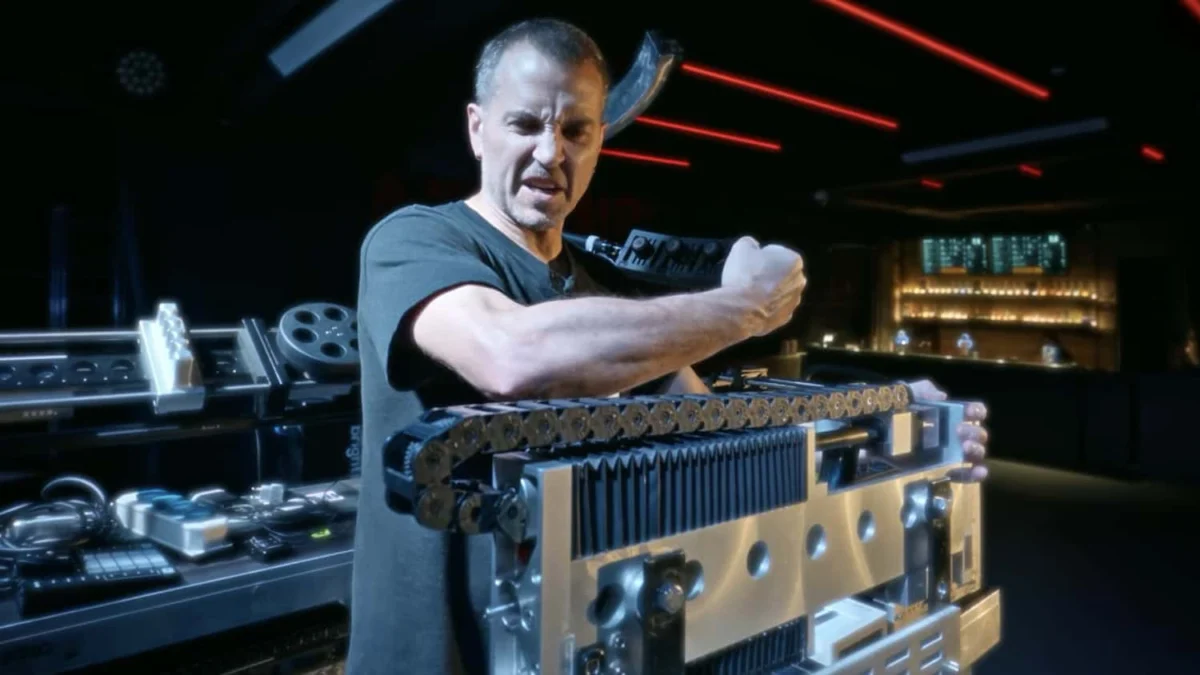
In a newly released mini-documentary filmed during his recent European summer tour in Krakow, Poland, mechanical engineer and industrial metal innovator Tristan Shone—known professionally as Author & Punisher—provides an in-depth exploration of his unique approach to live electronic music. The film, which captures Shone amidst the gritty backdrop of his rigorous touring schedule, serves as both a technical gear tour and a philosophical manifesto on the state of contemporary performance. Shone, who designs and fabricates his own "Drone Machines," uses the platform to critique the prevailing trends in electronic music, arguing that the reliance on backing tracks, costumes, and artificial enhancements has diluted the visceral connection between the artist and the audience.
The Philosophy of Physical Performance
At the heart of Author & Punisher’s work is a rejection of the "press play" culture that has become synonymous with many sectors of electronic and industrial music. Shone’s perspective is informed by his background in mechanical engineering and fine arts, leading him to view the stage not merely as a space for presentation, but as a site of manual labor and physical risk.
"I’m not interested in your costumes and extreme stage presence, running around in the crowd," Shone states in the documentary. "I’m more interested in you being able to perform the songs you wrote in a live capacity and that being captivating and powerful."
This emphasis on "live capacity" refers to the direct correlation between a performer’s physical actions and the resulting sound. In traditional rock or orchestral settings, this connection is inherent: a drummer hits a snare, and a sound is produced. In electronic music, however, the rise of Digital Audio Workstations (DAWs) and MIDI sequencing has allowed for a decoupling of action and sound. Shone argues that when a performance is "perfect and the same every night" due to the use of backing tracks and pitch correction, it loses the essential element of human fallibility that defines a compelling live experience.
The Engineering of Sound: The Drone Machines
To solve the problem of "boring" electronic performances, Shone spent nearly two decades developing a series of custom-built instruments that require significant physical exertion to operate. These "Drone Machines" are not mere controllers; they are heavy-duty industrial interfaces that utilize linear actuators, high-torque motors, and massive sliding rails.
The documentary highlights several key components of Shone’s current rig:
- The Rails: A massive sliding interface that controls pitch and volume through physical momentum. To trigger notes, Shone must physically shove or pull heavy steel blocks, a process that mirrors the movements of industrial factory work.
- The Throttles: Modeled after the controls found in heavy machinery or aircraft, these devices allow Shone to manipulate filters and distortion parameters with tactile precision.
- The Mute Press: A heavy-duty striking interface used for percussive elements, requiring the artist to exert downward force to trigger industrial-strength drum samples.
By utilizing these machines, Shone introduces a level of physical resistance into his music. This resistance ensures that every performance is unique, as the nuances of his physical fatigue, the temperature of the venue, and the mechanical state of the gear all influence the final output. This "risk," as Shone describes it, is what he believes is missing from modern stages.
A Chronology of Innovation and Evolution
Tristan Shone’s journey from a graduate student at the University of California, San Diego (UCSD) to a globally recognized industrial artist is marked by a consistent evolution of both sound and machinery.
- 2004–2010: The Foundation. During his time in San Diego, Shone began merging his skills in sculpture and engineering. His early machines were bulky and focused primarily on drone and noise textures. Albums like The Great Red Spirit (2005) and Drone Machines (2010) established his reputation for "mechanical doom."
- 2013–2015: Refinement and Recognition. With the release of Women & Children (2013), Shone began to incorporate more structured songwriting. The machines became more streamlined for touring, though they remained incredibly heavy, often requiring custom crates and specialized shipping logistics.
- 2018–Present: Melodic Integration. The release of Beastland (2018) on Relapse Records marked a shift toward more aggressive, rhythmic industrial metal. This was followed by Krüller (2022), which saw Shone incorporating more melodic elements and collaborating with members of Tool. The machines used in the current "Inside the Rig" documentary represent the pinnacle of this evolution—instruments that are capable of delicate synthesis as well as crushing distortion.
Data and Logistics: The Weight of Industrial Music
The logistical challenges of Author & Punisher’s tour are a testament to his commitment to the "live capacity" he advocates. While a typical electronic musician might tour with a laptop and a small MIDI controller weighing less than 10 pounds, Shone’s setup is an outlier in the industry.
- Total Rig Weight: Shone’s primary performance rig, including the Drone Machines and their dedicated housing, frequently exceeds 300 pounds.
- Custom Fabrication: Approximately 90% of the hardware used on stage is custom-designed and fabricated by Shone himself, utilizing CNC machining, 3D printing, and traditional welding.
- Technical Failure Rate: Because the machines are mechanical and subject to intense physical vibrations, the "risk" Shone mentions is literal. Maintenance is required after almost every show to ensure that sensors remain calibrated and mechanical joints remain fluid.
In the Krakow interview, Shone emphasizes that the years spent perfecting these machines are what allow him to deliver a powerful performance. "I love to see folks work within a set of limitations that they can play live," he adds. "It may take years to perfect, but show us what you practiced and developed over 100 shows, not what you recorded last week and augmented with costumes and makeup."
Industry Context and the Critique of "Spectacle"
Shone’s comments arrive at a time of significant debate within the music industry regarding the authenticity of live performances. The proliferation of "syncing" to pre-recorded tracks has become a standard practice not only in pop and EDM but also in metal and rock. A 2023 industry report suggested that over 60% of major touring acts utilize some form of automated backing tracks to maintain sonic consistency.
Critics of Shone’s perspective might argue that "spectacle"—including costumes and elaborate stage presence—is a valid form of entertainment that enhances the audience’s experience. However, from a journalistic and musicological standpoint, Shone represents a lineage of "industrial" music that traces back to the early 1980s. Groups like Einstürzende Neubauten used power tools and scrap metal to create sound, and Mark Pauline’s Survival Research Laboratories (SRL) turned industrial machinery into performance art. Shone’s work is a modern continuation of this tradition, where the "spectacle" is the machine itself and the human labor required to tame it.
Broader Implications for Electronic Music
The implications of Shone’s philosophy extend beyond the niche of industrial metal. As artificial intelligence and automation continue to permeate the creative arts, the value of "human-in-the-loop" performance is becoming a central topic of discussion. Shone’s rig acts as a physical barrier against total automation. Because his instruments require specific mechanical inputs to function, they cannot be easily replaced by an algorithm or a pre-recorded sequence without losing their essence.
Furthermore, Shone’s approach challenges the current "content-first" model of the music industry. In an era where artists are often pressured to release music rapidly to satisfy social media algorithms, Shone’s insistence on practicing and developing a craft over "100 shows" serves as a reminder of the importance of artistic longevity and technical mastery.
Conclusion: The Future of the Rig
As Author & Punisher concludes his European tour, the "Inside the Rig" documentary stands as a significant document of a musician who refuses to take the path of least resistance. By documenting the Krakow performance and the intricacies of his machines, Shone provides a blueprint for how electronic music can reclaim its physical soul.
The documentary suggests that the future of captivating live performance may not lie in more advanced software or more elaborate costumes, but in a return to the tactile, the mechanical, and the risky. For Tristan Shone, the goal is clear: to ensure that when an audience watches a performance, they are witnessing a genuine struggle between man and machine—a struggle that results in something uniquely powerful, imperfect, and undeniably live.
