

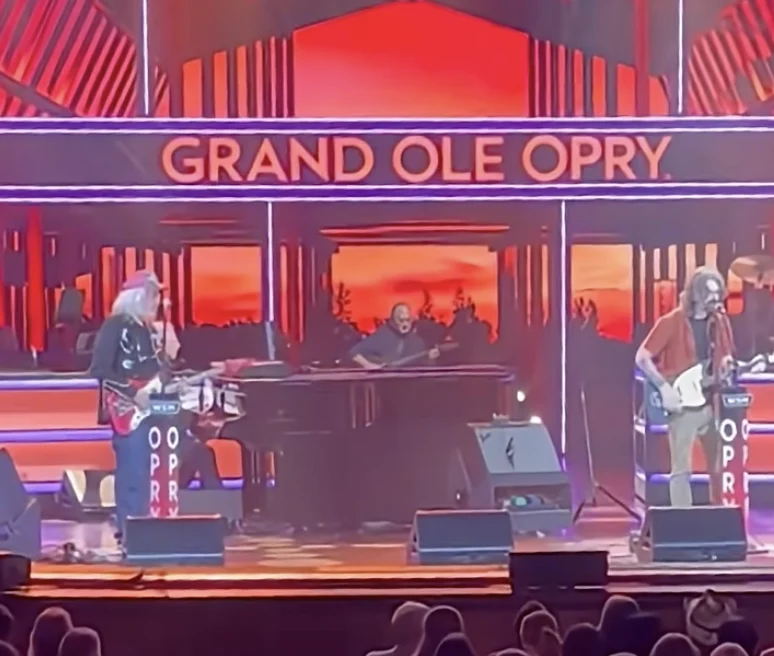
Nashville, TN – In a convergence of distinct musical worlds, acclaimed alt-country musician John R. Miller returned to the venerable stage of the Grand Ole Opry last night, delivering a performance that resonated beyond traditional genre confines. The evening was highlighted by the surprise appearance of J Mascis, the iconic frontman of alternative rock pioneers Dinosaur Jr., who made his unexpected Grand Ole Opry debut alongside Miller. This landmark collaboration followed the digital release last week of Miller’s new LP, The Great Unknowing, an album steeped in Appalachian storytelling and recorded at the historic Church Studio in Tulsa, Oklahoma. The unexpected pairing of Miller’s roots-infused lyricism with Mascis’s signature guitar prowess not only captivated the live audience but also ignited discussions across the music industry about the evolving landscape of contemporary performance spaces.
The evening at the Opry was a tapestry of musical innovation and tradition. Miller, known for his evocative songwriting and authentic Appalachian voice, introduced Mascis as a "monumentally influential practitioner of the guitar," a descriptor that barely scratched the surface of the indie rock legend’s profound impact on generations of musicians. Together, the duo performed "Steering Wheel Drums," a track from Miller’s freshly released album. Mascis, with his characteristic long hair and distinct playing style, brought an electric, almost ethereal layer to Miller’s alt-country sound, a fusion that transcended expectations and offered a fresh perspective on both artists’ repertoires. The choice of "Steering Wheel Drums" for this momentous debut was particularly fitting, allowing Mascis to weave his distinctive, often improvisational, guitar work into the track’s narrative framework, showcasing a shared reverence for musicality that bridges their seemingly disparate genres.
The Unveiling at the Grand Ole Opry: A Night of Unexpected Harmony
The atmosphere inside the Grand Ole Opry House was electric with anticipation even before Mascis’s introduction. John R. Miller, who has steadily built a reputation for his deeply resonant songwriting and captivating live performances, had already engaged the audience with selections from his new album. His return to the Opry, an institution he holds in high regard, was in itself a significant event for his growing fanbase. However, the energy in the room visibly shifted when Miller announced his special guest. Gasps and murmurs quickly turned to cheers as Mascis emerged from the wings, guitar in hand, a somewhat improbable figure on the hallowed wooden circle that has hosted country music’s greatest legends for nearly a century.
The performance of "Steering Wheel Drums" was a masterclass in collaborative artistry. Mascis’s guitar lines, known for their distortion, feedback, and melodic brilliance, intertwined with Miller’s acoustic foundation and vocals, creating a sound that was both familiar and startlingly new. It wasn’t merely an alt-rock musician playing country; it was a genuine musical conversation, demonstrating the universal language of skilled instrumentation and heartfelt expression. For many in the audience, accustomed to the Opry’s traditional country and Americana programming, Mascis’s presence was a revelation, challenging preconceived notions of what constitutes "Opry material" and underscoring the venue’s increasing willingness to embrace diverse musical forms. The collaboration served as a powerful testament to the idea that true artistry knows no genre boundaries, especially when executed with such mutual respect and proficiency.
A Career of Authentic Narratives: John R. Miller’s Journey
John R. Miller has, over the past decade, emerged as a compelling voice in the alt-country and Americana landscape. Hailing from Shepherdstown, West Virginia, his music is deeply rooted in the storytelling traditions of the Appalachian region, characterized by introspective lyrics, a keen observational eye, and melodies that often evoke a sense of nostalgic longing and hard-earned wisdom. His discography, which includes critically acclaimed albums like Depreciated (2018) and Long Arc of the Loading Dock (2021), has garnered him a loyal following and established him as a musician’s musician, admired for his lyrical depth and unvarnished authenticity.
The Great Unknowing, Miller’s latest offering, continues this trajectory, further solidifying his position as a poignant chronicler of the human experience. The album’s recording at Leon Russell’s legendary Church Studio in Tulsa adds another layer of historical weight and artistic significance. The Church Studio, a former church building transformed into a recording haven by the late rock and roll icon Leon Russell, boasts a rich history, having hosted countless legendary sessions for artists across various genres, including Eric Clapton, Willie Nelson, and Bob Dylan. Its unique acoustics and storied past undoubtedly contributed to the sonic texture and spiritual depth of Miller’s new work, providing a powerful backdrop for his reflective narratives. The digital release of the album last week set the stage for Miller’s Opry return, offering audiences a fresh body of work to connect with before witnessing its live interpretation in such a significant setting.
An Unexpected Icon Enters the Circle: The Legacy of J Mascis
J Mascis stands as one of the most influential guitarists and vocalists in alternative rock history. As the driving force behind Dinosaur Jr. since their formation in 1984, Mascis pioneered a sound that blended punk rock’s aggression with classic rock’s melodicism and the raw power of distorted guitars. His unique, often feedback-laden guitar solos, characterized by their soaring, emotional quality and distinctive vibrato, have inspired legions of guitarists and profoundly shaped the sound of indie and alternative rock throughout the late 20th and early 21st centuries. Dinosaur Jr.’s seminal albums like You’re Living All Over Me and Bug are considered touchstones of the genre, showcasing Mascis’s distinctive songwriting and guitar wizardry.
Mascis’s appearance at the Grand Ole Opry is particularly remarkable given his long-standing association with the often-underground, anti-establishment ethos of indie rock. While the Opry has, in recent years, shown a willingness to host artists from outside traditional country confines – including instances of rock and pop acts gracing its stage – Mascis represents a particularly deep dive into alternative culture. His presence symbolizes a growing recognition within mainstream country institutions that musical excellence and cultural impact transcend genre boundaries. For a musician whose career has largely unfolded within the context of independent labels and alternative scenes, making his debut on such a storied, mainstream platform marks a significant personal milestone and a potent symbol of cross-genre appreciation. It demonstrates that the Opry’s "circle," while sacred, is not impenetrable to those who bring undeniable talent and unique artistry.
Beyond the Hallowed Stage: The Nashville Pop-Up
The collaboration between Miller and Mascis was not confined solely to the Opry’s iconic stage. The two musicians extended their unexpected partnership to a more intimate setting, delighting fans with a pop-up performance at Nashville record store Vinyl Tap. This event offered a different flavor of their synergy, providing a raw, up-close experience for those fortunate enough to attend. Here, they tackled a cover of Neil Young’s legendary "Cortez The Killer."
The choice of "Cortez The Killer" was profoundly insightful. Young’s classic, known for its sprawling guitar passages, historical narrative, and raw emotional intensity, is a staple of rock and folk-rock canon. It allowed Mascis to truly unleash his improvisational guitar prowess in a familiar, yet still unique, context. The song’s epic scope and guitar-driven nature provided a perfect canvas for both artists: Miller’s vocal delivery lending a new layer of gravitas to the lyrics, and Mascis’s guitar work adding his signature blend of melodic beauty and controlled chaos. This performance at Vinyl Tap not only underscored the depth of their musical compatibility but also served as a nod to the shared lineage of guitar-centric, narrative-driven music that runs through both alt-country and alternative rock, tracing back to influential figures like Neil Young. It was a moment that further cemented the unexpected alliance, demonstrating a genuine artistic connection beyond the structured environment of the Opry.
The Opry’s Evolving Tapestry: Other Notable Debuts
The same night that John R. Miller and J Mascis made waves, the Grand Ole Opry continued its dynamic programming by hosting another significant debut: the acclaimed alternative rock band Switchfoot. Marking their first appearance on the Opry stage, the Grammy-winning San Diego group brought a different yet equally impactful energy to the evening. They were joined by reigning CMA Entertainer of the Year Lainey Wilson, a powerhouse in contemporary country music, for a collaborative performance of Switchfoot’s hit "Beautiful Life."
This dual set of genre-crossing debuts on a single night underscores the Grand Ole Opry’s ongoing strategic evolution. While steadfastly honoring its roots and preserving the rich heritage of country music, the institution has increasingly demonstrated a willingness to embrace artists from diverse musical backgrounds. This approach aims to introduce its traditional audience to new sounds while simultaneously attracting broader demographics to the Opry experience. The inclusion of Switchfoot and Lainey Wilson, much like the Miller-Mascis collaboration, highlights a concerted effort by Opry management to showcase the universal appeal of music and to foster unique, memorable collaborations that bridge perceived divides between genres. It positions the Opry not merely as a museum of country music, but as a vibrant, living stage where musical innovation and tradition can harmoniously coexist.
Voices from the Crossroads: Artist Reflections
John R. Miller himself articulated the profound significance of the evening, particularly regarding his collaboration with J Mascis. Speaking to Rolling Stone, Miller conveyed his exhilaration: "So incredibly cool and surreal to get to see J Mascis rip on the hallowed stage of the Grand Ole Opry. I’m super grateful to the wonderful folks who run the Opry show, not only for having me back, but for giving me the opportunity to honor one of my all-time guitar heroes in an especially unlikely fashion."
Miller’s words encapsulate the sentiment of many who witnessed the event. The "surreal" nature speaks to the unexpected yet deeply gratifying convergence of two distinct musical paths. His gratitude towards the Opry management highlights their progressive vision in facilitating such an unconventional pairing. By allowing Miller to honor a personal "guitar hero" from a completely different genre on country music’s most sacred stage, the Opry demonstrated an understanding that musical reverence transcends stylistic boundaries. While Mascis, true to his character, offered no public statement immediately following the performance, his mere presence and the powerful impact of his playing spoke volumes. For an artist known for his understated demeanor, his participation in such a high-profile, genre-bending event is a testament to the respect he holds for Miller’s artistry and the unique allure of the Opry stage itself. Industry observers infer that such events are part of the Opry’s broader strategy to maintain relevance and expand its cultural footprint, showcasing its capacity for both tradition and innovation.
Implications and the Future of Genre Boundaries
The unprecedented collaboration between John R. Miller and J Mascis at the Grand Ole Opry carries significant implications for the music industry, particularly concerning genre definition and the evolution of legacy institutions.
Blurring Lines and Expanding Audiences
This event powerfully underscores the ongoing trend of genre fluidity in contemporary music. As digital platforms and diverse listening habits break down traditional barriers, artists and audiences are increasingly seeking out unexpected collaborations that defy easy categorization. The Opry performance introduced Miller’s nuanced alt-country to Mascis’s alternative rock fanbase, and conversely, exposed Mascis’s iconic guitar work to a predominantly country and Americana audience. This cross-pollination has the potential to expand the listenership for both artists and, crucially, for the Grand Ole Opry itself, demonstrating its capacity to host and celebrate diverse musical expressions without diluting its core identity. It serves as a compelling example of how unexpected pairings can create new artistic conversations and engage broader cultural dialogues.
Preserving Tradition While Embracing Innovation
For an institution as steeped in tradition as the Grand Ole Opry, hosting Mascis represents a delicate balance between preserving its heritage and embracing innovation. This decision reflects a strategic understanding that to remain relevant in a rapidly changing music landscape, even the most revered institutions must adapt. By carefully curating moments like this, the Opry showcases its respect for musical craftsmanship across all genres, signaling that its stage is open to artists who embody excellence, regardless of their primary musical classification. It reinforces the idea that the "circle" is not just for country music, but for music that moves people, offering a glimpse into the Opry’s forward-thinking approach to its second century.
Elevating Appalachian Roots and Alt-Country Visibility
For John R. Miller, this collaboration is a significant career milestone. Sharing the stage with a rock legend like J Mascis on such a prominent platform undoubtedly elevates his profile, bringing his critically acclaimed alt-country sound and Appalachian narratives to a much wider audience. It validates his artistry and showcases the richness and depth of the alt-country genre to listeners who might not typically engage with it, proving that authentic storytelling and skilled musicianship resonate universally. It places Miller squarely in the conversation as a bridge-builder between different musical communities.
A Testament to Musical Craftsmanship
Ultimately, the collaboration served as a profound testament to the power of musical craftsmanship. Both Miller and Mascis are revered for their distinct yet equally compelling approaches to their instruments and songwriting. Their joint performance celebrated the shared language of guitar artistry and heartfelt expression, proving that at its core, great music transcends labels. It was a moment that emphasized skill, passion, and the undeniable magic that happens when exceptional musicians connect on stage, regardless of their stylistic origins.
The combined events of John R. Miller’s new album release, his return to the Opry, and the electrifying debut of J Mascis alongside him have etched a memorable chapter into the annals of contemporary music. This unexpected fusion not only delighted audiences and critics but also provided a powerful illustration of the Grand Ole Opry’s evolving identity as a dynamic stage where tradition meets trailblazing innovation, pushing the boundaries of what is possible within the sacred circle of country music.
