

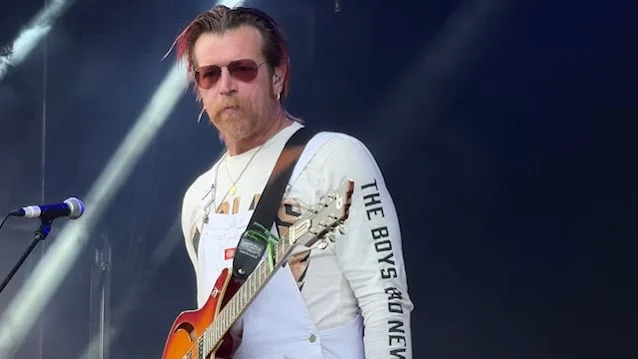
In a recent interview that offers a profound look into the lingering effects of the horrific 2015 Bataclan terrorist attack, Jesse Hughes, the frontman of the rock band Eagles of Death Metal, has revisited the controversial comments he made in the months following the tragedy. Speaking with Scott Michael Nathan on The Bad Decisions Podcast, Hughes addressed what he believes the public has consistently misunderstood about his processing of the events that claimed 90 lives.
Hughes, who was on stage when Islamic State group extremists stormed the Paris venue in November 2015, stated, "Well, they weren’t there. That’s one thing. But also you have to consider that I was traumatized. I was deeply traumatized, and I was very, very protective of everyone that had been there. So I wouldn’t say that I don’t believe the things that I said at the time, but I would definitely say that today I probably wouldn’t say them because it’s just not necessary."
This candid admission marks a significant moment for Hughes, who faced intense scrutiny and criticism for his post-attack remarks. His statements, particularly those made in the immediate aftermath, fueled debate and controversy, drawing parallels to divisive political rhetoric and leading to accusations of insensitivity and Islamophobia.
The Scars of Trauma and the Weight of Public Scrutiny
The Bataclan massacre, a coordinated series of attacks across Paris on November 13, 2015, by the Islamic State of Iraq and Syria (ISIS), remains one of the deadliest acts of terrorism in modern European history. The attack on the Eagles of Death Metal concert, where 89 concertgoers were killed, became a focal point of global mourning and outrage. In the harrowing days and weeks that followed, Hughes, alongside other survivors, grappled with unimaginable grief and trauma.
Hughes’s initial public statements, particularly those made in interviews with outlets like Fox Business, suggested a questioning of the security measures in place at the Bataclan. He alluded to a lack of Muslim security personnel and claimed that some individuals acted suspiciously or failed to appear for their shifts on the night of the attack. These allegations, amplified by media coverage, quickly ignited a firestorm.
The context of these statements is crucial. Hughes was speaking as a survivor, deeply affected by the loss of life and the shattering of his band’s performance into a scene of unimaginable horror. His words, while intended to convey his perspective on the security failures, were interpreted by many as an indictment of an entire religious group. This interpretation was exacerbated by existing political narratives, particularly those voiced by then-presidential candidate Donald Trump, who had previously made unsubstantiated claims about Muslim celebrations in New Jersey following the September 11, 2001 attacks.
Hughes acknowledged the immense pressure and the "endless" number of individuals who sought to "manipulate me and use my tragedy to their benefit," stating, "it disgusted me on both sides of the aisle." This suggests a feeling of being exploited, caught between the raw pain of his experience and the calculated agendas of others.
A Shift in Perspective: "Check Your Politics at the Door"
Hughes articulated a core philosophy that has guided his approach to music and performance: "I’m a rock and roller. I don’t care who you vote for — check your politics at the door, and everyone gets to come here and shake their dick and have a good time." He lamented that the circumstances of that night temporarily stripped him of this ideal, forcing him into a position where such a carefree environment felt impossible.
His renewed emphasis on this inclusive ethos suggests a desire to return to a space where the shared experience of music transcends political divisions. This sentiment is echoed in his clarification regarding his political leanings: "Sometimes people will say I’m a Trump supporter. That is just not true. I’ve never, ever, ever one time in the press ever endorsed or said that I support the man. I’ve just said things that have been controversial that you could attribute maybe to one side or another. But I have a different perspective. And I still believe the things I believe, but I was able to return to a place where — check your politics at the door."
This distinction is vital. Hughes is not disavowing his beliefs but rather asserting that his personal convictions should not be conflated with political endorsements or used to define his response to a universally tragic event. He cites the iconic words of Elvis Presley, "I’m an entertainer and it’s nobody’s business what I vote for, ’cause I ain’t here to tell you who to vote for," as a guiding principle for artists.
Addressing Misconceptions on Social Issues
The conversation also touched upon broader social issues, with Hughes directly addressing potential misconceptions about his stance on LGBTQ+ rights. In response to Scott Michael Nathan’s personal pro-gun stance and acceptance of gay marriage, Hughes stated emphatically, "Dude, our first album is literally the transgender flag. I don’t think anyone realizes that. I grew up in Palm Springs. Nobody is more supportive of the gay community than I am, dude."
This statement directly counters any perception that his controversial comments in the wake of the Bataclan attack were indicative of broader intolerance. He pointed out the difficulty in discerning these nuances when "everyone’s all worked up and everyone’s angry and everyone’s too busy hating." This highlights a perceived societal tendency to oversimplify complex individuals and situations, especially in the charged atmosphere following a terrorist event.
A Chronology of Controversy and Apology
The timeline of Hughes’s public statements and subsequent apologies provides a clearer picture of his evolving public persona and his efforts to navigate the aftermath of the Bataclan attack:
- November 13, 2015: The Eagles of Death Metal concert at the Bataclan theater in Paris is targeted by ISIS terrorists. 89 concertgoers are killed in the attack.
- November 2015 – Early 2016: In interviews, Jesse Hughes makes statements questioning the security at the Bataclan, suggesting that Muslim security guards were absent and that some individuals acted suspiciously. These comments draw widespread criticism and accusations of Islamophobia.
- March 2016: Hughes issues a formal apology to the staff and security of the Bataclan for his previous implications. This apology follows his interview with Fox Business where he raised concerns about security personnel. He stated, "Out of respect for the police still investigating, I won’t make a definite statement, but I’ll say it seems rather obvious that they had a reason not to show up."
- Fall 2016: As a consequence of his earlier remarks, Hughes is barred from attending the Bataclan’s re-opening concert, a symbolic event marking the venue’s return to normalcy.
- March 11, 2026: In an interview with The Bad Decisions Podcast, Hughes reflects on his past statements, attributing them to trauma and a desire to protect those present. He clarifies his political stance and reiterates his belief in a music-focused, apolitical concert environment.
Broader Implications and Societal Reactions
The events surrounding the Bataclan attack and Hughes’s subsequent public discourse had far-reaching implications, extending beyond the music industry. The attacks galvanized France, leading to a robust military response against ISIS in Syria and significantly escalating global concern about the terrorist organization’s reach.
In the United States, the attacks intensified the ongoing debate about Syrian refugee admissions, with security concerns becoming a paramount issue for policymakers and the public alike. The fear of lone-wolf attacks or individuals infiltrated by terrorist groups led to increased scrutiny and calls for stricter immigration policies.
The controversy surrounding Hughes’s statements also underscored the challenges of navigating free speech, trauma, and the responsibility of public figures in the digital age. His experience highlights how quickly words can be amplified and distorted, leading to unintended consequences and the creation of a public narrative that may not accurately reflect the speaker’s intentions or internal state.
The founding of Eagles of Death Metal by Jesse Hughes and Queens of the Stone Age frontman Josh Homme in 1998 predates the events of 2015 by nearly two decades. The band, known for its energetic live performances and often provocative stage presence, had cultivated a devoted following. The Bataclan attack irrevocably altered the band’s trajectory and placed its members, particularly Hughes, under an unprecedented level of public and media attention.
Hughes’s recent interview suggests a mature reflection on his past actions, acknowledging the profound impact of trauma while seeking to clarify his intentions and re-establish his core values. His return to the philosophy of "checking politics at the door" signifies a hope for a return to a more unifying form of artistic expression, where the shared experience of music can serve as a powerful antidote to division and hate. The journey from the trauma of the Bataclan to this present moment of reflection demonstrates the enduring struggle to reconcile personal suffering with public accountability and the complex realities of communication in a hyper-connected world.
