

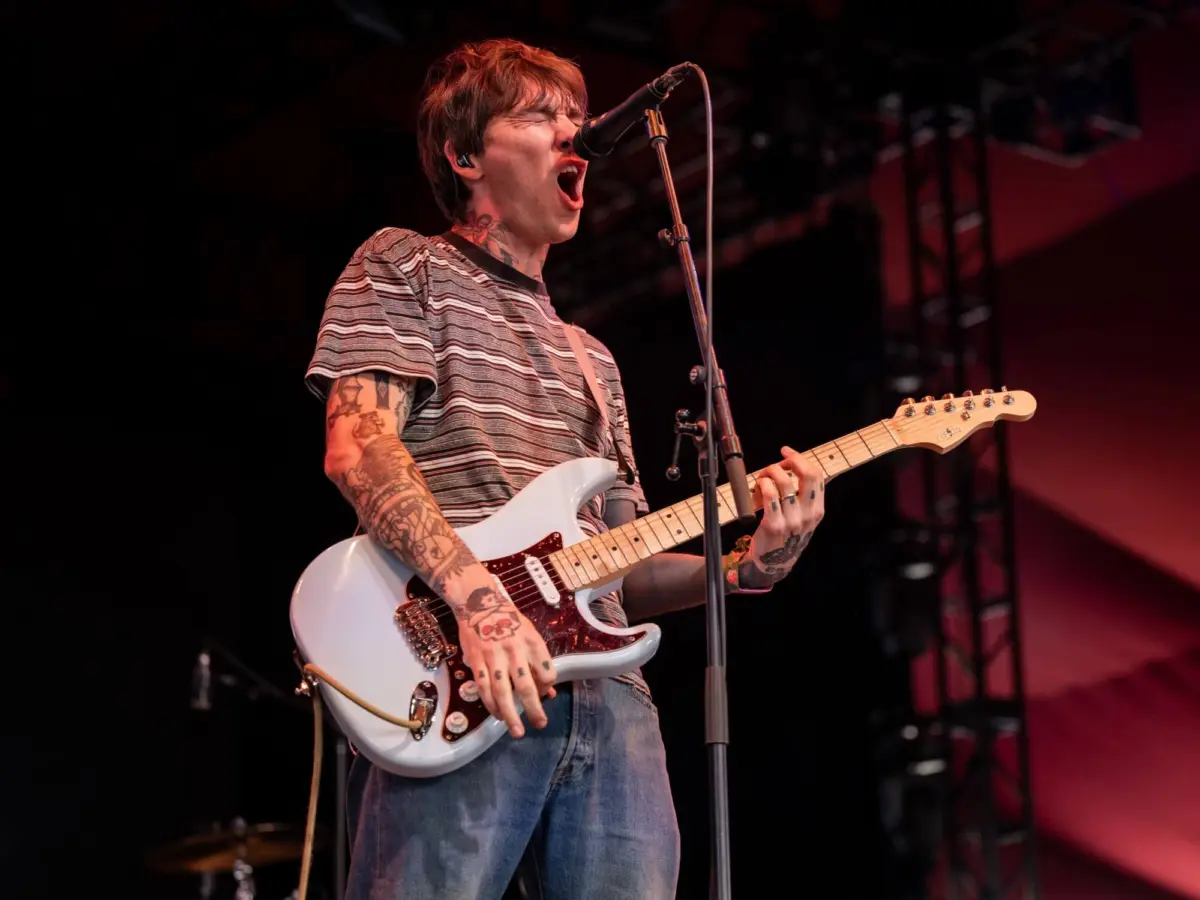
The ongoing evolution of guitar amplification technology has long been a subject of passionate discourse within the music industry, but a recent provocative stance by punk rock emo revivalists Joyce Manor has thrust the debate into sharp relief. In an interview with Marshall, lead vocalist Barry Johnson and guitarist Chase Knobbe openly expressed their disdain for digital amp modellers, likening their use to "vaping" and branding the practice "un-rock-n-roll." This direct challenge to a rapidly growing segment of the guitar market underscores a persistent philosophical divide between traditional analog purists and proponents of modern digital solutions, highlighting broader questions of authenticity, aesthetic, and performance in contemporary music.
The Provocation: Joyce Manor’s Unapologetic Stand on Digital Amplification
Joyce Manor’s critique emerged during a discussion where the band members reminisced about their formative experiences with traditional tube amplifiers. Barry Johnson did not mince words, stating, "I’m judging you – get an amp! It’s so un-rock-n-roll. It’s so not cool!" He further escalated his critique with a vivid, dismissive analogy, comparing the use of modellers to vaping: "You’ve got to get cabs – or you’re, like, vaping, y’know? Just rip a cig! What are you doing?! Plug into an amplifier! Drink a beer and plug into an amp. Grow up already!" This humorous yet pointed tirade, capped with a sarcastic "Modelling amp!! Jesus Christ!", articulates a clear preference for the tactile, raw experience of traditional tube amplification.
For a band deeply rooted in the punk and emo revival scenes, where authenticity and a certain DIY ethos often resonate strongly, this stance is perhaps unsurprising. The physical presence of a loud, imposing amplifier stack on stage is not merely functional; it is an integral part of the rock-n-roll aesthetic, a visual declaration of power and commitment. Johnson’s comments suggest that for Joyce Manor, the sonic output is inextricably linked to the method of its creation and presentation. The "cool factor" he references transcends mere auditory quality, encompassing the visual spectacle, the hands-on interaction, and the cultural legacy associated with classic guitar gear.
A Growing Divide: The Rise of Digital Modellers and Their Proponents
Joyce Manor’s strong opinions arrive at a time when digital amp modellers, such as the Kemper Profiler, Neural DSP Quad Cortex, Line 6 Helix, and Fractal Audio Axe-Fx, have achieved unprecedented levels of sophistication and market penetration. These devices leverage advanced digital signal processing (DSP) to meticulously recreate the sonic characteristics of classic and boutique amplifiers, cabinets, and effects pedals. They achieve this through various methods, including profiling (capturing the unique sonic fingerprint of a specific amp in a given setting) and modelling (algorithmically recreating the circuit behavior of an amp). The advent of impulse responses (IRs) for cabinet simulation has further enhanced their realism, allowing users to replicate virtually any speaker cabinet and microphone combination.
The benefits touted by proponents of digital modellers are manifold. Foremost among these is unparalleled versatility; a single unit can house hundreds of amplifier models, offering an almost limitless palette of tones at the musician’s fingertips. This translates into significant practical advantages:
- Portability: Eliminating the need to transport heavy amplifier heads and cabinets, modellers simplify touring and studio logistics.
- Consistency: Digital rigs offer identical tone night after night, regardless of venue acoustics or power fluctuations, a critical factor for professional touring musicians.
- Recording Capabilities: Many modellers feature direct USB recording interfaces, allowing for high-quality, silent recording without the need for microphones or elaborate studio setups.
- Cost-Effectiveness: While initial investment can be substantial, a single modeller can replace an entire collection of expensive vintage amps and pedals, potentially saving musicians money in the long run, especially when considering maintenance costs for tube amps.
This technological paradigm shift has garnered considerable endorsement from high-profile artists across diverse genres. Jade Puget of AFI, for instance, has openly embraced modellers, famously describing traditional tube amps as "constraining," implying that their inherent characteristics limit sonic exploration rather than enabling it. For artists seeking a vast and flexible sound design toolkit, digital platforms offer a freedom that tube amps, by their very nature, cannot match.
Even legendary figures like Tony Iommi of Black Sabbath, often seen as an icon of traditional heavy metal tone, have acknowledged the efficacy of modern digital solutions. Iommi has stated that it’s "hard to tell the difference" between a high-quality modeller and a real amplifier, a testament to the advancements in digital replication. While Iommi’s primary rig remains traditional, his acknowledgment highlights the sonic fidelity achieved by modellers, particularly in contexts where consistency and reliability are paramount. Other major acts like Metallica, Dream Theater, and countless session musicians have integrated modellers into their live and studio setups, prioritizing their practical advantages and sonic consistency. This widespread adoption indicates a fundamental shift in how many professional musicians approach their craft, valuing efficiency and expansive tonal options.
The Allure of Analog: A Defense of Tube Amps and Tradition
Despite the undeniable technological prowess and practical benefits of digital modellers, a strong contingent of musicians, including Joyce Manor, remains fiercely loyal to traditional tube amplifiers. Their arguments often extend beyond mere auditory preference, delving into the subjective, sensory, and even philosophical aspects of playing guitar.
The "authenticity" argument centers on the unique sonic characteristics of tube amps. Tube circuitry introduces non-linearities, harmonic richness, and a dynamic response that many purists believe digital models, however advanced, cannot fully replicate. The way a tube amp "sags" under heavy attack, the organic breakup as volume increases, and the subtle variations in tone based on pick attack and guitar volume knob manipulation are often cited as intangible qualities that define the "feel" of a real amp. This tactile and responsive interaction is crucial for many guitarists, who view their amplifier not just as a sound source, but as an extension of their instrument.
For Joyce Manor’s Barry Johnson and Chase Knobbe, this connection is deeply personal and historical. Their recollections of acquiring their first tube amps underscore the foundational role these instruments played in their musical development. Johnson’s first amp was a Marshall JCM800, bought from a friend and previously owned by a Thrice guitarist, modded for high gain. Knobbe’s first Marshall was a 1987X, the "Yngwie Malmsteen one," which he admits to having little understanding of its knobs, yet it "still sounded awesome" when he simply "turned everything up." These anecdotes highlight a formative period of hands-on discovery, where experimentation with physical gear shaped their sound and understanding of tone. This "experimental approach," as the article notes, contrasts sharply with the pre-packaged presets and digital menus of modellers.
This sentiment is echoed by other prominent voices in the analog camp. Mike Piera, founder of Analog Man, a highly respected boutique pedal manufacturer, articulated a similar philosophy in a February interview. He stated, "I don’t personally try out the digital modelling things. I have no interest in them. Because to me, it’s not any fun… I want to play my guitar. I want it to go through real pedals, real amps and real speakers." Piera’s emphasis on "fun" and the physical chain of "real" components underscores the idea that the joy of guitar playing is not solely about the final sound, but the journey of creating it through tangible interactions with hardware.
Beyond the sound and feel, the visual and cultural impact of traditional gear is a significant factor. Legendary blues-rock guitarist Joe Bonamassa articulated this viewpoint on the No Cover Charge podcast, asserting that modellers "aren’t as cool" as the real deal. Bonamassa famously remarked, "People hear with their eyes. It’s the whole thing!" He posed a rhetorical question: "Imagine if Eddie Van Halen showed up with a Neural [Quad Cortex] and a Suhr. Is it as cool? I’m not knocking John Suhr, I’m not knocking Neural… Great invention, but I just pose the question." Bonamassa’s point is that the visual spectacle of a massive stack of Marshall amps behind a rock god like Eddie Van Halen is an indelible part of rock history and stage presence. The sight of vintage, rugged gear contributes to the mystique and power of a performance, an aesthetic element that a minimalist digital setup, however sonically perfect, simply cannot replicate. Joyce Manor’s "un-rock-n-roll" judgment resonates deeply with this perspective, suggesting that the spirit of rock-n-roll is as much about the visual and historical narrative as it is about the auditory experience.
The Nuance of Tone: Bridging the Gap or Deepening the Chasm?
The debate between analog and digital is rarely black and white, and many musicians navigate a nuanced middle ground. Hybrid approaches are increasingly common, where tube amplifiers might be used for their core tone and feel, while digital units handle effects processing or power attenuation. Some artists use modellers for silent practice and recording, reserving their tube amps for live performances. The context of music creation — whether in a sprawling arena, a cramped club, a professional studio, or a bedroom — often dictates the most practical and effective amplification solution.
Furthermore, the question of whether audiences can genuinely distinguish between high-quality digital and analog tones in a live mix or a mastered recording remains a point of contention. While purists argue for subtle sonic differences, many engineers and casual listeners might find it challenging to identify the source of the amplification. This suggests that for many, the aesthetic and practical considerations of the musician might outweigh the auditory discernment of the listener.
The evolution of sound itself is also at play. Is a strict adherence to traditional methods a preservation of an art form, or a resistance to innovation that could unlock new creative possibilities? Digital technology, with its capacity for pristine, consistent, and often novel sounds, arguably pushes the boundaries of sonic exploration in ways that traditional gear cannot. Conversely, the "limitations" of analog gear can foster creativity, forcing musicians to extract maximum expression from finite resources, much like how early blues and rock pioneers innovated within the constraints of their rudimentary equipment.
Broader Implications: Culture, Cost, and Creativity
The "amp wars" between analog and digital have significant implications across various facets of the music industry. Economically, the rapid growth of the digital guitar gear market represents a formidable challenge to traditional amplifier manufacturers, many of whom are now also developing their own digital solutions or hybrid products to stay competitive. The accessibility factor is also crucial; modellers can offer a more affordable entry point into a vast world of tones for aspiring musicians who cannot afford a collection of vintage amplifiers. They also provide a practical solution for those living in apartments or needing silent practice options.
Culturally, the debate reflects a broader tension in the digital age: how do we balance tradition with innovation, authenticity with convenience? Joyce Manor’s passionate defense of analog gear is a rallying cry for those who believe that the essence of rock-n-roll lies in its raw, tangible, and often imperfect human element. It is a reminder that music is not just about sound waves, but about culture, identity, and the visceral experience of creation and performance.
In conclusion, Joyce Manor’s spirited dismissal of amp modellers, while humorous, has effectively reignited a fundamental discussion within the guitar community. It highlights the enduring appeal of analog authenticity, the tactile joy of traditional gear, and the powerful visual symbolism of a classic rock setup. Conversely, the widespread adoption and endorsement of digital modellers by other high-profile artists underscore the undeniable practical advantages, sonic versatility, and technological advancements they offer. Ultimately, the choice between analog and digital remains intensely personal, a reflection of individual priorities concerning tone, performance, aesthetic, and the very definition of what it means to be a modern guitarist. The debate, far from settling, continues to evolve, pushing musicians and manufacturers alike to reconsider the past, embrace the present, and anticipate the future of guitar amplification.
