

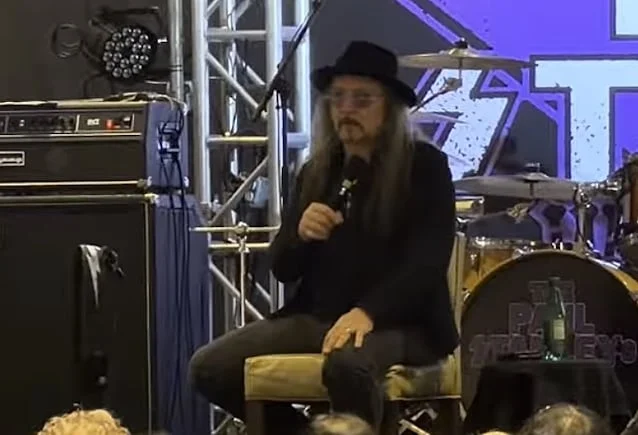
Podcast Rock City Live has released a comprehensive video of KISS drummer Eric Singer’s extensive question-and-answer session held on April 12th at the Indy KISS Fan Expo, hosted at the Embassy Suites by Hilton in Indianapolis, Indiana. The session provided fans with a deep dive into Singer’s decades-long journey with the iconic rock band, touching upon his initial doubts about rejoining KISS, the evolution of the rock music landscape, and his perspective on fan reception to lineup changes.
Early Days and Uncertainties: A Retainer and a Waiting Game
When the original lineup of KISS, featuring Peter Criss on drums and Ace Frehley on guitar, reunited in 1996 for a highly anticipated tour, Eric Singer harbored no illusions about his immediate future with the band. "No," Singer definitively stated when asked if he anticipated playing with KISS again during that period. "Well, you don’t know what in life’s gonna happen, so I didn’t think so." His approach at the time was one of patient observation. "And I didn’t do anything that whole year, in ’96. I just stayed home."
This period of introspection and non-commitment was facilitated by the band’s leadership. Gene Simmons and Paul Stanley, recognizing the unpredictable nature of a reunion tour’s success, kept both Singer and then-KISS guitarist Bruce Kulick on retainer for the entirety of 1996. "Gene and Paul were nice enough—they actually paid Bruce and I [and they] kept on on a retainer for that whole year," Singer explained. He elaborated on their strategic thinking: "’Cause they didn’t know if their tour was gonna be successful or what was gonna happen. So they just thought, ‘Okay, let’s just go and see what happens. And if it doesn’t work out with the reunion, we still have a band and we’ll just continue on.’ I’m guessing that was their mindset." This financial safeguard allowed Singer the freedom to hold out for a potential return, a decision that proved prescient.
During this same period, Singer received an offer to join Vince Neil’s solo band. However, he declined, prioritizing the possibility of a future with KISS. "And in fact, I was offered to play with Vince Neil to join his solo band that summer, but I didn’t do it because I thought, ‘I don’t know what’s gonna happen with KISS, so I should just kind of bide my time.’" This demonstrates a strategic foresight and unwavering loyalty to the potential of re-engaging with KISS.
The Shifting Tides of Rock and the Call Back
Singer vividly recalled the challenging musical climate of the early to mid-1990s, a stark contrast to the genre’s previous dominance. "At that time, rock and roll and the kind of music most of us probably like was not really all that popular. Grunge took over by ’92," he observed. The impact of this shift was palpable, even affecting established artists. Singer cited his experience with Alice Cooper: "I mean, I played with Alice Cooper ’90 and ’91. After ’91 Alice didn’t tour until 1997. He didn’t tour for six years ’cause there was no market for it." This extended hiatus underscores the precariousness of touring for many rock acts during that era.
However, the tides eventually turned. "Eventually things kind of turned around. And then Alice asked me to come back and play with him in ’98. Then I toured with Brian May that year too." This period saw Singer re-establishing himself in the rock scene, playing with both Alice Cooper and Queen guitarist Brian May. The momentum built during this time ultimately led to the pivotal call from KISS. "And then, all of a sudden, they called me up to come back and play with KISS. And I was playing with Alice at the time."
A Dual Career and the Inevitable Full Commitment
For nearly a decade, from 1998 to 2008, Eric Singer managed to juggle his commitments to both Alice Cooper and KISS. "From ’98 to 2008, I still played with Alice and I was doing both gigs for a while." This remarkable feat of musical endurance highlights Singer’s versatility and dedication. The increasing demands of KISS, however, eventually necessitated a singular focus. "But then KISS actually got busy and wound up touring more starting in 2008. And that was it. Then we were off and running until the end of the touring in 2023." This marks the beginning of Singer’s consistent and defining tenure as KISS’s primary drummer, leading up to the band’s final tours.
The Reunion Era and Subsequent Lineup Shifts
The year 1996 marked a significant moment in KISS’s history: a full-scale reunion of its original lineup. This era, featuring Peter Criss and Ace Frehley alongside Gene Simmons and Paul Stanley, captivated fans and reignited the band’s global popularity. However, this configuration proved to be transient. After Peter Criss departed the band for a second time, Eric Singer rejoined the KISS lineup in 2004.
The subsequent and longest-standing iteration of KISS, from Singer’s 2004 return until the conclusion of their touring career, comprised Paul Stanley, Gene Simmons, Eric Singer, and guitarist Tommy Thayer. Singer had a pre-existing relationship with Thayer, having known him since the mid-1980s, which likely facilitated a smoother integration. Tommy Thayer, a former member of the band Black ‘n Blue, had also previously played in a KISS tribute band, further solidifying his connection to the KISS universe before officially joining.
Returning to the Catman Persona: A Call from Australia
Singer’s return to KISS in 2004, particularly the circumstances surrounding his adoption of the "Catman" persona, was a topic of discussion during his 2015 interview with MichaelCavacini.com. At that point, he was still actively touring with Alice Cooper. The initial reunion tour of 1996 had been a monumental success, and Singer had maintained limited contact with the band members during that time.
The pivotal call came from Paul Stanley, extending an invitation to tour in Australia and Japan. "Paul called me up and told me that they wanted me to come tour with them in Australia and Japan," Singer recalled. Stanley conveyed that a change was being made due to unspecified issues with Peter Criss. Intriguingly, Singer was abroad when this offer was extended. His legal representative was the intermediary, relaying the proposition from KISS. "My lawyer contacted me, saying KISS reached out to him and that they wanted me in the band."
The specifics of his stage persona were initially ambiguous. "I didn’t know what was going on at the time regarding the makeup. My lawyer said, ‘They’re going to have you wear makeup, but they’re not sure what they’re going to do yet.’" By the time Singer returned, the decision had been made: he would don the iconic Catman makeup.
The Departure of Ace Frehley and Tommy Thayer’s Integration
Singer’s initial tenure back in the band, which lasted for just over a year, was marked by the eventual departure of guitarist Ace Frehley. According to Singer, Frehley’s increasing unreliability became a significant impediment. "I was back in the band for a little over a year, and then Ace decided he didn’t want to be in the band. He was becoming less and less reliable." The unpredictability surrounding Frehley’s commitments created logistical nightmares for the band and their management. "Every time we tried to do something, it would become difficult because we wouldn’t know if he’d make it or not. One minute he’d say, ‘Yes.’ Then the next minute he’d say, ‘No.’"
The impact of this inconsistency was far-reaching. "I remember that summer, the summer of 2001, when I first came back, our manager booked a European tour three times and had to cancel it each time. The reason why is because Ace would commit to it and then change his mind." This repeated cancellation of a major tour undoubtedly resulted in substantial financial losses and reputational damage for the band.
Singer emphasized that the band made considerable efforts to retain Frehley. "Just so I’m clear, the band did everything in their power to keep Ace in KISS. But he’s the one that made it more and more difficult." The breaking point reportedly came during a private party performance. "And eventually, we did a show, a private party, and Ace didn’t want to show up in L.A. to do rehearsals. We had already committed to doing the show, so we had Tommy Thayer step in and do the show. And that was it. From that point on, Tommy was the guitar player." This incident solidified Thayer’s position as the band’s lead guitarist, a role he would maintain for the remainder of KISS’s touring career.
Addressing Fan Perceptions: Makeup and Legacy
Eric Singer acknowledged the persistent criticism from some KISS fans who struggled to accept him and Tommy Thayer as legitimate members of the band, particularly due to their wearing the classic makeup previously associated with Ace Frehley and Peter Criss. This sentiment often revolved around the idea that the makeup was intrinsically tied to the original members and that its use by replacements was somehow inauthentic.
Singer countered these arguments by drawing parallels with other enduring rock acts. "If a band can’t continue on because somebody quits, can’t play anymore, whatever the reason is, that shouldn’t prevent the remaining members from continuing on if that’s what they want to do," he asserted. He cited the examples of STYX and Foreigner as bands that have successfully continued with lineup changes while maintaining a high standard of performance. "STYX is a good example. I’m really good friends with Ricky Phillips, their bass player. I saw STYX in their heyday back in the ’70s, but I think they’re every bit as good now, if not better. The same thing applies to FOREIGNER. They’re another great band that no longer features all of the classic or original members, but they sound fantastic."
His core philosophy centers on the integrity of the performance. "To me, that’s what it’s all about. As long as the members of the band are doing the music justice and paying respect to its origins, then I’m fine with it. That’s what it’s all about. If a band gets new members and they aren’t very good, then you have the right to complain." This perspective places emphasis on musical proficiency and respect for the band’s legacy, rather than a rigid adherence to original lineups.
Regarding the specific issue of the makeup, Singer found the fan reaction intriguing. "The way people look at the makeup situation is interesting to me. I don’t play any different in makeup than I do out of makeup, yet people perceive that there is a difference." He acknowledged a subtle shift in his own approach over time. "I do have a more toned-down approach than I did when I first joined the band, but that’s because I believe that’s what the music dictates and needs." This suggests an evolution in his performance style, driven by the demands of the music itself rather than external pressures.
Singer also directly addressed and refuted a common misconception: that he was instructed to emulate Peter Criss’s singing, playing, or stage presence. "I’ve heard people say that I was told to sing, play and act like Peter Criss. That’s completely ridiculous. I’ve never once been told to do that. Never. So, when people say that, it’s totally ridiculous. Look at any of the shows I’ve done since being in the band after Peter. I don’t play anything like Peter Criss." This statement aims to clarify his individual contribution and artistic identity within the KISS framework, dispelling any notion of him being a mere impersonator.
The release of this full Q&A session provides invaluable insight into Eric Singer’s perspective on his enduring career with KISS, the challenges and triumphs of maintaining a legendary band through various lineups, and his reasoned approach to fan engagement and artistic integrity. The video, available via Podcast Rock City Live, offers KISS aficionados a direct connection to one of the band’s most consistent and dedicated members.
