

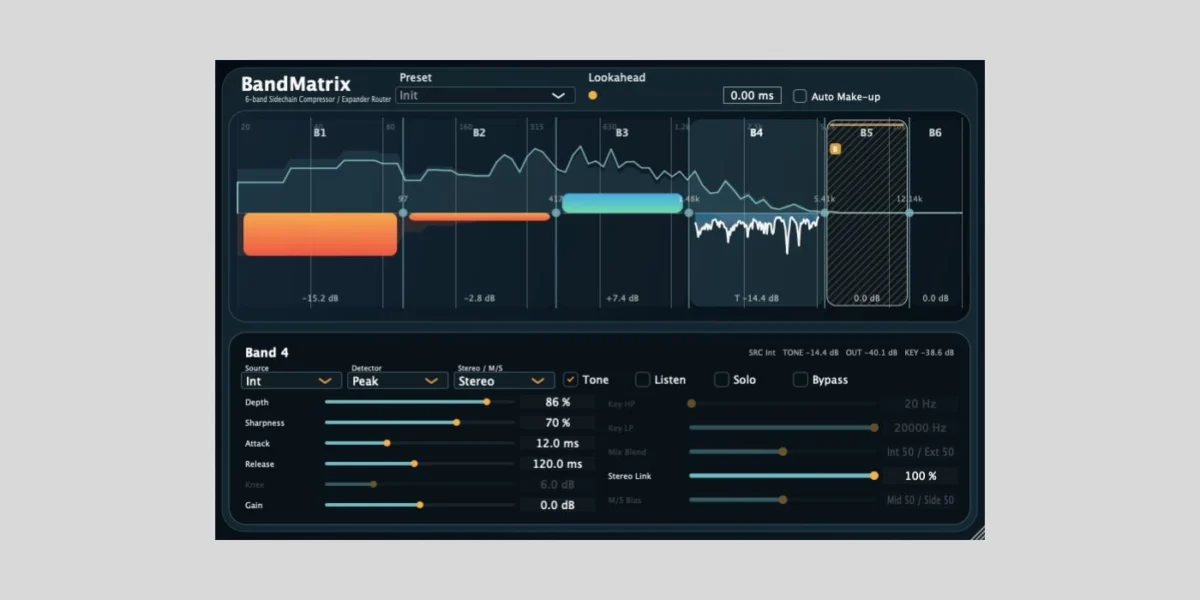
Kojima Audio has released BandMatrix, a sophisticated multi-band dynamics plugin now freely available for download on both macOS and Windows platforms, supporting VST3, AU, and AAX formats. This introduction marks a significant development in the audio plugin landscape, offering a powerful tool that transcends the capabilities of conventional multi-band compressors through an innovative and flexible routing system. The plugin’s release has generated considerable interest among audio professionals and hobbyists alike, promising to democratize advanced dynamics processing and creative sound design.
The Genesis of a New Dynamics Paradigm
Multi-band dynamics processors have long been indispensable tools in audio production, crucial for addressing frequency-specific issues, enhancing clarity, and achieving a polished sound across various stages of mixing and mastering. Traditional multi-band compressors typically divide the audio spectrum into several distinct frequency bands, allowing engineers to apply compression or expansion independently to each. This approach enables targeted adjustments, such as taming harsh high frequencies, tightening muddy bass, or controlling sibilance without affecting the broader sonic balance. However, the core innovation of BandMatrix lies in its departure from this conventional model, introducing a novel routing architecture that dramatically expands its utility.
While information regarding the developer, Kojima Audio, remains relatively sparse, their debut offering, BandMatrix, immediately positions them as a contender focused on pushing the boundaries of plugin design. The concept delivered by BandMatrix suggests a design philosophy centered on user empowerment and creative flexibility, challenging established norms in a highly competitive market. The decision to offer such a technically advanced plugin for free is particularly noteworthy, reflecting a potential strategy to quickly gain market penetration and establish a reputation for innovation and generosity within the audio production community.
Unpacking BandMatrix’s Unique Routing System
At the heart of BandMatrix’s appeal is its groundbreaking ability to drive each of its six dynamics bands from disparate sources. Unlike standard multi-band processors where each band reacts solely to its internal signal, BandMatrix offers three distinct control pathways:
- Internal Signal: The most traditional method, where a band reacts to the dynamics of the frequency content within its own designated range from the input audio.
- External Sidechain Inputs: This common feature in advanced dynamics processors allows an external audio source to trigger the compression or expansion of a specific band. For example, an external kick drum track can be routed to drive the lowest frequency band of a bass guitar or synth pad, ensuring that the bass frequency of the kick creates space by momentarily attenuating the corresponding frequencies in the other instrument. This technique is invaluable for achieving a clean, punchy low-end mix, preventing frequency clashing, and enhancing rhythmic definition.
- Band-to-Band Driving: This is where BandMatrix truly differentiates itself. Any of its six bands can be configured to drive any other band. This opens up an unprecedented array of creative and problem-solving possibilities. Imagine using the dynamics of a vocal’s mid-range to control the high-frequency content of a reverb tail, or having the transient energy of a snare drum’s attack band dynamically shape the release of a synth pad’s lower frequencies. This interconnected control system allows for complex, dynamic interactions within a single instance of the plugin, fostering intricate sound design and sophisticated mixing techniques that would typically require multiple plugins and convoluted routing.
The implications of this band-to-band driving capability are vast. It facilitates advanced de-essing, where the compressor on the high-frequency band reacts specifically to the harshness detected in the internal signal’s upper-mid range. Beyond remedial tasks, this system enables experimental sound manipulation, allowing producers to create evolving, reactive textures where different elements of a sound dynamically influence each other in real-time. For instance, feeding each band from an entirely different external source—such as a pad from a synth, a loop from a drum machine, and a complex sound effect—allows for the creation of intricate, responsive sonic landscapes that react organically to multiple inputs.
Comprehensive Feature Set and Intuitive Design
Beyond its unique routing, BandMatrix boasts a robust set of features designed to offer granular control over dynamics and tone shaping. The plugin operates in both standard stereo and mid/side modes, providing enhanced flexibility for mastering and detailed stereo imaging adjustments. The mid/side functionality is particularly useful for controlling the dynamics of the center (mono) image independently from the sides (stereo width), allowing for precise focus or expansion of elements within the mix. A dedicated solo feature and a listen function are also integrated, enabling users to isolate and critically evaluate the effect of each band in real-time, crucial for meticulous tweaking and informed decision-making.
Each of the six bands offers a comprehensive suite of parameters:
- Attack and Release: These standard dynamics controls dictate how quickly the compressor/expander reacts to a signal exceeding or falling below the threshold, and how long it takes to return to its original state. Precise manipulation of these parameters is vital for shaping transients, controlling sustain, and preserving the natural dynamics of a sound.
- Sharpness: This parameter likely influences the knee of the compression curve, affecting how smoothly or aggressively the dynamics processing engages. A sharper knee results in a more immediate and noticeable effect, while a softer knee provides a more transparent and gradual application of dynamics.
- Depth: This control likely determines the intensity or amount of compression/expansion applied.
- Gain: Allows for level adjustment of each band post-dynamics processing, enabling precise balancing of the processed frequencies.
- Stereo Linking: This feature allows users to link the dynamics detection of the left and right channels for a band, ensuring a consistent stereo image, or unlink them for independent processing, useful for creative stereo widening or narrowing effects.
A dedicated tone shaping mode is also included, providing further control over the spectral balance within the multi-band compression matrix. This suggests a capability to subtly or drastically alter the timbre of the audio by influencing how the dynamics processing interacts with the frequency content, potentially allowing for dynamic EQ-like effects or harmonic sculpting.
For enhanced precision, BandMatrix offers the choice between Peak and RMS detection. Peak detection reacts to the instantaneous loudest points of the signal, ideal for catching fast transients and preventing clipping. RMS (Root Mean Square) detection, on the other hand, responds to the average loudness over a short period, mimicking human hearing more closely and providing a smoother, more natural-sounding dynamic control. The inclusion of a lookahead feature further refines transient control by allowing the plugin to analyze incoming audio slightly before processing, virtually eliminating unwanted overshoot and ensuring perfectly smooth dynamics even with fast attack times. Optional auto-gain functionality automatically compensates for perceived loudness changes caused by compression, helping maintain consistent levels and simplifying the mixing process.
All these advanced features are presented within a "nice-looking and easy-to-understand user interface with visual feedback." A well-designed UI is paramount for complex plugins, as it reduces cognitive load and allows users to quickly grasp the plugin’s status and make informed adjustments. Visual feedback, such as gain reduction meters or frequency spectrum displays, is particularly valuable in multi-band dynamics processors for monitoring the effects of processing in real-time.
Broader Impact and Implications
The release of BandMatrix, especially as a free offering, has significant implications for the audio production community and the plugin market. For aspiring producers and those with limited budgets, it provides access to a tool that offers capabilities typically found in high-end, commercial plugins. This democratization of advanced tools can foster greater creativity and allow a wider range of individuals to achieve professional-sounding results.
For seasoned professionals, BandMatrix presents a unique problem-solver and a creative catalyst. Its innovative routing system can streamline complex mixing tasks, allowing for more efficient workflows and opening new avenues for sound design. The ability to perform subtle mixing tasks, intricate bus control, and even mastering-grade dynamics processing, all within a single plugin, makes BandMatrix a versatile powerhouse. Its application ranges from precisely controlling the dynamics of individual tracks to shaping the overall spectral balance of a complete mix or master.
The developer’s decision to provide direct download access without requiring sign-ups or mail registrations further enhances its appeal, removing common friction points associated with obtaining free software. This user-friendly approach aligns with a philosophy of accessibility and immediate utility.
Version History and Ongoing Development
As of the latest update on March 19, 2026, BandMatrix is in version 1.6.0. This update reportedly includes an unconfirmed bug fix specifically for Windows users, indicating active development and a commitment from Kojima Audio to refine and stabilize the plugin. While the exact nature of the bug fix is not detailed, it underscores the iterative process of software development and the developer’s responsiveness to user feedback. Kojima Audio has also provided contact information on their webpage for users who encounter any issues, fostering a direct line of communication for support and problem resolution.
Conclusion: A Game-Changer for Audio Professionals?
BandMatrix by Kojima Audio stands as a remarkable entry into the competitive world of audio plugins. By reimagining the core functionality of multi-band dynamics processing, it offers an unparalleled level of control and creative flexibility. Its unique routing system, combined with a comprehensive feature set and an intuitive user interface, positions it as a highly valuable tool for anyone involved in audio production. The fact that such an innovative and powerful plugin is available for free further solidifies its status as a must-try for engineers, producers, and sound designers seeking to elevate their craft. Its potential to become a staple in studios worldwide is considerable, setting a new benchmark for what can be achieved with freely distributed audio software. The future development of Kojima Audio and their BandMatrix plugin will undoubtedly be watched with keen interest by the audio community.
