

Laboratory 0 has officially launched BLOT, an experimental software synthesizer that represents a significant departure from traditional subtractive and additive synthesis methods by focusing on modal synthesis as its primary engine for sound generation. This new tool challenges the conventional user interface design of digital audio workstations by replacing standard knobs, faders, and sliders with a tactile, visual environment where users shape "matter" to influence sonic output. By utilizing the geometry of on-screen objects as the foundational "patch," BLOT offers a highly intuitive yet mathematically complex approach to electronic music production, bridging the gap between physical modeling and abstract sound design.
A Departure from Traditional Synthesis Paradigms
For decades, the landscape of software synthesis has been dominated by virtual analog interfaces that replicate the hardware of the 1970s and 80s. While effective, these interfaces often restrict the user to a linear workflow of oscillators, filters, and envelopes. Laboratory 0’s BLOT disrupts this trajectory by implementing a modal synthesis architecture. In this framework, sound is not merely generated by a waveform; it is simulated as the vibration of a physical object.
In BLOT, every visual element—referred to by the developers as a "lump" of matter—acts as a modal resonator. These resonators are comprised of eight damped oscillators, which are meticulously tuned based on the size and shape of the visual object. The software utilizes just-intonation ratios tied to a MIDI root note, ensuring that as the user manipulates the "matter" on screen, the resulting harmonic content remains musically coherent while offering a level of microtonal flexibility rarely seen in mainstream synthesizers.
The Physics of Sound: Understanding Modal Synthesis
To understand the significance of BLOT, one must examine the underlying principles of modal synthesis. Unlike Frequency Modulation (FM) or Pulse Width Modulation (PWM), modal synthesis seeks to recreate the "modes" of vibration inherent in physical materials like wood, metal, or glass. When an object is struck, it vibrates at several different frequencies simultaneously; these are its modes.
BLOT automates the complex mathematics of these vibrations. Smaller pieces of "matter" within the interface ring at higher frequencies, while larger masses produce deeper, more resonant tones. The distribution of these modes—how far they spread across the frequency spectrum, their brightness, and their decay time—is determined by the physical characteristics assigned to the on-screen geometry, such as its shape and perceived "heat." This creates a dynamic environment where the sound is never static, responding instead to the simulated physical properties of the digital workspace.
The Sculptural Interface: Turning Geometry into Audio
The most striking feature of BLOT is its interactive interface, which functions more like a digital sculpting suite than a musical instrument. The user interacts with the sound by physically manipulating the "matter" on the screen through several distinct gestures:
- Tendril Extension: Pulling a "tendril" from the main mass transforms that section into a plucked waveguide string. The pitch of this string is determined by its length, allowing for the creation of harp-like or percussive string sounds within a broader ambient texture.
- Indentation and Formants: Pressing a "dent" into the matter creates a formant filter. This simulates the physics of a human mouth or a resonant cavity, where the position and depth of the dent determine the vowel-like qualities of the filtered sound.
- Fragmentation: Users can "cut" pieces of the matter, causing the modes to split into two distinct pitches. This allows for the creation of complex polyphonic textures from a single initial source.
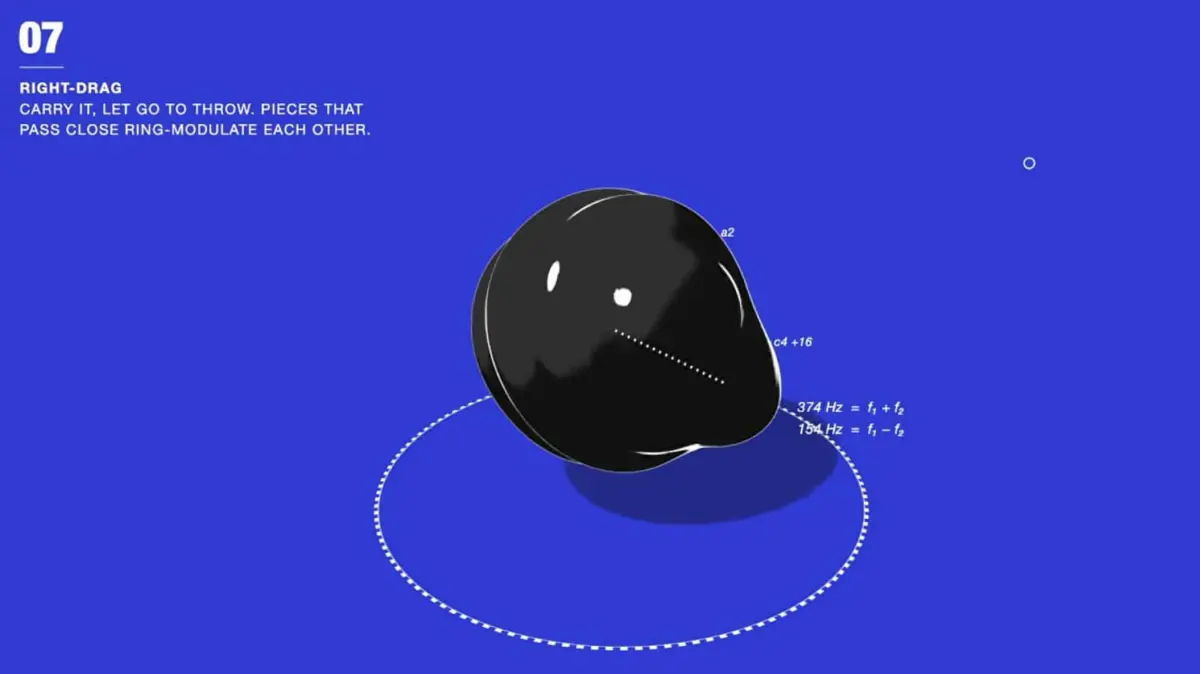
- Fusion and Modulation: When two pieces of matter are brought into close proximity, they begin to ring-modulate each other, creating dissonant, metallic, or bell-like sidebands. If they touch, they fuse back into a single mass, consolidating their sonic properties.
This tactile approach allows composers to "perform" the synthesis in real-time, moving away from the rigid programming often associated with digital signal processing.
Technical Architecture and Signal Processing
Beyond its visual interface, BLOT is powered by a robust technical back-end designed for high-fidelity audio output. The excitement of the modal resonators occurs through various inputs: a "slow breathing" noise floor, simulated strikes, and friction generated by sweeping across the matter.
One of the more advanced features is the "droplet" system. When the matter "runs hot"—a state achieved through rapid interaction or high-intensity settings—it produces short, high-frequency tones that rise in pitch as they "burst." This simulates the erratic behavior of particles under thermal stress, adding a layer of organic unpredictability to the sound.
To manage the harmonic complexity and prevent digital aliasing, BLOT employs a 4× oversampled multiband saturator. As the matter is "rubbed" or pushed into higher gain stages, this saturator takes over, utilizing a feedback comb filter tuned to the MIDI root note. This ensures that even at extreme levels of distortion, the output maintains a musical relationship to the original composition. Furthermore, the "Memory" module—an eight-line feedback delay network—acts as a temporal buffer, holding and re-circulating the sounds generated by the matter to create lush, evolving soundscapes.
Chronology of Development and Release
The development of BLOT by Laboratory 0 follows a growing trend in the "boutique" software industry, where small independent developers create highly specialized tools that prioritize experimentation over mass-market appeal. While the exact development timeline of BLOT remains internal to Laboratory 0, the release follows a period of increased interest in physical modeling synthesis, spurred by the success of hardware like the Mutable Instruments Elements and software like Ableton’s Collision.
BLOT was officially made available to the public in early 2024. Laboratory 0 chose a "name your price" or free distribution model via the Gumroad platform, a move that has historically helped experimental tools gain rapid traction within the underground electronic music community. By lowering the barrier to entry, Laboratory 0 has positioned BLOT as an accessible entry point for musicians curious about modal synthesis but perhaps intimidated by the steep learning curves of environments like Max/MSP or SuperCollider.
Dual-Engine Performance and MIDI Integration
BLOT is designed to be played as a live instrument, featuring full MIDI integration. Incoming MIDI notes serve two primary functions: they shift the root frequency of the entire system and "strike" every piece of matter currently active on the screen. This allows for rhythmic, sequenced performances that retain the chaotic beauty of the modal engine.
The software offers two distinct engines to cater to different sonic needs:
- Default Engine: This engine is designed for clarity. The sound remains clean and resonant until the user actively "rubs" or overloads the matter. It is ideal for crystalline pads, bell tones, and subtle ambient textures.
- Intense Engine: This engine introduces immediate heat and drive. Every cut, strike, or movement generates saturation, and "hot" pieces of matter are programmed to crackle and hiss. This mode is suited for industrial textures, aggressive leads, and experimental noise.
Additionally, a "Pause" function allows users to freeze the matter in its current geometric state. While frozen, the resonators continue to sound, allowing for the exploration of static, unchanging timbres that can be further processed through external effects.
Industry Context: The Rise of Experimental Freeware
The release of BLOT comes at a time when the digital audio workstation (DAW) market is increasingly saturated with high-priced emulations of vintage gear. Market analysts note that there is a growing fatigue among professional sound designers regarding "yet another" Minimoog or 808 clone. This has paved the way for "experimental freeware"—tools that offer unique synthesis methods and unconventional workflows for free or at a very low cost.
Laboratory 0’s decision to release BLOT for free aligns with the philosophy of open-source and community-driven development seen in platforms like VCV Rack. By providing high-level tools without a financial paywall, developers foster a loyal user base that contributes to the tool’s longevity through shared presets, tutorials, and community feedback.
Implications for Modern Sound Design and Composition
The implications of BLOT for the wider music industry are twofold. First, it democratizes access to complex physical modeling. Traditionally, high-quality modal synthesis required expensive hardware or deep knowledge of modular software environments. BLOT’s "shaping matter" metaphor makes these concepts digestible for the average producer.
Second, BLOT encourages a more performative approach to sound design. In film scoring and game audio, there is a constant demand for sounds that feel "alive" and organic. Because BLOT’s sound is tied to a simulated physical object that can be manipulated in real-time, it allows sound designers to create assets that have a natural sense of movement and evolution. The ability to "pluck," "dent," and "fuse" sounds provides a level of articulative detail that is difficult to achieve with standard ADSR (Attack, Decay, Sustain, Release) envelopes.
Conclusion and Availability
BLOT stands as a testament to the creative potential of software-based synthesis when it steps outside the bounds of traditional hardware emulation. By focusing on the intersection of geometry and acoustics, Laboratory 0 has provided a tool that is as much a visual art piece as it is a musical instrument. Its combination of modal resonators, waveguide strings, and formant filters—all housed within a tactile, heat-reactive environment—offers a new vocabulary for electronic musicians.
BLOT is currently available as a free download from Laboratory 0’s Gumroad store. It is compatible with modern operating systems and is expected to see wide adoption among experimental composers, ambient producers, and sound designers looking to add a touch of "digital organicism" to their work. As the industry continues to evolve, tools like BLOT remind the community that the most exciting sounds often come from the most unconventional methods.
