

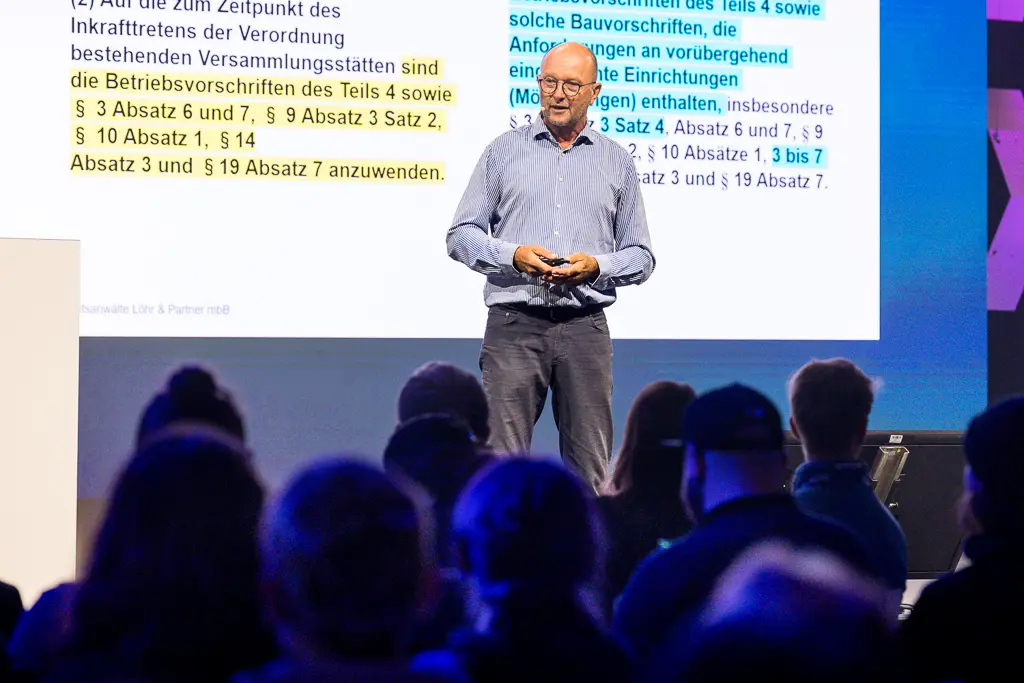
The Mainstage of the LEaT con 25 in Hamburg became a focal point for the European event industry as legal experts and venue operators gathered to dissect the impending overhaul of the Muster-Versammlungsstättenverordnung (MVStättVO). This regulatory framework, which serves as the blueprint for safety and construction standards across Germany’s event venues, is undergoing its most significant revision in decades. Volker Löhr, a preeminent legal authority in event law whose Bonn-based practice advises over 200 event centers and half of the Bundesliga stadiums, delivered a comprehensive status report that clarified the timeline and technical nuances of the amendment. While the industry had long anticipated a "2025 version" of the ordinance, the current legislative trajectory suggests a more protracted timeline, with the summer of 2026 now identified as the earliest realistic window for implementation.
The MVStättVO is not merely a bureaucratic document; it is the fundamental legal pillar that dictates whether a concert hall can open, how a stadium must be staffed, and what safety protocols a trade fair must follow. As the industry navigates a post-pandemic landscape marked by labor shortages and evolving technical requirements, the legal modernization of these rules has moved from the periphery of administrative law to the center of operational strategy for production managers and technical directors.
The Legislative Timeline and the Myth of MVStättVO 2025
For several months, trade associations and venue operators have operated under the assumption that a new version of the Model Place of Assembly Ordinance would be finalized by late 2025. However, during his presentation at LEaT con 25, Löhr corrected this misconception by detailing the current progress of the inter-state project group. Under the umbrella of the Fachkommission Bauaufsicht (Specialist Commission for Building Supervision), the drafting process is currently addressing paragraphs 23 and 24 of a total 48.
The delay is attributed to two primary factors: the unprecedented volume of qualified feedback from industry stakeholders and the mandatory European Union notification process. Because certain sections of the ordinance affect the internal market and technical standards, they must be vetted by the European Commission to ensure they do not create unnecessary barriers to trade. Consequently, the industry is now looking toward a mid-2026 release. This extension provides a necessary buffer for venues to prepare, yet Löhr warned that the direction of the changes is already sufficiently clear to necessitate immediate internal reviews by operators.
Retrofitting and the Primacy of Operational Regulations
A central concern for owners of existing venues is the financial burden of retrofitting. Under German building law, "Bestandsschutz" (grandfathering) generally protects existing structures from new construction requirements unless a significant renovation occurs or an acute danger is identified. Löhr clarified that while the new MVStättVO is unlikely to trigger a blanket requirement for structural or technical retrofitting, the legal emphasis is shifting toward "Betriebsvorschriften" (operational regulations).
The distinction is critical. Even if a building’s physical structure remains exempt from new construction codes, the way it is operated—including staffing levels, fire watch protocols, and emergency exit management—must comply with the latest standards. A significant critique raised during the Hamburg summit was the historical "mis-sorting" of these rules. Many operational requirements are currently buried within construction-focused paragraphs, such as Section 10 regarding seating arrangements. The industry is currently lobbying for a more logical reorganization to ensure that technical teams and operators can easily identify their daily responsibilities without navigating complex architectural legalities.
Reforming Responsibility under Section 38
One of the most contentious points of discussion involves Section 38, which governs the responsibility and presence of venue representatives and event managers. For twenty years, the industry has debated exactly when "operation" begins. Does a venue require a certified event manager during the load-in and setup phase, or only once the public enters the building?
Löhr argued that the current ambiguity has led to significant friction and unnecessary costs for venues. The proposed changes aim to differentiate more clearly between "technical supervision" during the construction phase and "event management" during the public-facing phase. The goal is to move toward a role-based model where qualifications match the specific task. For example, a production manager with deep technical expertise is more valuable during a complex stage build than a general event manager. The commission is reportedly moving toward a "joint event management" model for large-scale arenas, where the venue operator and the event organizer share a matrix of responsibilities.
Conflict Resolution in Joint Management Models
In multifunctional arenas, the relationship between the building operator and the external promoter is often defined by a "double leadership" structure. While this promotes collaboration, it creates a legal vacuum in crisis situations: who has the final word?
Löhr proposed a decision-making matrix based on the nature of the risk.

- Building-Related Issues: Matters involving fire alarm systems, structural integrity, or permanent building services must fall under the absolute authority of the venue operator.
- Event-Related Issues: Crowd behavior, artistic content, and internal production workflows should be the domain of the organizer.
This systemic approach aims to prevent the "contractual theater" often seen in event agreements, where both parties attempt to deflect liability. By establishing clear escalation paths and scenario-based responsibilities before the doors open, venues can mitigate the risk of administrative fines or forced shutdowns.
New Standards for Crowd Management and Wave Breakers
The amendment is set to introduce more rigid standards for crowd control at large-scale events. A significant update involves the regulation of wave breakers (barriers used to manage crowd pressure) in front of stages. The draft ordinance suggests a hard limit of 5,000 persons for the first wave breaker section.
This "hard number" is a response to evolving crowd science and the lessons learned from international festival incidents. However, the ordinance will likely allow for deviations if a venue can provide a scientifically backed "Safety Concept" (Sicherheitskonzept) demonstrating that an alternative arrangement achieves the same level of protection. This places an even greater emphasis on the role of specialized safety consultants and engineers, as the Safety Concept will become the primary legal instrument for bypassing standardized limits.
The One-Week Deadline for Safety Concepts
A particularly controversial proposal involves a mandatory deadline for the finalization of safety concepts. The draft suggests that all safety protocols and authority approvals must be in place at least one week prior to the start of the event.
From a journalistic and industry-analysis perspective, this requirement appears highly ambitious. Touring productions often undergo floor plan adjustments just days or even hours before an event due to technical constraints or ticket sales. A rigid one-week deadline could create a "bottleneck of non-compliance," where venues are forced to operate in a legal gray area because a local authority has not yet issued a final sign-off on a minor adjustment. Löhr noted that the industry is pushing for more flexibility, arguing that the law should reflect the dynamic nature of live production rather than the static nature of traditional construction.
Staffing Shortages and Section 40: Moving Beyond Automatism
Section 40, which dictates the presence of qualified technical personnel (such as "Meister für Veranstaltungstechnik" or Master Technicians), is being viewed through the lens of the current labor crisis. Historically, the ordinance triggered an "automatic" requirement for two master technicians whenever "complex movements" or high-risk stage effects were involved.
Löhr and various trade associations, including the EVVC (European Association of Event Centers), are advocating for a shift away from these rigid automatisms. Instead of a "one-size-fits-all" headcount, the new MVStättVO may allow for a risk-based assessment. This would permit venue operators to document and justify their staffing levels based on the specific production’s complexity and the staff’s familiarity with the house systems. This shift toward "responsible evaluation" rather than "numerical compliance" is seen as a vital step in keeping the German event industry competitive and operational amidst a dwindling pool of certified specialists.
Administrative Relief through Area-Based Seating Plans
In a move toward "Entbürokratisierung" (debureaucratization), the new ordinance may simplify the way seating plans are approved. Currently, many jurisdictions require every single chair to be drawn and measured to the millimeter. For venues that host rotating formats—from gala dinners to congresses—this creates a constant cycle of re-drawing and re-stamping plans.
The proposed solution borrows from the trade fair industry: "area-based" planning. Instead of individual chairs, operators would define "seating zones" with fixed emergency exit axes and corridor widths. As long as the furniture remains within the designated zones and respects the exit paths, the plan remains valid. This pragmatic approach would significantly reduce the administrative burden on both venue operators and local building authorities.
Broader Impact and Industry Outlook
The LEaT con 25 presentation underscored a fundamental truth: the "legalization" of the event industry is accelerating. While the delay to 2026 offers a reprieve, it also serves as a warning. The upcoming MVStättVO will demand a higher level of documentation, more sophisticated safety planning, and a clearer definition of roles between promoters and venues.
For the German event landscape, which contributes billions to the national GDP, these changes represent a balancing act between safety and economic viability. The move toward risk-based assessments and area-based planning suggests a growing trust in the professionalism of the industry. However, the increased scrutiny on safety concepts and the potential for new liability traps regarding security staff training indicate that the "zone of friction" between law and technology will remain a central challenge for years to come. As Volker Löhr concluded, the goal is not to create more rules, but to ensure that the rules we have actually function in the high-pressure environment of a live event.
