

The catastrophic flooding that swept through Western Germany in July 2021 left a trail of unprecedented destruction, and among the many community structures severely impacted was the Church am Widey in Hagen. Owned and operated by the Evangelical Free Church Congregation (Evangelische Freikirchliche Gemeinde) of Hagen, the facility faced a daunting recovery process after significant portions of the parish house were submerged. However, the necessity of a total structural renovation provided a rare opportunity to address long-standing acoustic challenges. In collaboration with the specialized engineering firm Ton & Technik Scheffe, based in Nümbrecht, the congregation has now completed a comprehensive overhaul of its audio-visual infrastructure, centered on a sophisticated system from Coda Audio. This modernization not only restores the church’s functional capacity but elevates it to a professional-grade venue capable of hosting high-caliber musical performances, including those by the Hagen Philharmonic Orchestra.
Historical Context: The Impact of the 2021 Flood on Hagen
In mid-July 2021, the low-pressure system known as "Bernd" triggered extreme rainfall across North Rhine-Westphalia and Rhineland-Palatinate. Hagen, situated at the confluence of the Volme, Ennepe, and Lenne rivers, became one of the focal points of the disaster. As water levels rose to record heights, the infrastructure of the city was overwhelmed. For the Church am Widey, the flooding was more than a localized inconvenience; it was a structural crisis. Large sections of the community center were inundated, with water penetrating the foundations and causing extensive damage to the interior finishes.
Matthias Scheffe, Managing Director of Ton & Technik Scheffe, noted that the damage was so pervasive that a simple repair was impossible. In the main community room, the ceiling, walls, and flooring all required complete removal and replacement. While the disaster was a source of significant hardship for the congregation, the "blank slate" created by the strip-out allowed for a fundamental reimagining of the room’s physics. Previously, the church had struggled with the inherent acoustic limitations of its architecture, but the renovation allowed for the integration of acoustic treatments and sound reinforcement systems from the ground up, rather than as an afterthought.
Architectural and Acoustic Challenges of the Main Hall
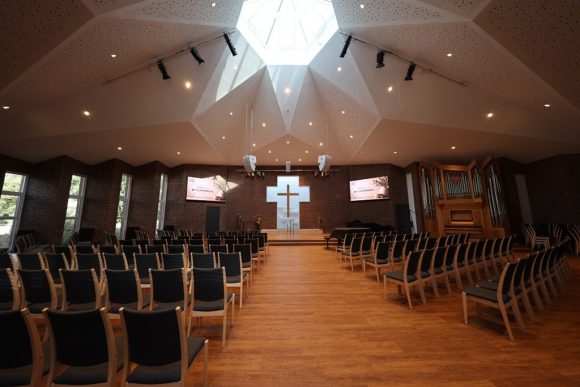
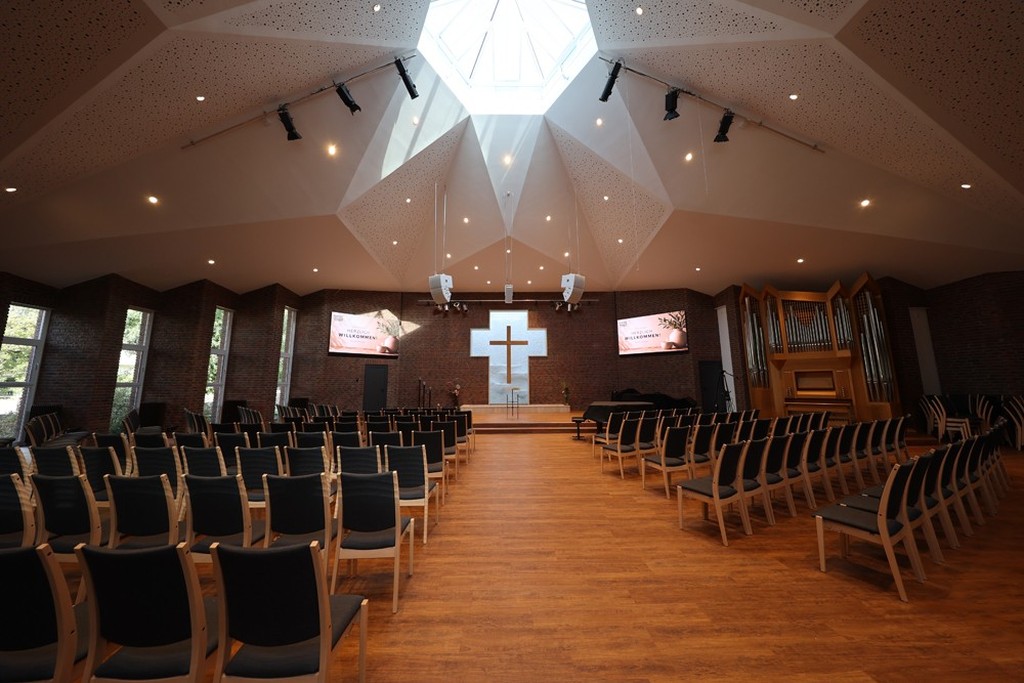
The primary sanctuary at the Church am Widey presents a classic architectural dilemma for sound engineers. The hall features a high, tent-like ceiling with a central skylight, which creates an aesthetically pleasing, airy atmosphere but results in a significant vertical volume relative to the floor area. This geometry typically leads to a high reverberation time (RT60), where sound waves bounce off hard surfaces, creating a "muddy" sonic environment that severely degrades speech intelligibility.
In a liturgical setting, the clarity of the spoken word is paramount. However, modern congregations also require high-fidelity musical reproduction. The Church am Widey hosts a diverse range of auditory content, from traditional organ music and choral arrangements to contemporary worship bands that utilize electronic instruments and percussion. Scheffe’s team conducted extensive acoustic measurements and calculations to develop a concept that could balance these competing needs. The goal was to minimize unwanted reflections while ensuring that the sound pressure level (SPL) remained consistent from the front rows to the very back of the hall.
Technical Implementation: The Coda Audio Solution
After evaluating various manufacturers, the decision was made to install a system from Coda Audio. The technical requirements of the room dictated a solution that occupied the middle ground between traditional point-source speakers and large-scale line arrays. According to Matthias Scheffe, a standard point-source system would have struggled to cover the depth of the room without excessive volume at the front, whereas a full line array would have been visually intrusive and overkill for the physical dimensions of the space.
The solution was found in Coda Audio’s N-APS (Next Generation Arrayable Point Source) technology. The N-APS is a 2-way compact system that combines the versatility of a point source with the arrayability of a line source. It features Coda’s proprietary Ring Diaphragm Curved Wave Driver (RDC) and two 6.5-inch neodymium ultra-low distortion cone drivers. A critical component of this technology is the Dynamic Airflow Cooling (DAC), which allows the speakers to handle high power loads by efficiently dissipating heat, thereby reducing power compression and maintaining consistent sound quality even during long services or concerts.
In the main hall, the configuration consists of:
- Four N-APS 90 and two N-APS 120 units: These provide the primary coverage, with the different dispersion angles (90 and 120 degrees) ensuring that the sound is tailored to the specific width and depth of the seating area.
- Two N-SUB units: These compact subwoofers handle the low-frequency requirements, essential for both the pipe organ’s deep pedals and the kick drum of a contemporary band.
- One HOPS8i: A High Output Point Source speaker serves as the center fill, anchoring the sonic image to the front of the room and improving localization for the congregation.
- Four D5-Cube units: These ultra-compact speakers are utilized as front fills to provide "near-field" coverage for the first few rows, ensuring that those closest to the stage do not sit in a "sonic shadow."
Amplification and System Management
To drive the complex array of speakers, the church utilized the LINUS6.4i networkable four-channel DSP amplifiers. The LINUS platform is designed to provide high-performance amplification while offering integrated digital signal processing (DSP) for loudspeaker management. This allows the engineers to fine-tune the crossover points, equalization, and time alignment of every speaker in the room.

The integration of DSP is particularly important in a venue where the technical staff are often volunteers. The system can be programmed with various presets—such as "Speech Only," "Choir and Organ," or "Full Band"—allowing a non-expert user to optimize the room’s acoustics at the touch of a button. This reliability was a key requirement for the Hagen congregation, who needed a system that was robust enough for professional use but simple enough for weekly ministry operations.
The Secondary Hall: A Multipurpose Space
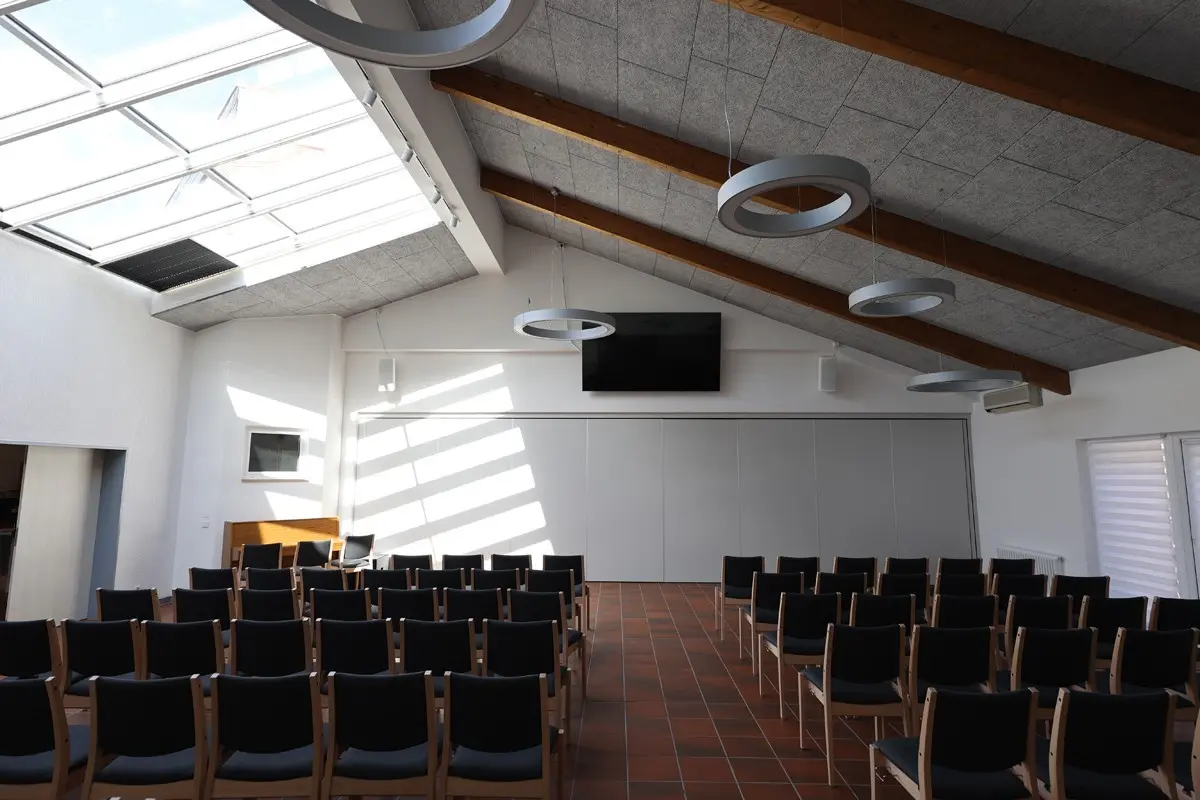
In addition to the main sanctuary, the renovation extended to the smaller hall, which serves as a multipurpose space for smaller gatherings, youth events, and meetings. While the acoustic demands are less extreme than in the main hall, the need for high-quality sound remained.
For this space, Ton & Technik Scheffe installed two HOPS8i units paired with a G15-SUB 15-inch subwoofer. This setup provides a full-range frequency response in a much smaller footprint. Like the main system, these are powered by an additional LINUS6.4i amplifier, ensuring a consistent sonic signature across the entire facility. The use of a 15-inch subwoofer in a smaller room allows for significant headroom, ensuring that even bass-heavy contemporary music can be reproduced without distortion.
Results and Community Impact
The feedback from the congregation has been overwhelmingly positive. Prior to the flood and the subsequent renovation, the church struggled with feedback loops during spoken word segments and a lack of clarity during musical performances. Since the installation of the Coda Audio system, these issues have been effectively mitigated. The controlled dispersion of the N-APS units ensures that sound is directed toward the audience and away from reflective surfaces like the ceiling and side walls, which has significantly reduced the ambient "wash" of noise.
An unexpected but prestigious outcome of the project is the interest from the local cultural sector. The improved acoustics and professional-grade audio system have made the Church am Widey an attractive venue for external organizations. The Hagen Philharmonic Orchestra (Philharmonisches Orchester Hagen) has already expressed plans to utilize the renovated hall for rehearsals. This crossover between a religious community space and a professional cultural institution highlights the success of the technical renovation. It demonstrates that with proper planning and high-quality equipment, a house of worship can serve as a vital pillar of the broader urban cultural landscape.
Broader Implications for Church Renovations
The project at the Church am Widey serves as a case study for other religious organizations facing similar challenges. Many churches across Europe are housed in aging structures with difficult acoustics, and as these communities move toward more diverse forms of worship, their audio needs evolve. The transition from a "repair" mindset to a "modernization" mindset is crucial.
Furthermore, the 2021 floods highlighted the vulnerability of community infrastructure to climate-related disasters. The decision by the Hagen congregation to invest in high-quality, durable technology as part of their rebuilding effort is a form of future-proofing. By selecting systems that are energy-efficient (through DAC technology) and versatile enough to accommodate different types of events, the church has ensured that its facility will remain relevant and functional for decades to come.
In conclusion, the restoration of the Church am Widey is a testament to resilience and strategic planning. Out of the devastation of the 2021 flood, the congregation has emerged with a facility that is technically superior to its predecessor. Through the expertise of Ton & Technik Scheffe and the advanced engineering of Coda Audio, the church has successfully balanced the solemnity of traditional worship with the technical demands of modern performance, creating a space that serves both its members and the wider city of Hagen.
