

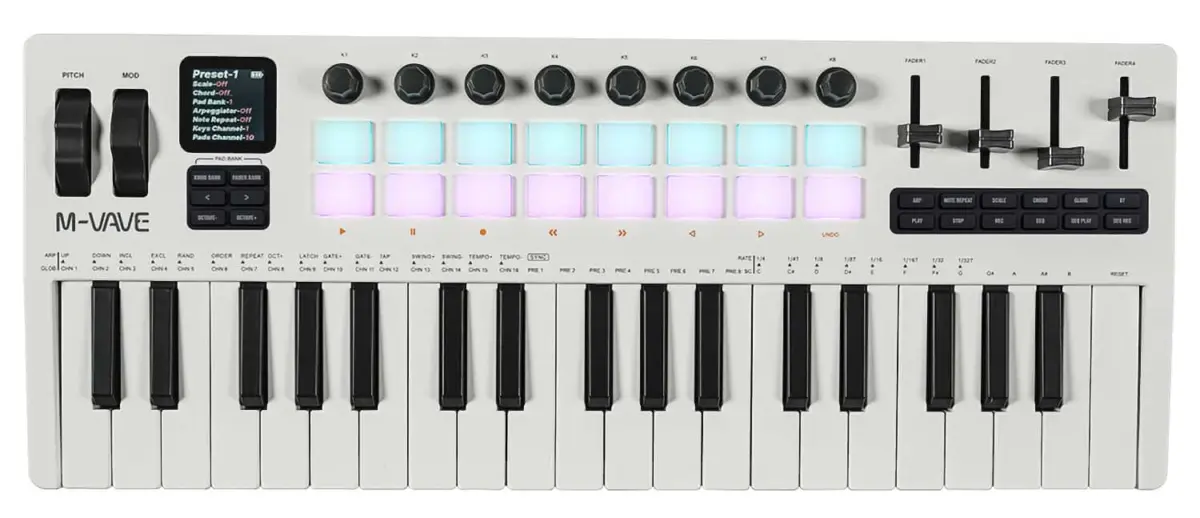
The landscape of affordable music production hardware is undergoing a significant transformation as independent developers begin to unlock the latent potential of budget-friendly synthesizers. In a recent development shared by the developer known as genkiginko, the M-Vave SMK-37, a 37-key MIDI controller and integrated synthesizer, has become the latest recipient of advanced alternate firmware. This project involves porting the "Makkuro37" and "Snoop37" firmware—originally designed for the M-Vave FM-1—to the larger SMK-37 platform. This transition represents a pivotal moment for the SMK-37, moving it from a basic entry-level peripheral to a more sophisticated tool for sound designers and electronic musicians who prioritize portability and customization.
The M-Vave SMK-37 has long been recognized in the industry as a versatile, low-cost solution for mobile producers. Retailing for approximately $135 USD, the device features 37 velocity-sensitive keys, 16 RGB-backlit velocity-sensitive pads, and a suite of assignable encoders. While its native capabilities are robust for the price point, the introduction of community-developed firmware aims to bypass manufacturer limitations, offering users enhanced control over the internal sound engine and MIDI routing. By leveraging the architectural similarities between the SMK-37 and the FM-1, genkiginko has demonstrated that the "Makkuro" and "Snoop" ecosystems can thrive on expanded hardware, providing a more tactile interface for complex synthesis.
Technical Evolution and the Hackability of M-Vave Hardware
The drive to modify M-Vave hardware stems from the brand’s use of accessible internal architectures. Like many modern budget synthesizers, the SMK-37 utilizes microcontrollers that, while locked under proprietary software at the point of sale, are capable of running much more sophisticated algorithms than those provided by the factory. The FM-1, a compact FM synthesis module from the same manufacturer, served as the initial "proof of concept" for this community. The success of the Makkuro and Snoop firmware on the FM-1 proved that the hardware could handle more nuanced frequency modulation, improved MIDI CC mapping, and even entirely new synthesis models.
Porting these firmwares to the SMK-37 is a logical progression. The SMK-37 provides a significantly better user interface than the FM-1, offering a full three-octave keyboard and a dedicated pad section. For a developer, the challenge lies in remapping the input/output (I/O) protocols of the firmware to match the SMK-37’s specific hardware configuration, including its unique matrix of buttons and the OLED display. The result of this porting effort is a device that retains the portability of a controller but gains the "brain" of a boutique synthesizer.
Chronology of Development: From FM-1 to SMK-37
The timeline of this development reflects the rapid pace of the "open-source hardware" movement within the music community. The M-Vave FM-1 was released to market as an ultra-affordable FM synth, quickly catching the attention of the "Synth DIY" community due to its price-to-performance ratio. Within months of its release, independent programmers began probing the device’s firmware, seeking to fix bugs and expand the voice architecture.
By late 2023, the Makkuro and Snoop firmwares had stabilized for the FM-1, offering users a cleaner interface and more reliable MIDI synchronization. Recognizing that the SMK-37 shared a similar internal chipset, the community began requesting a port that would allow the same synthesis engine to be played directly on the SMK-37’s keys without the need for external MIDI cables or complex routing. In early 2024, genkiginko released the first demonstrations of the SMK-37 running the alternate code, showing a marked improvement in the device’s sonic versatility and response times. This progression underscores a growing trend where the value of hardware is increasingly defined by its community support rather than its factory specifications.
Detailed Features of Makkuro37 and Snoop37 Firmware
The alternate firmwares bring a suite of features that are typically reserved for much more expensive hardware. While the factory firmware for the SMK-37 focuses on general-purpose MIDI control and a limited selection of preset sounds, Makkuro37 and Snoop37 focus on "deep" synthesis and performance flexibility.
- Enhanced FM Synthesis Engine: The ported firmware allows for more granular control over operators and carriers. Users can often access hidden parameters that the factory software ignores, allowing for the creation of complex metallic textures, evolving pads, and aggressive bass tones that characterize high-end FM synths.
- Improved MIDI Implementation: One of the primary complaints regarding budget controllers is "jitter" or latency in MIDI transmission. The custom firmware optimizes the USB and Bluetooth MIDI stacks, providing a more stable connection for professional DAW environments.
- Custom CC Mapping: The Snoop37 firmware, in particular, focuses on the "Snoop" protocol, which allows for advanced monitoring and remapping of Control Change (CC) messages. This enables the SMK-37 to act as a more intelligent hub for other external hardware.
- User Interface Refinement: The custom firmware often utilizes the SMK-37’s OLED screen more efficiently, providing real-time visual feedback of waveform changes and parameter values that were previously obscured.
The Economics of "Risk-Free" Experimentation
The primary driver behind the popularity of M-Vave modifications is the economic accessibility of the platform. At a price point of $135, the SMK-37 is categorized as a "low-risk" investment for enthusiasts. In the world of high-end synthesis, where a Moog or Prophet might cost upwards of $3,000, the prospect of "bricking" a device during a firmware flash is a significant deterrent. However, the M-Vave ecosystem allows users to experiment with third-party software with minimal financial jeopardy.
This economic reality has created a vibrant "sandbox" environment. If a user successfully flashes the Makkuro37 firmware and gains a professional-grade FM synth for a fraction of the cost of a Korg Volca or a Yamaha Reface, the value proposition is immense. If the process fails, the loss is manageable. This dynamic has accelerated the adoption of custom firmware, as users are more willing to participate in "beta" testing for developers like genkiginko.
Market Implications and the Response of Manufacturers
The rise of third-party firmware for M-Vave products places the manufacturer in a unique position. Traditionally, hardware manufacturers have discouraged the use of unauthorized software, often citing warranty concerns. However, in the budget sector, "hackability" has become a selling point. While M-Vave has not officially endorsed the Makkuro or Snoop projects, the existence of these mods has undoubtedly driven sales of the SMK-37 and FM-1 to a demographic that might otherwise have ignored "cheap" Chinese-made gear.
Industry analysts suggest that we are entering an era of "Hardware as a Service" (HaaS) in reverse, where the consumer buys the hardware shell and relies on the community to provide the "service" of software updates. This mirrors the trajectory of the smartphone industry’s early days, where "rooting" and "jailbreaking" were common practices to unlock a device’s full potential. For M-Vave, the community’s work serves as free Research and Development (R&D), highlighting which features users actually want in future iterations of their products.
Broader Impact on the Music Technology Industry
The SMK-37 firmware port is emblematic of a larger shift toward open-source principles in music technology. For decades, the industry was dominated by proprietary systems. Today, projects like the Elk Audio OS, the Daisy Seed platform, and the rise of Teensy-based synthesizers are proving that the future of music gear is modular and customizable.
By porting FM-1 firmware to the SMK-37, developers are breaking down the walls between different hardware form factors. This suggests a future where a musician could choose their preferred physical interface—be it a 25-key, 37-key, or 61-key layout—and simply "install" the synthesis engine of their choice. The SMK-37 project is a grassroots example of this "decoupled" approach to music hardware. It empowers the user to decide how their instrument should sound and behave, rather than being restricted by the manufacturer’s original vision.
Conclusion and Availability
The work of genkiginko and the broader M-Vave modding community has effectively extended the lifecycle and utility of the SMK-37. By transforming a basic MIDI controller into a sophisticated, customizable synthesizer, they have provided a blueprint for how budget hardware can punch well above its weight class.
For users interested in exploring these modifications, the documentation and source code are available through genkiginko’s GitHub repository. While the process of flashing alternate firmware requires a basic understanding of software tools and carries the standard risks associated with hardware modification, the rewards—a bespoke, high-performance synthesizer for under $150—are compelling. As the project continues to evolve, the SMK-37 stands as a testament to the power of community-driven innovation in the modern digital age. The M-Vave SMK-37 remains available through major online retailers, continuing its tenure as one of the most intriguing and adaptable tools in the entry-level synthesizer market.
