

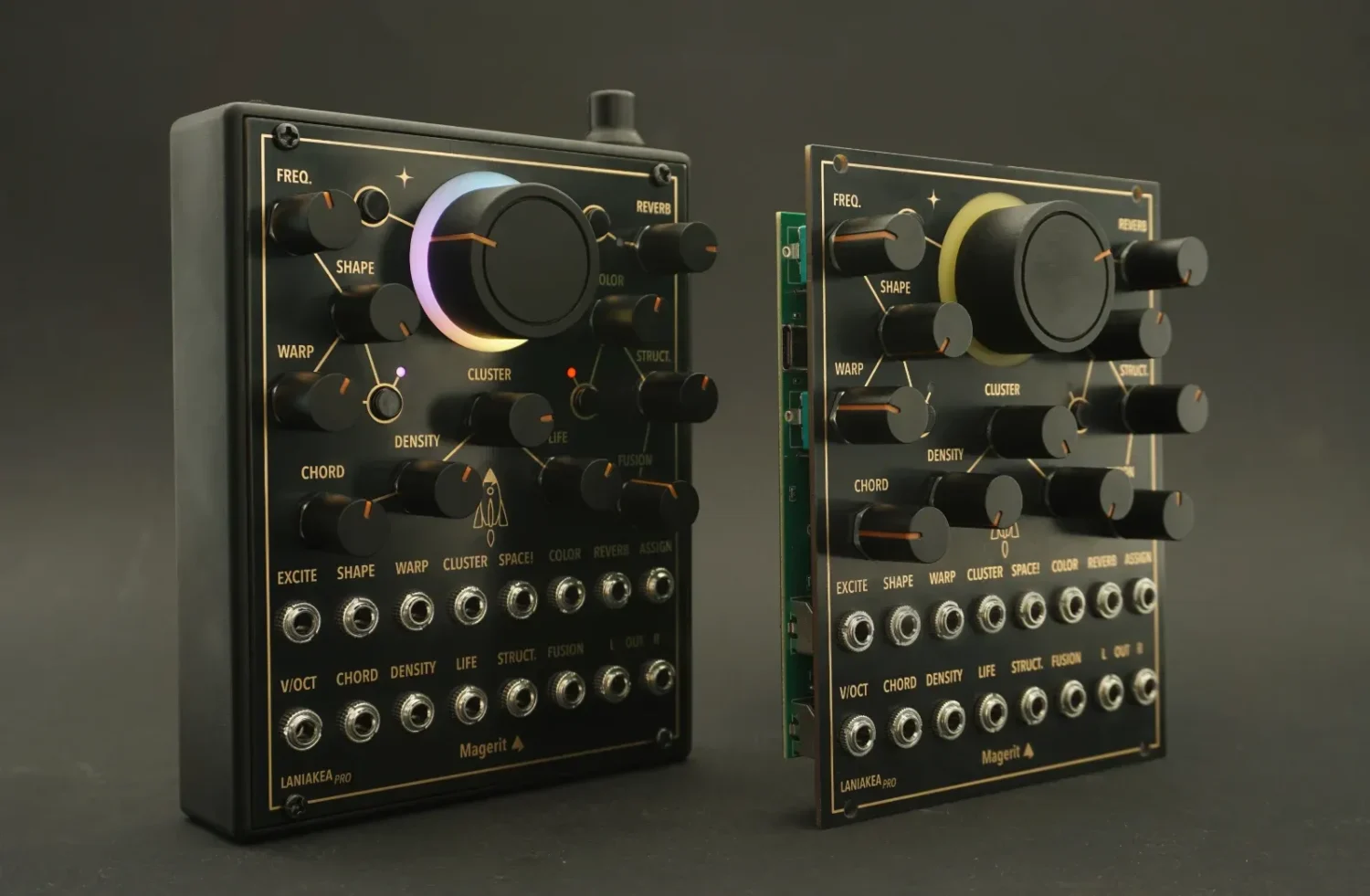
The boutique synthesizer market has seen a significant shift toward multi-engine, polyphonic modules that bridge the gap between traditional modular workflows and modern digital flexibility. Magerit, the Spanish hardware developer known for its innovative approach to digital synthesis, has officially announced the release of the Laniakea Pro. This new instrument represents a major evolution of the company’s original Laniakea concept, offering an eight-voice digital synthesizer that functions both as a 20HP Eurorack module and a portable standalone instrument. By integrating five distinct synthesis engines with advanced granular controls and physical modeling, the Laniakea Pro aims to provide a comprehensive sound design workstation within a compact form factor.
A New Benchmark for Polyphonic Modular Synthesis
The Laniakea Pro is designed to address one of the most persistent challenges in the Eurorack format: achieving high-quality polyphony without consuming excessive rack space or requiring complex patching logic. With eight voices of polyphony available via MIDI, the module provides a streamlined solution for melodic and harmonic composition. Each of the eight voices features its own dedicated low-pass gate (LPG), a design choice that nods to "West Coast" synthesis techniques while maintaining the precision of digital control. This architecture allows for natural, percussive decays and organic tonal shifts that are often difficult to replicate in purely digital environments.
The versatility of the Laniakea Pro is further enhanced by its dual-mode physical design. While the 20HP module is intended to sit at the heart of a Eurorack system, Magerit has introduced an optional battery-powered enclosure. This enclosure transforms the module into a standalone instrument, catering to performers who require portability or who wish to integrate the synthesizer into a non-modular studio setup. The enclosure includes internal power management and connectivity options that maintain the module’s full functionality without the need for an external Eurorack case.
Detailed Analysis of the Five Synthesis Engines
At the core of the Laniakea Pro are five synthesis engines, each offering a different approach to sound generation. This variety ensures that the instrument can cover a vast sonic territory, from classic analog emulations to complex, evolving textures.
1. Wavetable Synthesis
The wavetable engine is perhaps the most versatile of the five. It utilizes a 16 × 16 matrix of interpolated waves, allowing users to navigate through a three-dimensional landscape of sound. The engine supports up to 16 user-loaded wavetables, which can be imported via the companion software. By interpolating between waves, the Laniakea Pro produces smooth, continuous timbral shifts that are ideal for cinematic pads and complex leads.
2. Virtual Analog and Chiptune
For users seeking classic synthesizer tones, the Virtual Analog engine provides standard waveforms such as saw, square, and triangle. However, Magerit has expanded this engine to include chiptune-inspired behaviors, allowing for the creation of 8-bit aesthetic sounds reminiscent of early gaming consoles. This engine benefits significantly from the module’s onboard filters and modulation options, enabling everything from thick basslines to piercing lead sounds.
3. Two-Operator FM (Frequency Modulation)
The FM engine focuses on the interaction between two operators. While simpler than the six-operator architecture of classic 1980s synthesizers, the two-operator approach in the Laniakea Pro is optimized for immediate results and ease of modulation. It excels at producing metallic transients, bell-like tones, and aggressive, harmonically rich textures that cut through a mix.
4. Infinite Keys
The "Infinite Keys" engine is a specialized modeling suite that emulates six different keyboard instruments, including acoustic pianos and church organs. What distinguishes this engine is its ability to sustain notes indefinitely. This feature is particularly useful for ambient musicians and drone artists who require long-form, evolving harmonic foundations. The modeling parameters allow for the adjustment of mechanical noise and resonance, adding a layer of realism to the digital recreations.
5. Karplus-Strong Physical Modeling
The Karplus-Strong engine uses a delay-line based feedback loop to simulate the physics of plucked or struck strings. This engine is highly responsive to the module’s internal "Density" and "Life" controls, which introduce granular artifacts and jitter. The result is a highly expressive engine capable of producing everything from realistic harp-like sounds to otherworldly, dissonant metallic clangs.
Advanced Sound Shaping and Granular Behavior
Beyond the primary synthesis engines, the Laniakea Pro incorporates five sound-shaping algorithms and three distinct reverb types. These internal effects are not merely afterthoughts; they are integrated into the signal path to allow for deep modulation. The inclusion of three reverb types—ranging from intimate rooms to vast, ethereal spaces—provides the necessary spatial depth for polyphonic performance.
One of the most innovative aspects of the Laniakea Pro is the introduction of the "Density" and "Life" parameters. These controls bring granular synthesis techniques to all five engines. "Density" controls the frequency and overlap of generated grains, while "Life" dictates the duration and decay characteristics of the granular cloud. When applied to the wavetable or physical modeling engines, these controls can transform static sounds into shimmering, unpredictable textures.
Furthermore, the CLUSTER and CHORD functions allow users to organize the eight voices in musically intelligent ways. The CHORD function enables the triggering of complex harmonies with a single note, while the CLUSTER function groups voices together with slight detuning or timing offsets, creating massive, thick unison sounds that take full advantage of the digital processor’s power.
Chronology and Development Context
The release of the Laniakea Pro follows nearly two years of research and development by the Magerit team. The original Laniakea was released as a more focused, compact module that gained a following for its unique "Infinite Keys" engine and its ability to produce high-quality digital tones in a small footprint. However, user feedback indicated a demand for more polyphony, more synthesis options, and better integration with external hardware.
In late 2023, Magerit began teasing a "Pro" version that would address these demands. The development process involved a complete overhaul of the internal DSP (Digital Signal Processing) architecture to support the expanded eight-voice polyphony. The transition to a 20HP format was a strategic decision to balance the increased control surface requirements with the space constraints of modern Eurorack cases.
The launch of the Laniakea Pro marks Magerit’s most ambitious project to date, signaling the company’s intent to compete with established digital modular brands like 1010music, Waldorf, and Mutable Instruments.
Technical Specifications and Connectivity
The Laniakea Pro is equipped with a comprehensive array of I/O to ensure compatibility with both modular and traditional MIDI setups:
- Format: 20HP Eurorack module.
- Depth: Skiff-friendly design.
- Polyphony: 8 voices.
- Inputs: Multiple CV (Control Voltage) inputs for parameters like Pitch, Gate, and Timbre; MIDI TRS input.
- Outputs: Stereo audio output; MIDI TRS output/thru.
- User Interface: High-resolution display for visual feedback of wavetables and parameter values; dedicated encoders for navigation and real-time manipulation.
- Storage: SD card slot for loading user wavetables and saving presets.
The companion software provided by Magerit is a crucial component of the ecosystem. It allows users to manage their wavetable libraries and update firmware. By offering these tools as free downloads, Magerit ensures that the Laniakea Pro remains an open and evolving platform for sound designers.
Market Implications and Professional Reception
The introduction of the Laniakea Pro comes at a time when the "standalone-modular" hybrid category is expanding. Musicians are increasingly looking for gear that can live in a studio rack but can also be taken to a live performance as a self-contained unit. Magerit’s decision to offer a dedicated battery-powered enclosure positions the Laniakea Pro as a direct competitor to portable grooveboxes and compact desktop synths.
Industry analysts suggest that the Laniakea Pro’s pricing—starting at €379 for the module—is highly competitive. Given the cost of traditional analog polyphony in Eurorack, which often requires multiple modules and complex mixers, a single-module solution with eight voices and built-in effects represents a significant value proposition.
While official reviews are still forthcoming, early reactions from the synthesis community have highlighted the "Infinite Keys" engine and the physical modeling capabilities as standout features. The ability to perform church organ swells or plucked string sequences with eight-voice polyphony in a 20HP space is a rare utility in the current market.
Pricing and Availability
The Magerit Laniakea Pro is available for purchase through the official Magerit website and selected retailers. The pricing structure is designed to offer flexibility based on the user’s needs:
- Laniakea Pro Module: €379 (Standard 20HP Eurorack module).
- Module and Battery Enclosure Bundle: €469 (Includes the module and the standalone housing).
- Standalone Enclosure Only: €149 (For users who already own the module and wish to upgrade to a portable setup).
All versions include access to the free companion software and future firmware updates.
Conclusion
The Magerit Laniakea Pro is a sophisticated fusion of digital power and modular flexibility. By offering five diverse synthesis engines and a robust polyphonic architecture, it provides a versatile solution for a wide range of musical genres. Whether used as the harmonic centerpiece of a Eurorack system or as a portable standalone synthesizer for live performance, the Laniakea Pro reflects the modern trend toward integrated, multi-functional music hardware. As Magerit continues to expand its software ecosystem, the Laniakea Pro is poised to become a staple for sound designers seeking a deep, yet accessible, digital instrument.
