

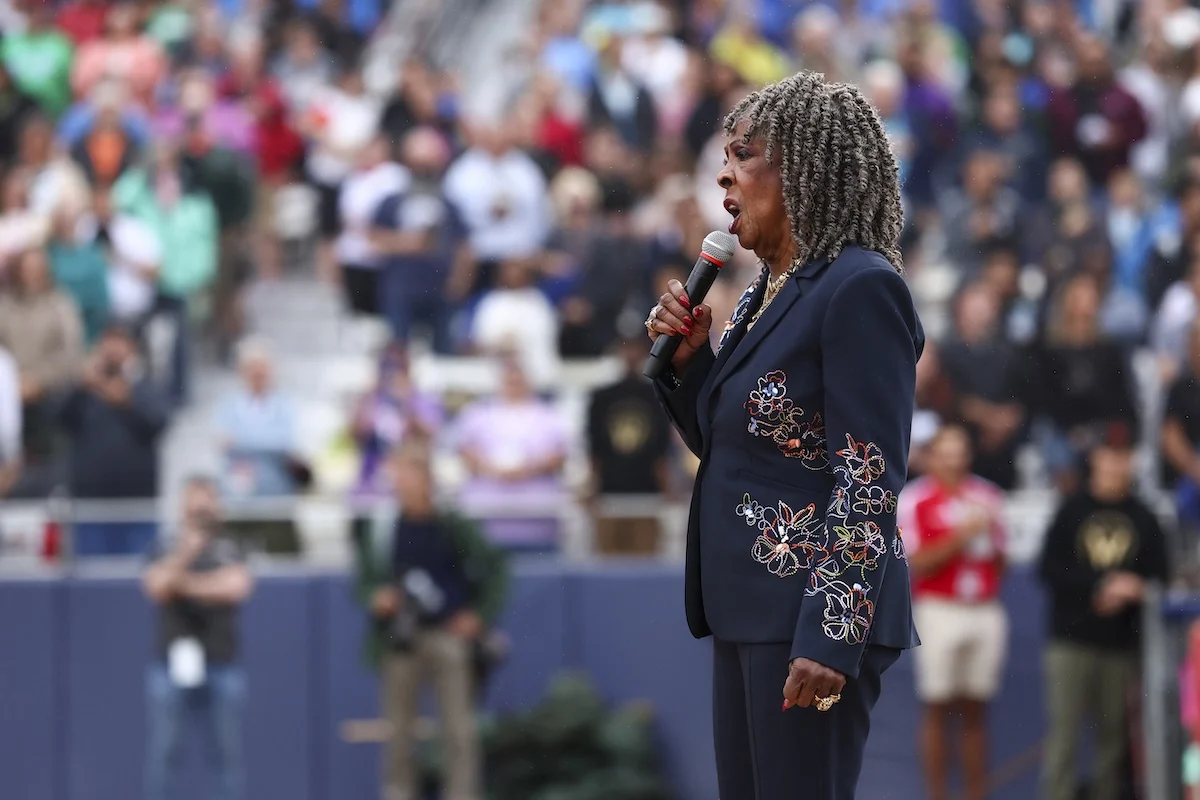
A new and highly discussed rendition of "The Star-Spangled Banner" has entered the public consciousness, drawing comparisons and sparking debate across social media and traditional news outlets. Motown legend Martha Reeves, renowned for her iconic hits with Martha Reeves and the Vandellas, became the subject of widespread attention following her unconventional performance of the national anthem at the inaugural game of the Women’s Professional Baseball League (WPBL) on Saturday, August 1st. The event, held at the Robin Roberts Stadium in Springfield, Illinois, was intended as a historic launch for the new league, but a significant portion of the post-event discourse centered on Reeves’ vocal delivery and her candid pre-performance comments regarding her accompanying backup singers.
The Genesis of a Viral Moment: Rehearsal Insights Emerge
The controversy began to simmer even before the live performance aired widely. Footage obtained by TMZ from a rehearsal preceding the main event offered an initial glimpse into the challenges Reeves faced and her direct communication style. In the rehearsal video, Reeves is seen and heard stopping her backup singers. At one point, she directly addressed one of the vocalists, informing her that she was "out of tune." More pointedly, over the stadium microphone, Reeves then expressed her preference for performing solo, stating unequivocally about the backup ensemble, "I don’t think I need them. I don’t need them." This footage, circulated widely after the main performance, provided crucial context to the subsequent viral reaction, painting a picture of pre-show tensions and a performer seeking optimal control over her presentation. The candidness of Reeves’ remarks during a public rehearsal set an unusual precedent, highlighting the pressures and specific artistic visions that often accompany high-stakes live performances.
The Inaugural Performance and Immediate Public Reaction
On August 1st, Martha Reeves took to the field at Robin Roberts Stadium, a venue named after the legendary Hall of Fame pitcher and a fitting location for the launch of a new women’s sports initiative. Accompanied by backup vocalists, her rendition of "The Star-Spangled Banner" deviated from traditional melodic expectations, featuring distinct vocal inflections and an interpretive style that immediately caught the attention of attendees and online viewers. The performance was swiftly shared across social media platforms, leading to an explosion of reactions. Many commentators described it as "unconventional," "unique," or "interesting," while others expressed confusion or criticism regarding its departure from the anthem’s familiar tune. The rapid dissemination of clips and commentary underscored the immediate and pervasive nature of viral content in contemporary media, transforming a single performance into a global talking point within hours. The comparison to Fergie’s much-criticized 2018 NBA All-Star Game anthem performance was almost instantaneous, establishing a benchmark for unconventional renditions that become cultural touchstones.
Martha Reeves’ Official Statement: Addressing the Challenges
In the immediate aftermath of the performance going viral, Martha Reeves issued a comprehensive statement to TMZ on August 2nd, offering her perspective on the events and the conditions surrounding her performance. Her statement began by acknowledging her extensive career and recent milestone: "Having just celebrated my 85th birthday, I’ve learned a great deal over more than 60 years of performing live." She emphasized the honor of the invitation, stating, "It was an incredible honor to be invited to perform at the inaugural Women’s Professional Baseball League event and to help celebrate such a historic moment for women in sports. I wouldn’t have missed it for the world."
Reeves then detailed the environmental and technical difficulties she encountered: "The field conditions were wet and windy, and without stage monitors I wasn’t able to hear myself as I normally would." She concluded by expressing a degree of disappointment in the outcome, while reaffirming her support for the event: "While it wasn’t the performance I had hoped for, I’m grateful to have been there in support of these remarkable athletes and this groundbreaking league." This statement provided critical context, shifting the narrative from solely focusing on artistic interpretation to also considering the very real challenges faced by performers in live, outdoor settings, particularly when technical support is suboptimal.
The Significance of the Women’s Professional Baseball League (WPBL)
The inaugural game, which served as the backdrop for Reeves’ performance, represented a pivotal moment for women’s sports. The Women’s Professional Baseball League aims to provide a professional platform for female baseball players, echoing the legacy of historical leagues like the All-American Girls Professional Baseball League (AAGPBL), famously immortalized in the film "A League of Their Own." The establishment of the WPBL in the early 2020s signifies a renewed commitment to expanding opportunities for women in a sport historically dominated by men. The league’s mission extends beyond mere competition; it seeks to inspire young girls, promote gender equality in athletics, and offer professional pathways that have long been scarce.
The choice of Robin Roberts Stadium in Springfield, Illinois, for the inaugural game was symbolic. Roberts, a celebrated pitcher for the Philadelphia Phillies, represents a golden era of baseball, and his namesake stadium provided a traditional, yet intimate, setting for this historic launch. The significance of this event, therefore, transcends a single anthem performance. It marked a crucial step in the ongoing evolution of women’s sports, striving to carve out space and recognition in a competitive landscape. The league’s organizers would undoubtedly have hoped for the spotlight to remain firmly on the athletes and the groundbreaking nature of the competition, making any diversion of attention, however brief, a point of consideration.
The National Anthem: A Minefield of Performance and Expectation
"The Star-Spangled Banner" holds a unique and often fraught position in American public life. As the national anthem, its performance at major sporting events and public ceremonies is steeped in tradition and symbolic meaning. Audiences typically expect a rendition that is respectful, vocally competent, and adheres largely to the established melody, symbolizing national unity and reverence. This deeply ingrained expectation creates a challenging environment for performers, who often face a delicate balance between artistic interpretation and patriotic duty.
Over the decades, numerous artists have found themselves at the center of controversy for their renditions of the anthem. Some notable examples include:
- Jimi Hendrix at Woodstock (1969): While now iconic, Hendrix’s psychedelic, distorted guitar interpretation, particularly his use of feedback to mimic bomb noises, was highly unconventional for its time and sparked debate about artistic freedom versus patriotic solemnity.
- Roseanne Barr at a San Diego Padres game (1990): Barr’s screeching, off-key rendition, coupled with her mimicking of spitting and crotch-grabbing, was widely condemned as disrespectful and led to significant public outrage, including a denouncement from then-President George H.W. Bush.
- Christina Aguilera at Super Bowl XLV (2011): Aguilera famously fumbled the lyrics during her performance, a gaffe that, while not intentionally disrespectful, drew widespread criticism for its perceived lack of preparation at such a high-profile event.
- Fergie at the NBA All-Star Game (2018): Fergie’s slow, bluesy, and heavily jazz-influenced rendition was widely panned for being off-key, overly stylized, and, as some critics suggested, inappropriately sexualized. It immediately became a viral meme and a benchmark for anthem misfires.
Martha Reeves’ performance, while distinct from these examples, falls into a similar category of renditions that challenge public expectations. The underlying tension often lies between a performer’s artistic license and the audience’s deep-seated reverence for the national symbol. Reeves’ explanation of technical difficulties — specifically the lack of stage monitors and adverse weather conditions — highlights a common pitfall for even seasoned artists. Stage monitors are crucial for vocalists to hear their own voice accurately against the ambient noise, allowing them to maintain pitch and timing. Without them, even the most experienced performers can struggle, especially in windy, open-air environments where sound can be easily dispersed or distorted.
Broader Implications and Public Discourse
The viral spread of Reeves’ performance ignited a multifaceted public discourse. On one side, critics argued that regardless of technical difficulties, the performance was a significant departure from the anthem’s traditional melody and therefore disrespectful or, at the very least, jarring. Many expressed concern that a legend of Reeves’ stature should have been better supported or perhaps should have opted for a more straightforward delivery given the circumstances.
Conversely, a significant portion of the public, particularly fans of Reeves and those sympathetic to the challenges of live performance, came to her defense. They highlighted her illustrious career, her contributions to American music, and argued that a single, challenging performance should not overshadow her legacy. They pointed to her candid statement as evidence of her professionalism and transparency, suggesting that the circumstances were largely beyond her control. Some also noted that the "unconventional" nature could be interpreted as artistic expression, a testament to her enduring spirit as a performer at 85 years old.
The incident also inadvertently brought additional, albeit tangential, attention to the nascent Women’s Professional Baseball League. While the initial focus might have been diverted from the athletes, the sheer volume of discussion surrounding the anthem performance undoubtedly exposed the league’s existence to a broader audience than it might have otherwise reached on its inaugural day. This "any publicity is good publicity" effect, while perhaps not ideal for the league’s desired messaging, is a common phenomenon in the age of viral media.
For Martha Reeves herself, the episode represents a moment of intense public scrutiny late in a storied career. While it may temporarily overshadow some of her more recent endeavors, it is unlikely to diminish her foundational impact on Motown and popular music. Her statement, delivered with grace and professionalism, aimed to contextualize the moment, reminding the public of the realities of live performance and her unwavering support for important causes like women’s sports.
Ultimately, the viral moment surrounding Martha Reeves’ national anthem performance at the inaugural WPBL game serves as a compelling case study. It illustrates the enduring power of "The Star-Spangled Banner" to ignite public passion, the inherent risks and challenges of live performance for even the most legendary artists, and the rapid, often unforgiving, nature of modern media culture in amplifying such events into global conversations. As the Women’s Professional Baseball League continues its inaugural season, and Martha Reeves continues her illustrious career, this moment will likely be remembered as a complex confluence of artistic interpretation, technical hurdles, and a nation’s deep-seated reverence for its symbols.
