

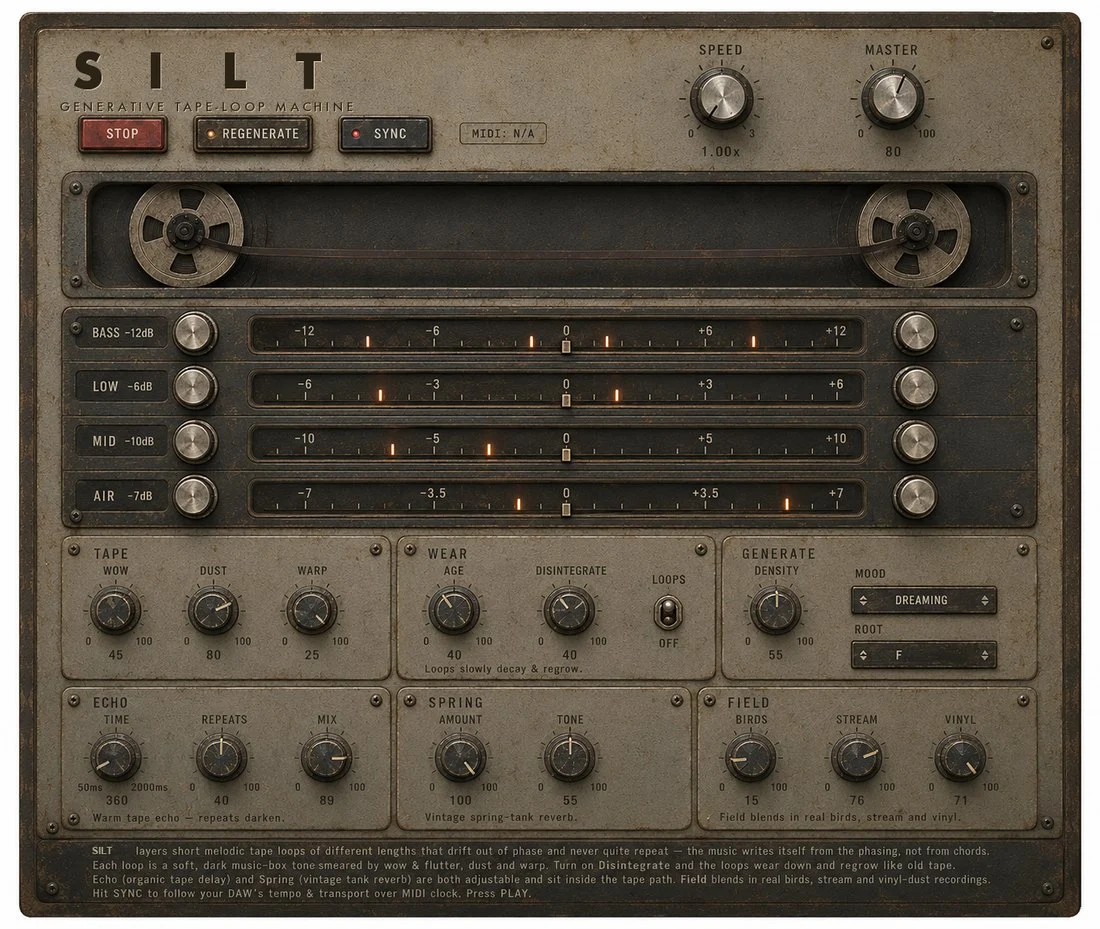
Tunary Instruments has officially launched SILT, a specialized generative tape-loop instrument designed to provide musicians, film composers, and sound designers with a tool for creating organic, ever-evolving sonic textures. This new software instrument enters a growing market for "generative" music tools—software capable of creating shifting musical patterns that do not strictly repeat—by utilizing a four-loop architecture inspired by the avant-garde tape techniques of the mid-20th century. At its core, SILT employs four melodic loops of varying lengths that slowly drift out of phase with one another, a process that ensures the resulting composition is constantly changing, much like the natural erosion or "silt" deposits from which the instrument takes its name.
The release of SILT comes at a time when interest in lo-fi aesthetics and generative composition is at an all-time high within the electronic music community. By combining traditional synthesis methods with field recordings and digital emulations of analog hardware degradation, Tunary Instruments aims to bridge the gap between technical precision and the "beautiful accidents" associated with physical tape machines. The instrument is currently available at an introductory price of $29 USD, with a standard retail price of $39 USD scheduled to take effect following the initial launch period.
The Technical Architecture of Generative Phase Shifting
The fundamental design of SILT is rooted in the concept of phase music, a technique popularized by minimalist composers such as Steve Reich and Terry Riley. In traditional music production, loops are typically synchronized to a master clock or tempo, ensuring they start and stop at the same time. SILT intentionally subverts this convention. By utilizing four short melodic loops of slightly different lengths, the instrument allows the different musical phrases to "slide" past one another.
As these loops cycle, the relationship between the notes changes. A melody that begins on the first beat of the first loop may eventually align with the middle of the second loop, the end of the third, and a specific texture in the fourth. This creates a mathematical progression of sound that can take hours, or even days, to return to its original starting configuration. For the user, this means the software effectively "writes" its own music within the parameters set by the performer, making it an ideal tool for long-form ambient works, museum installations, or background textures for film and television.
The sound engine itself is centered on "soft music-box tones." These primary oscillators are designed to be delicate and percussive, providing a clear melodic foundation that can withstand heavy processing. Tunary Instruments has emphasized that these tones are not static; they are processed through a virtual signal chain that emulates the mechanical inconsistencies of vintage recording hardware.
Emulating the Physicality of Analog Tape
A significant portion of SILT’s character is derived from its "Tape Machine" emulation module. In the analog era, tape loops were physical strips of magnetic tape spliced together to form a circle. As these loops ran through a tape deck, they were subject to various forms of degradation: the motor might fluctuate (wow), the tape might vibrate (flutter), or the magnetic surface might accumulate "hiss" and "crackle" from dust and age.
SILT recreates these artifacts digitally, allowing users to "smear" the music-box tones with layers of sonic grit. This process of "smearing" serves a dual purpose: it adds harmonic complexity to the simple sine or triangle-based tones and provides a sense of nostalgia and warmth that is often missing from purely digital synthesis. The "wow" and "flutter" controls allow for pitch instability, which, when applied to generative loops, enhances the "drifting" sensation of the music.
Furthermore, the instrument incorporates integrated field recordings to provide a grounded, organic atmosphere. These recordings include the sounds of birds, running streams, and the rhythmic crackle of vinyl records. By layering these environmental sounds beneath the melodic loops, SILT creates a "soundscape" rather than just a melody. The inclusion of these elements reflects a broader trend in modern "eco-acoustic" composition, where natural sounds are used to provide a sense of place and tranquility.
Historical Context and the Resurgence of Generative Tools
The launch of SILT is part of a larger historical trajectory in music technology. Generative music, a term famously coined by Brian Eno in the 1990s, describes music that is ever-changing and created by a system. Eno’s landmark 1975 album Discreet Music was created using a similar logic to SILT: two tape recorders of slightly different speeds creating a recursive, overlapping melody.
While these techniques once required expensive reel-to-reel tape decks and physical splicing kits, the transition to the Digital Audio Workstation (DAW) environment has made these complex systems accessible to a wider audience. Over the last decade, the "Lo-fi" movement—exemplified by the massive popularity of "Lo-fi Hip Hop" and "Ambient Study" streams—has created a commercial demand for instruments that can produce "imperfect" sounds.

Market data suggests that the "Utility Plugin" and "Boutique Instrument" sectors of the music software industry are expanding. Producers are moving away from massive, all-in-one synthesizers in favor of smaller, specialized tools that do one thing exceptionally well. SILT fits into this "Boutique" category, offering a specific aesthetic (warm, dusty, evolving) rather than a broad range of generic sounds.
Pricing, Availability, and Market Positioning
Tunary Instruments has positioned SILT as an entry-level professional tool. The introductory price of $29 USD places it in direct competition with other popular ambient tools, such as those from Spitfire Audio’s "LABS" series or various offerings from boutique developers like Hainbach or Felt Instruments.
The software is available via the Tunary Instruments website. While the company has not released specific hardware requirements, the plugin is expected to follow standard VST3, AU, and AAX formats, making it compatible with major DAWs including Ableton Live, Logic Pro, FL Studio, and Pro Tools.
The target demographic for SILT includes:
- Film and Game Composers: Who require "bed" tracks that can play for extended periods without becoming repetitive or distracting.
- Ambient Artists: Seeking to add organic "drift" to their compositions without manual automation.
- Content Creators: Looking for royalty-free, evolving background music for long-form video content or podcasts.
- Hobbyists: Interested in the "Slow Music" movement and generative art.
Analysis of Implications for the Music Industry
The introduction of tools like SILT highlights a significant shift in the philosophy of music production. Traditionally, the goal of a musical instrument was to give the performer total control over every note. Generative instruments represent a "collaborative" approach between the human and the machine. The human sets the boundaries—choosing the loops, the amount of tape hiss, and the speed of the drift—while the machine handles the minute-by-minute variations.
This "set-and-forget" style of composition is becoming increasingly vital in the age of streaming. Platforms like Spotify and YouTube have seen a surge in "functional music"—audio designed for sleeping, studying, or relaxing. Because these tracks often need to be very long (sometimes 10 hours or more), generative tools like SILT allow producers to create vast amounts of high-quality, non-repetitive audio in a fraction of the time it would take to compose manually.
However, the rise of such tools also sparks debate within the industry regarding the nature of authorship. When a machine determines the placement of notes through a phase-shifting algorithm, the role of the "composer" shifts toward that of a "curator" or "system designer." SILT addresses this by keeping the source material—the four melodic loops—at the forefront, ensuring that the human element remains the primary driver of the sound.
Summary of Features and Future Outlook
SILT by Tunary Instruments stands as a testament to the enduring appeal of analog imperfection in a digital world. By focusing on the interplay of four loops and the degradation of virtual tape, it offers a specialized solution for creators looking to explore the fringes of ambient music.
Key features of the instrument include:
- Four-Loop Engine: Unique lengths per loop for infinite phase-shifting possibilities.
- Tape Emulation: Adjustable wow, flutter, and age-based saturation.
- Organic Textures: Integrated field recordings (birds, water, vinyl) for atmospheric depth.
- Minimalist Interface: Designed for ease of use and immediate sonic results.
- Affordable Entry Point: $29 introductory pricing makes generative music accessible to a broad audience.
As Tunary Instruments continues to develop its catalog, SILT serves as a flagship for their design philosophy: creating instruments that feel "alive." In a landscape dominated by static samples and rigid grids, the "silt" and "drift" of this new instrument provide a necessary breath of organic unpredictability. Whether used as a subtle layer in a cinematic score or as the sole source of a generative art piece, SILT provides a sophisticated bridge between the tape-loop experiments of the past and the digital workflows of the future.
