

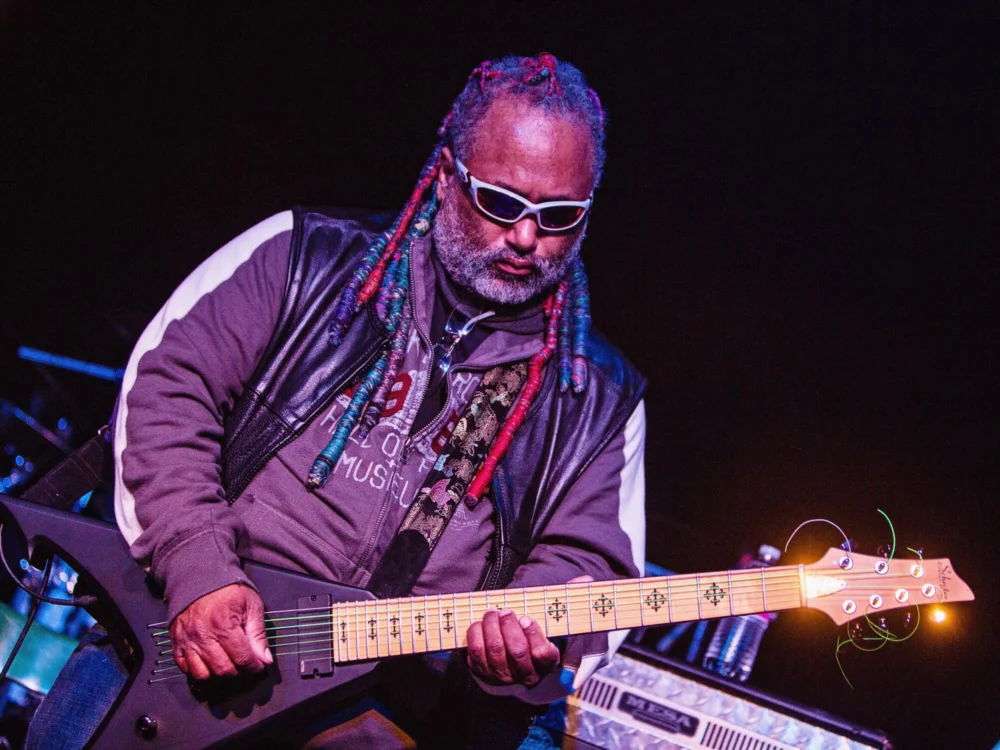
The world of live music thrives on spectacle and connection, where a musician’s presence can be as impactful as their sound. Audiences often observe an artist’s facial expressions and body language as a barometer of their engagement, ranging from the ecstatic "guitar face" to the deeply introspective gaze. For Michael Hampton, the revered guitarist of the legendary Parliament-Funkadelic collective, his often-observed stoic demeanor on stage has frequently led to misinterpretations. In a recent candid interview with Mojo magazine, Hampton addressed these perceptions directly, offering a revealing glimpse into his artistic philosophy and the internal world of a musician deeply committed to authenticity. His core revelation: "I can’t fake the funk, if I’m not feeling something," provides a profound statement on artistic integrity that resonates far beyond the confines of funk music.
Deconstructing the "Miserable" Persona: A Commitment to Authenticity
Hampton’s remarks dispel the notion that his often stone-faced appearance stemmed from disinterest or boredom. Instead, he explains it as a direct reflection of his internal connection, or sometimes, a lack thereof, to the moment’s musical "funk." He acknowledged the potential for misunderstanding, laughing as he reflected, "The way I may have come across on-stage, it might have been like I wasn’t having a good time. [I might have looked] a little bit bored… because I can’t fake the funk, if I’m not feeling something." This statement is not an admission of apathy, but rather a testament to a profound artistic honesty. In an era where performative exuberance is often expected, Hampton’s approach highlights a deeper, more personal engagement with his instrument and the music itself.
The physical and emotional demands of sustained touring and performance are immense. Musicians are expected to deliver peak energy night after night, often across diverse venues and varying audience responses. Hampton alludes to this fatigue, explaining, "I went as far as I could go and, you know, you get tired." He contrasts his approach with more flamboyant performers, stating, "Still to this day I’m not the one dancing around. I like to joke a bit but I’m pretty serious about playing. I just go with the flow and kind of stay in my lane." This self-description paints a picture of a musician whose primary focus is the sonic output, the intricate interplay of notes, and the rhythmic pulse, rather than external showmanship. His stage presence, therefore, is not a performance in itself, but a transparent manifestation of his internal musical journey.
The Evolution of the Live Funk Experience: A Shifting Sonic Landscape
Hampton also offered insights into how the live performance dynamic has evolved within Parliament-Funkadelic over the decades. He notes a shift in the sonic balance, expressing a yearning for the raw, guitar-driven power of earlier eras. "Nowadays on tour, I’m not as loud as I would like to be, there’s a lot of vocals," he observed. This sentiment reflects a common challenge faced by guitarists in large ensembles, where the intricate layering of instruments and vocals can sometimes relegate individual voices to a less prominent position.
His nostalgia is palpable when he recalls a time when the amplifiers could be "cranked up all the way" for tracks like "Cosmic Slop," a powerful, psychedelic funk anthem from Funkadelic’s 1973 album of the same name. "Cosmic Slop," known for its heavy guitar riffs and distorted textures, exemplifies the unbridled, experimental spirit of early Funkadelic. Hampton’s longing for this era underscores a desire for a return to a more unrestrained, guitar-centric soundscape. Despite these changes, his dedication remains unwavering, particularly when it comes to the iconic "Maggot Brain." He states, "I’ll play Maggot Brain until I’m told, ‘Okay, it’s time to end it.’" This commitment to one of rock history’s most celebrated guitar solos speaks volumes about his connection to the piece and its enduring power, both for him and the audience.
A Legacy Forged in Funk: Michael Hampton’s Entry into Parliament-Funkadelic
Michael Hampton’s journey into the legendary Parliament-Funkadelic collective is a story steeped in musical destiny and raw talent. The year 1971 marked a significant turning point for Funkadelic with the departure of the iconic Eddie Hazel, whose virtuosic and emotionally charged guitar work had been a cornerstone of the band’s sound, most notably on the groundbreaking 1971 album Maggot Brain. Hazel’s extended, soul-searing solo on the title track remains one of the most revered and influential guitar performances in music history. The task of finding a successor to such a monumental figure was daunting, requiring not just technical prowess but an intuitive understanding of the P-Funk ethos.
The search culminated in the serendipitous discovery of a prodigious 17-year-old Michael Hampton. The story, now legendary, recounts how Hampton was enlisted after he delivered a stunning, impromptu performance of the entire 10-minute "Maggot Brain" solo at a Parliament-Funkadelic aftershow party. This audacious display of skill and profound musical sensitivity immediately captured the attention of George Clinton and the band members. His ability to not only replicate but also imbue the complex and emotionally demanding piece with his own youthful energy and interpretation was undeniable. This pivotal moment secured his place in the P-Funk lineage, demonstrating an innate connection to the band’s psychedelic funk aesthetic. Hampton officially joined the collective in 1972, stepping into shoes that few could fill and beginning a tenure that would span decades.
The Enduring Impact of Parliament-Funkadelic and Hampton’s Contributions
Parliament-Funkadelic, under the visionary leadership of George Clinton, was far more than a band; it was a sprawling musical universe. Emerging from the late 1960s, the collective pioneered a revolutionary blend of funk, psychedelic rock, R&B, and soul, characterized by outlandish stage shows, elaborate costumes, and a deep, groove-laden sound. Their influence extends across genres, profoundly shaping hip-hop, rock, and electronic music. Artists from Dr. Dre to Red Hot Chili Peppers have cited P-Funk as a primary inspiration, sampling their tracks and emulating their innovative spirit.
Hampton’s contributions post-Hazel were crucial in maintaining and evolving the guitar legacy of Funkadelic. While Hazel’s early work set a high bar, Hampton brought his own distinct voice, characterized by a blend of melodic fluidity, raw power, and an exploratory edge that fit perfectly within Clinton’s ever-expanding musical vision. He played on numerous seminal albums during the 1970s, a period often considered the golden age of P-Funk. His guitar work can be heard on albums such as America Eats Its Young (1972), Cosmic Slop (1973), Standing on the Verge of Getting It On (1974), Let’s Take It to the Stage (1975), Tales of Kidd Funkadelic (1976), Hardcore Jollies (1976), and the commercially successful One Nation Under a Groove (1978). Each of these records showcased Hampton’s versatility, from searing solos to driving rhythm guitar, contributing significantly to the band’s ever-evolving sound.
The improvisational nature of P-Funk performances was legendary, with concerts often stretching for hours, built on spontaneous jams and "inter-changeable" musical sections. Hampton confirmed this enduring spirit, noting, "Everything’s pretty much a spontaneous surprise and it’s all inter-changeable." This collaborative and fluid approach allowed musicians like Hampton the freedom to explore and react in real-time, making each performance a unique event. This improvisational ethos, coupled with the band’s commitment to pushing musical boundaries, cemented their status as one of the most innovative and influential groups in popular music.
The Authenticity Imperative: A Musician’s Integrity and Broader Implications
Michael Hampton’s candid explanation of his stage demeanor carries significant implications for understanding artistic integrity in performance. In an industry increasingly driven by visual spectacle and curated personas, Hampton’s insistence on emotional honesty offers a refreshing counter-narrative. His "I can’t fake the funk" philosophy suggests that true artistic expression cannot be manufactured; it must arise organically from an internal wellspring. This perspective resonates deeply with many artists and fans who prioritize genuine connection over mere entertainment.
The psychological aspect of performance is complex. Musicians face immense pressure to not only execute their craft flawlessly but also to embody an expected persona. Hampton’s comments highlight the tension between "performing a role" and simply "being oneself" on stage. For him, the music itself is the performance, and his physical manifestation is merely a byproduct of his engagement with it. This distinction is crucial, as it suggests that an artist’s internal state directly impacts the authenticity of their external presentation. His approach subtly challenges the notion that a performer must always project overt joy or energy to be considered "engaged," instead positing that deep concentration and internal connection are equally valid, if not more profound, forms of engagement.
This perspective enriches the understanding of an artist’s relationship with their craft and audience. It encourages a re-evaluation of what constitutes a "good" performance, moving beyond superficial metrics of showmanship to a deeper appreciation for the artist’s genuine connection to their art. Hampton’s honesty provides a valuable case study in how personal integrity can define an artist’s legacy, demonstrating that profound impact can be achieved through unwavering authenticity, even if it means defying conventional expectations of stage presence.
Hampton’s Continued Creative Journey and Enduring Legacy
Despite the shifting dynamics of live performance, Michael Hampton’s dedication to music remains undimmed. His commitment to playing "Maggot Brain" until he’s told to stop symbolizes an unbreakable bond with his instrument and the timeless power of the music he helped create. Beyond his enduring role in Parliament-Funkadelic, Hampton has also pursued solo endeavors, continuing to explore his musical vision. His recent work, such as the Into The Public Domain EP, underscores his ongoing creative journey, allowing him to delve into new sonic territories while carrying forward the spirit of innovation that has defined his career. These projects showcase his continued evolution as a guitarist and composer, proving that his artistic wellspring is far from dry.
In conclusion, Michael Hampton’s candid reflections offer a powerful insight into the soul of a musician. His "I can’t fake the funk" declaration is more than just an explanation of his stage presence; it is a profound statement on artistic integrity and the unwavering pursuit of authentic expression. Far from being a flaw, his often-serious demeanor is a testament to a deep, internal connection to the music, a commitment that has defined his indelible mark on funk history. In an ever-evolving music industry, Hampton’s unwavering dedication to the unadulterated funk stands as a powerful reminder of the lasting power of genuine artistic expression.
