

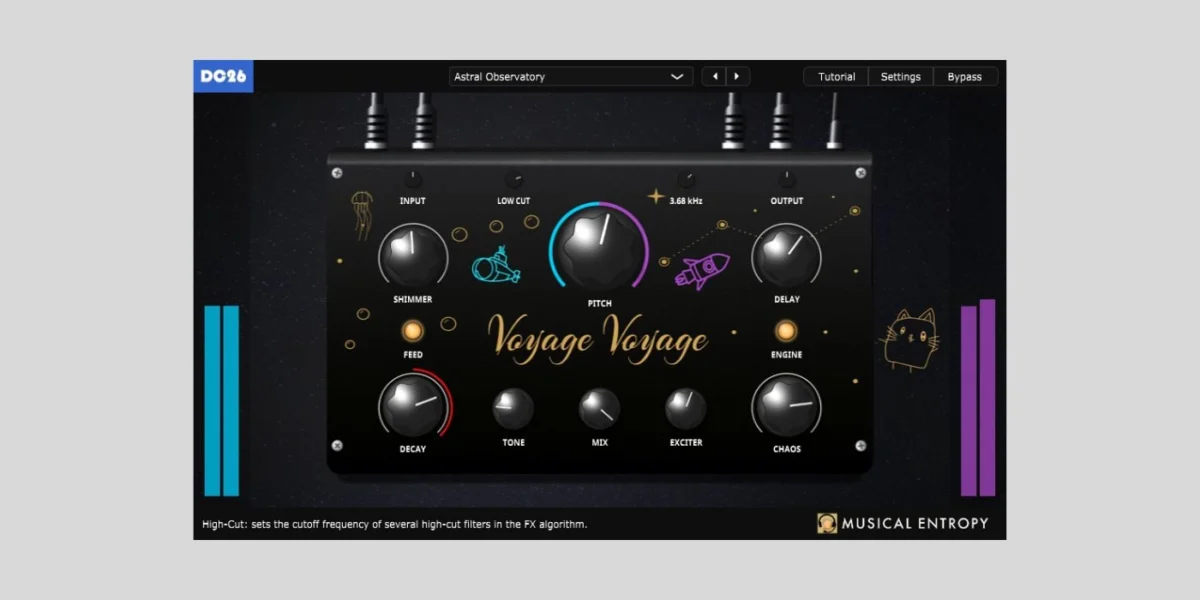
Musical Entropy has officially released Voyage Voyage, an innovative and entirely free shimmer reverb and drone instrument compatible with macOS, Windows, and Linux operating systems. This release marks a significant entry in the ongoing KVR Developer Challenge 2026, where it has already garnered considerable attention as a standout contender among a highly competitive field. The plugin, developed by Ivan Cohen, blends advanced digital signal processing with intuitive design, positioning itself as a versatile tool for sound designers and music producers seeking lush ambient textures, evolving soundscapes, and powerful drone capabilities.
A New Standard for Freeware: Voyage Voyage’s Core Innovation
Voyage Voyage distinguishes itself by combining the ethereal qualities of a shimmer reverb with the distinct character of a BBD-style (Bucket-Brigade Device) delay emulation. This dual architecture allows it to produce rich, harmonically complex reverb tails that can be pitched-shifted to create soaring, angelic textures. Crucially, pushing the decay parameters high enough transforms the effect into a self-generating instrument, capable of producing sustained drones and intricate, evolving soundscapes from a single input chord or even from its internal exciters. This hybrid functionality—part effect, part instrument—is a testament to Cohen’s vision for hands-on sound design.
The plugin is immediately available for download from the Musical Entropy website, offering compatibility across major platforms in VST3, AU, and CLAP formats. Its compact size, approximately 17 MB, ensures minimal impact on system resources, further enhancing its appeal to a broad user base, from professional studios to home-based "bedroom producers."
The KVR Developer Challenge: A Catalyst for Innovation
The KVR Developer Challenge, an annual competition hosted by the prominent KVR Audio community, serves as a vital incubator for innovation within the audio plugin development sphere. Established over two decades ago, the challenge encourages independent developers to create and release original, free audio software. It has historically been a launchpad for numerous plugins that have gone on to achieve widespread acclaim and even commercial success, contributing significantly to the democratization of music production tools. Past challenges have introduced groundbreaking synthesizers, effects, and utilities that have become staples in many producers’ arsenals.
The 2026 iteration of the challenge has already seen several promising entries, including Sucrose, Chance, and Gneiss, each bringing unique functionalities to the table. Voyage Voyage’s inclusion among these highlighted entries underscores its perceived quality and inventive approach. The challenge’s structure not only fosters a spirit of friendly competition but also benefits the wider music production community by continually injecting high-quality, free resources into the ecosystem. For developers like Ivan Cohen, it provides a platform for visibility, peer feedback, and the opportunity to contribute meaningfully to the art of sound.
Behind the Scenes: Ivan Cohen’s Vision and Development Process
Ivan Cohen, the sole developer behind Musical Entropy, revealed that the genesis of Voyage Voyage stemmed from an unexpected discovery during a client project. While designing a shimmer reverb algorithm, Cohen observed that the self-oscillating tail of the effect possessed an intriguing potential as a texture source. This serendipitous insight became the "seed" for the KVR Developer Challenge entry, shifting the focus from a mere effect to a more interactive and generative sound design tool. Cohen’s objective was to create a plugin that emphasized reverb, drones, and, critically, a hands-on approach to sound manipulation.
The development process for Voyage Voyage has been characterized by meticulous attention to detail and a commitment to bespoke DSP (Digital Signal Processing) engineering. Cohen explicitly stated that the core DSP algorithms were "created and tweaked by hand over the years," emphasizing a traditional, craft-based approach to audio software development. This statement serves as a clear distinction in an era where discussions around Artificial Intelligence (AI) in creative tools are increasingly prevalent. While AI was minimally employed for "quick UI background-noise generation," the overarching UI concept and execution, including layered assets and even a drawing by his seven-year-old daughter, were entirely manual, highlighting a personal and artisanal touch.
Unpacking the Feature Set: Beyond Conventional Reverb
Voyage Voyage transcends the capabilities of a standard reverb unit by integrating a suite of sophisticated controls designed for deep sound sculpting. While it includes familiar parameters such as decay, tone, mix, input/output gain, low cut, and high cut filters, its true power lies in its unique "Shimmer," "Exciter," and "Chaos" sections.
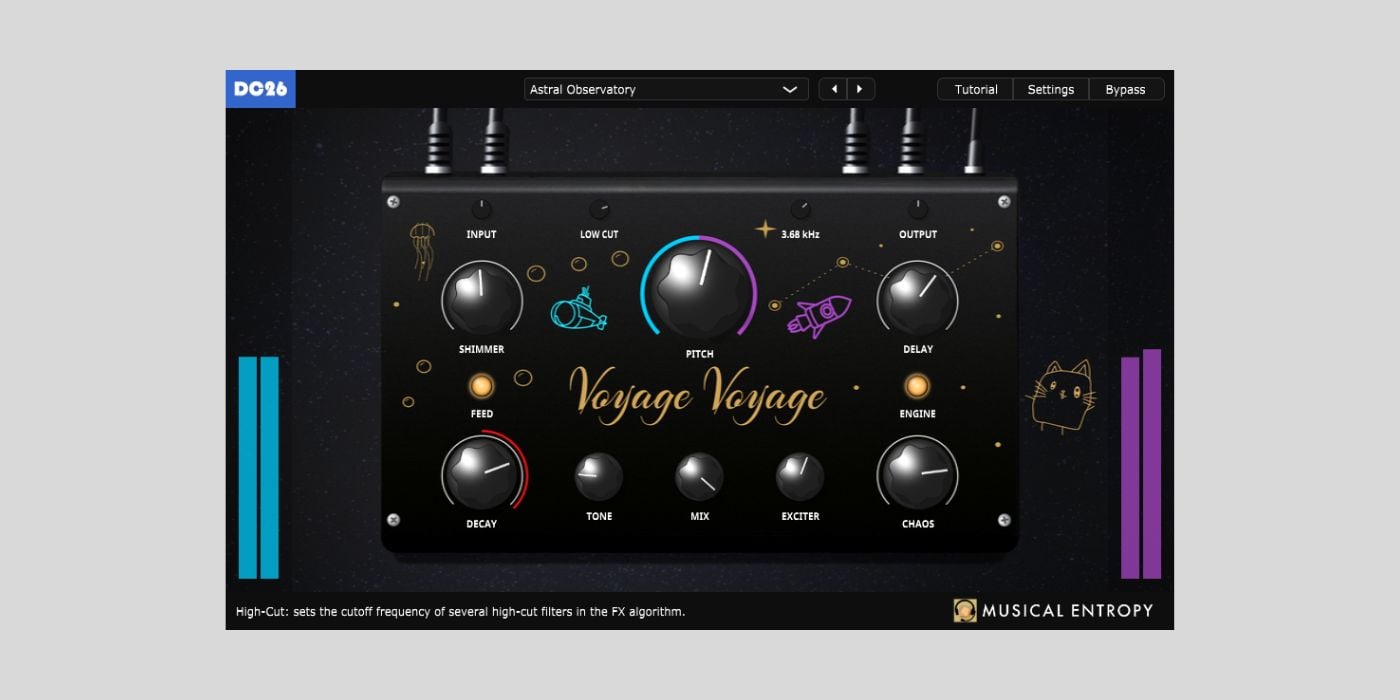
- Shimmer: This core component is responsible for the plugin’s signature ethereal quality. It introduces pitch-shifted copies of the input signal into the reverb tail, typically an octave or fifth above, creating a rich, harmonic wash that sustains and evolves. The implementation in Voyage Voyage is designed to be particularly lush, allowing users to craft expansive soundscapes.
- Exciter: This feature allows users to "feed" the delay lines with either pure tone or noise. By modulating these internal exciters, producers can generate distinct sonic characteristics within the evolving drone. For instance, a tonal exciter can create harmonic pads and sustained pitches, while a noise-based exciter can introduce textural grit or atmospheric ambience, providing a foundational layer for sound design experiments.
- Chaos: Perhaps the most experimental control, "Chaos" pushes the boundaries of the plugin’s sonic output. Engaging this parameter can morph the sound towards various unstable and unpredictable textures, including extreme diffusion, freeze-style reverb effects (where the reverb tail is indefinitely sustained), heavily modulated delays, and resonant textures reminiscent of physical modeling. This control is instrumental in generating dramatic, evolving, and often surprising sound design elements, allowing for rapid exploration of sonic extremes.
The integration of a BBD-style delay emulation further refines the character of the reverb tails. Bucket-Brigade Devices are analog delay lines known for their warm, slightly degraded, and often modulated delay repeats. Emulating this classic analog behavior imbues Voyage Voyage’s digital shimmer with a desirable vintage character, adding depth and organic movement that digital-only delays often struggle to replicate authentically.
Design Philosophy and User Experience
The visual aesthetic and interactive elements of Voyage Voyage were carefully considered, drawing inspiration from respected hardware manufacturers. Ivan Cohen cited Erica Synths’ FX units and Korg’s "Submarine" and "Space/Riser"-style shimmer concepts as key influences. These inspirations suggest a design philosophy that prioritizes both functional clarity and an engaging, tactile user experience, often found in high-end hardware.
Beyond its primary controls, Voyage Voyage incorporates several "easter eggs" and hidden UI features that encourage playful exploration and expand its creative potential:
- Clickable Objects for Drone Frequency: Specific elements within the user interface can be clicked to set the frequency of the internal drone generator, allowing for quick tuning and experimental tonal shifts without diving into menus.
- Virtual Spring Reverb Kick: A particularly whimsical and beloved feature, users can virtually "kick" the plugin, mimicking the physical interaction with a classic spring reverb tank. This delightful detail adds a layer of immersion and harkens back to vintage studio equipment.
- Randomized Presets: The ability to generate randomized presets is a powerful tool for overcoming creative blocks and discovering unexpected sonic textures, promoting exploration and rapid ideation.
A notable innovation is the plugin’s support for game controllers. Cohen shared an Instagram video demonstrating seamless recognition and control of plugin parameters via a joystick. This feature blurs the lines between traditional audio effects and interactive performance instruments. For a plugin that can transition from a subtle effect to a full-fledged drone generator, game controller integration offers an intuitive and expressive way to manipulate parameters in real-time, opening up new avenues for live performance and creative interaction that go beyond mouse and keyboard control. This approach resonates with the broader trend of bridging gaming hardware with music production, offering a more physical and engaging interface for complex parameter modulation.
The Broader Impact: Freeware Excellence and Creative Empowerment
The release of Musical Entropy’s Voyage Voyage carries several significant implications for the audio production community and the future of plugin development.
Firstly, it significantly raises the bar for what users can expect from free software. In an industry where premium plugins often command substantial prices, a tool of Voyage Voyage’s caliber, offering advanced features, robust performance, and unique functionality at no cost, is a powerful democratizing force. It makes sophisticated sound design capabilities accessible to a wider audience, including aspiring producers, students, and those with limited budgets, fostering creativity without financial barriers.
Secondly, the plugin’s innovative feature set, particularly its hybrid effect/instrument nature and game controller support, pushes the boundaries of plugin design. It challenges conventional notions of what an "effect" or an "instrument" can be, inspiring other developers to explore more interactive and multi-functional designs. The emphasis on hands-on sound design and exploratory features like the Chaos control and hidden UI elements encourages users to experiment and discover, moving beyond preset browsing to genuine sonic creation.
Thirdly, for Musical Entropy and Ivan Cohen, Voyage Voyage’s strong reception within the KVR Developer Challenge is a significant validation of his expertise and creative vision. Such recognition within a respected community can elevate his profile, potentially leading to future collaborations, commercial ventures, or further contributions to the freeware ecosystem. The transparency regarding the manual DSP development, in contrast to AI-driven methods, also resonates with a segment of the user base that values traditional engineering and artistic craft.
Finally, the success of entries like Voyage Voyage reinforces the enduring importance of the KVR Developer Challenge. It continues to serve as a vital platform for showcasing emerging talent, fostering community engagement, and driving innovation. The collective output of the challenge consistently enriches the toolkits available to musicians and producers worldwide, ensuring a vibrant and evolving landscape for audio software.
As producers worldwide begin to integrate Voyage Voyage into their workflows, its unique blend of shimmer reverb, drone generation, and intuitive controls is poised to inspire new sonic explorations and redefine expectations for what a free plugin can achieve. Its release is not merely the introduction of another effect but a significant contribution to the evolving art of sound design and music production.
