

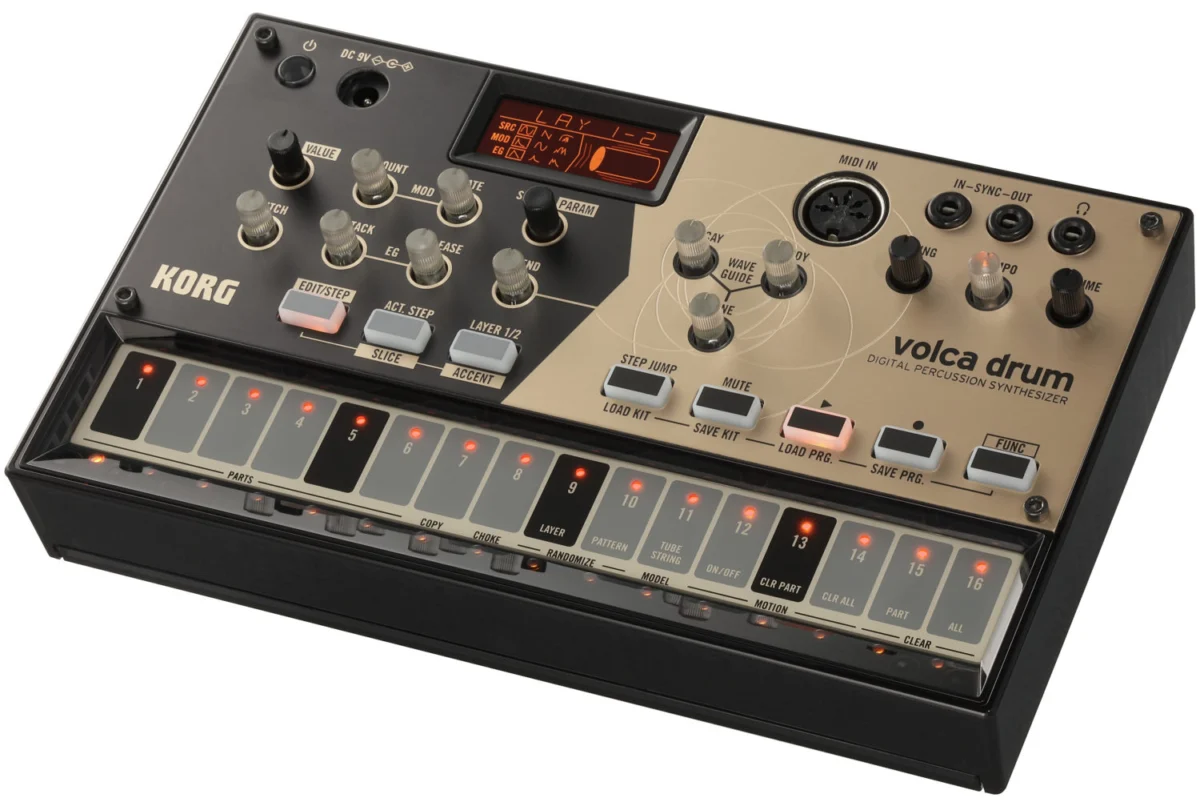
The landscape of compact music production hardware has been significantly altered by the release of the "hj Firmware," an unofficial, community-driven software update for the Korg Volca Drum. Developed by independent programmer hj-oja and highlighted in recent demonstrations by the synthesizer community, this third-party firmware introduces a suite of professional-grade features previously reserved for high-end boutique instruments. By integrating advanced sequencing logic, such as probability-based trig conditions and enhanced editing capabilities, the update effectively transforms the entry-level digital percussion synthesizer into a more formidable tool for live performance and complex sound design.
The Korg Volca Drum, originally released in early 2019, occupies a unique niche within Korg’s popular Volca line. Unlike its predecessors, which largely relied on analog circuitry or PCM samples, the Volca Drum utilizes a six-part, two-layer digital signal processing (DSP) engine based on physical modeling. While the hardware was praised for its idiosyncratic sound palette, users have long noted limitations in its sequencing depth and certain persistent software bugs. The hj Firmware addresses these concerns directly, providing a comprehensive overhaul of the device’s internal logic without requiring physical modifications to the hardware.
Technical Enhancements and Sequencing Innovation
The centerpiece of the hj Firmware is the introduction of "trig conditions," a feature popularized by Swedish manufacturer Elektron. This functionality allows users to assign specific logic to individual steps in a sequence, determining whether a sound will trigger based on a percentage of probability or specific pattern cycles (e.g., triggering only every second or fourth time a loop plays). In the context of the Volca Drum’s 16-step sequencer, this addition provides a significant boost to generative composition, allowing a short loop to evolve over time without sounding repetitive.
Beyond probability, the firmware enhances the device’s editing workflow. Users now have access to refined parameter control and new randomization features that can be applied to specific layers or entire kits. These "new powers," as described by early adopters, allow for a more fluid "performative" style of synthesis where the machine can be pushed into chaotic or structured variations with minimal manual input. The update also includes critical bug fixes that had affected the original factory firmware, improving the overall stability and MIDI response of the unit.
The Evolution of the Volca Series: A Historical Context
To understand the impact of the hj Firmware, one must look at the trajectory of the Korg Volca series. Launched in 2013 with the Volca Keys, Bass, and Beats, the series was designed to bring affordable, hands-on synthesis to the masses. Over the past decade, the line has expanded to include over a dozen units, each focusing on a specific synthesis type.
The Volca Drum arrived as a departure from the "bread and butter" sounds of the Volca Beats. By using a digital waveguide resonator and two-layer oscillators, it allowed for the creation of metallic clangs, deep kicks, and experimental textures. However, the budget-friendly nature of the Volca line often means that the sequencers are functional but basic. The emergence of the hj Firmware follows a precedent set by other "alt-firmware" projects, most notably the "Pajen" firmware for the Volca Sample, which similarly unlocked hidden potential in the hardware. This trend highlights a growing movement where software developers within the musician community extend the lifecycle of hardware through reverse engineering and creative coding.
Chronology of Development and Release
The development of the hj Firmware has been a focused effort to maximize the Volca Drum’s ARM-based architecture. While Korg provides official updates—the most recent being version 1.14—these typically focus on minor stability improvements rather than feature expansion. The hj project emerged on GitHub as an open-source initiative, allowing for transparent peer review and iterative updates.
- January 2019: Korg officially launches the Volca Drum, showcasing its physical modeling engine.
- 2020–2022: The device gains a cult following for its unique sound, but community forums (such as Reddit’s r/volcas and Gearspace) frequently host requests for more advanced sequencing features.
- Late 2023: Initial versions of the hj Firmware begin to circulate in developer circles, focusing on fixing the "note-off" MIDI issues and expanding the internal memory handling.
- Early 2024: The firmware reaches a stable "v1.0" equivalent, introducing the highly anticipated trig conditions.
- Current Status: The firmware is now publicly available on GitHub (hj-oja/vdcf), with video demonstrations from creators like "Waiting For Zyo" showcasing its stability in live performance environments.
Data and Performance Metrics
The Korg Volca Drum operates on a 10-bit or 12-bit internal resolution (depending on the specific DSP block), and the hj Firmware manages to squeeze additional functionality out of the existing CPU cycles without introducing significant latency. According to technical documentation accompanying the GitHub repository, the firmware optimizes the way the sequencer handles "motion sequences"—the recording of knob movements.
In the original firmware, motion sequencing was limited to certain parameters. The hj update expands the flexibility of these recordings, allowing for more granular control over the resonator settings and pitch envelopes. For performers, this means the "Probability" (PROB) setting can now be adjusted on a per-step basis for all six parts simultaneously, a feat that usually requires much more expensive hardware sequencers or a dedicated Digital Audio Workstation (DAW).
Community Response and Industry Implications
The reaction from the electronic music community has been overwhelmingly positive, though tempered by the inherent risks of third-party software. On platforms like YouTube and various synthesizer enthusiast forums, users have noted that the hj Firmware "breathes new life" into a five-year-old device. The ability to add "Elektron-style" logic to a unit that retails for approximately $150 to $200 creates a high value-to-cost ratio that is difficult for manufacturers to compete with in the entry-level market.
Industry analysts suggest that projects like the hj Firmware represent a "democratization of hardware." When manufacturers stop providing major feature updates for older products to focus on new releases, the community often takes over. This creates a secondary market for "legacy" gear that remains relevant due to community-led innovation. While Korg has not officially commented on the hj Firmware, the company has historically maintained a neutral-to-supportive stance toward the "maker" community, as evidenced by their inclusion of open-source SDKs in products like the NTS-1 and the Minilogue XD.
Risks, Installation, and Support
As with any unofficial software, the hj Firmware comes with a set of caveats. It is not supported by Korg’s official warranty channels. Installing the firmware requires a specific process involving the transfer of audio data (a common method for Volca updates) or a direct connection, and any failure during the update process could potentially "brick" the device—rendering it unusable.
The developer, hj-oja, has provided the firmware for free via GitHub, emphasizing that it is an independent project. The "vdcf" (Volca Drum Custom Firmware) repository includes a detailed "readme" file outlining the installation steps and a list of known issues. Users are encouraged to back up their existing kits and patterns before proceeding, as the new firmware may alter the way internal data is stored.
Broader Impact on the Synthesizer Market
The success of the hj Firmware for the Volca Drum may signal a shift in consumer expectations. As the cost of DSP chips continues to drop, the hardware itself becomes a shell for the software running within it. Musicians are increasingly looking for "extensible" hardware—devices that can grow and change over time.
Furthermore, this project underscores the importance of the "Right to Repair" and the "Right to Modify" movements within the tech industry. By allowing users to access and improve the software on their devices, the lifespan of electronic instruments is extended, reducing electronic waste and fostering a deeper connection between the musician and their tools. The Volca Drum, with its hj Firmware, stands as a testament to the power of community-driven development in the modern era of music production.
In conclusion, the hj Firmware is more than just a simple patch; it is a significant technological leap for the Korg Volca Drum. By bridging the gap between budget-friendly hardware and professional sequencing logic, it provides musicians with a powerful, portable, and highly creative instrument that punch far above its weight class. As the project continues to evolve on GitHub, it remains a focal point for those interested in the intersection of coding, synthesis, and performance.
