

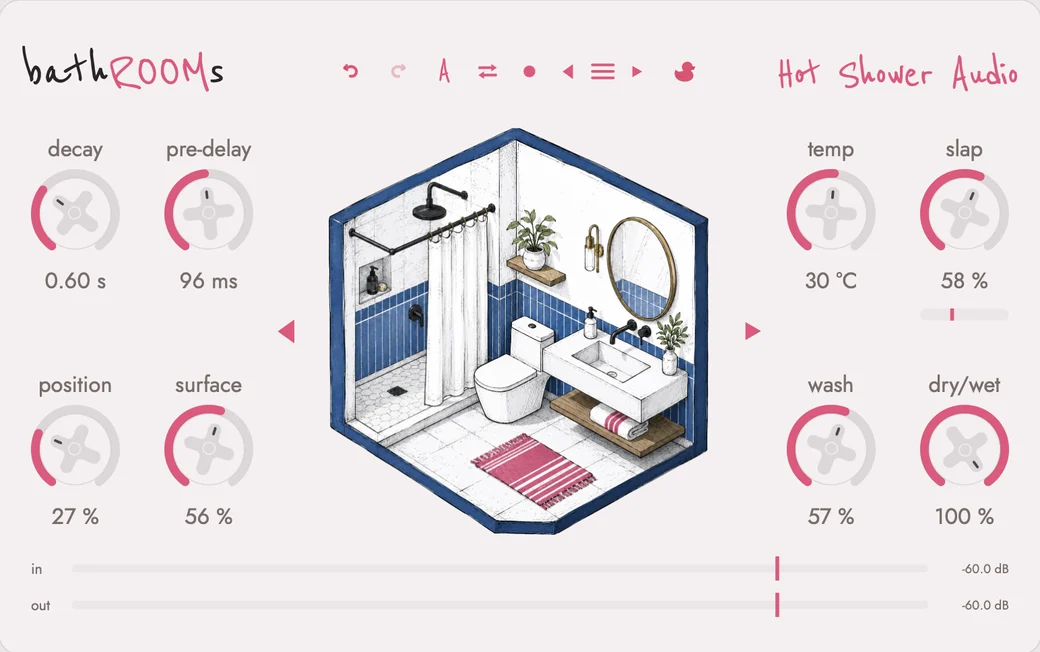
Hot Shower Audio has officially announced the release of bathROOMs, a specialized reverb plugin designed to replicate the unique acoustic signatures of various domestic bathroom settings for use within digital audio workstations (DAWs). This new software enters a competitive market of spatial effects by focusing specifically on the highly reflective, short-decay environments that musicians and vocalists have historically utilized for their distinct "shower-singing" resonance. By offering the plugin under a "pay-what-you-want" pricing model, the developers have positioned the tool as an accessible entry point for home studio enthusiasts and professional sound designers alike who seek to capture the intimate, tiled ambiance of household spaces.
The release marks a significant moment for Hot Shower Audio, a developer known for niche audio tools that prioritize character and specific environmental modeling over generic algorithmic presets. The bathROOMs plugin is compatible with both macOS and Windows operating systems, supporting major plugin formats to ensure seamless integration into standard production workflows. The software’s primary value proposition lies in its ability to transform sterile digital recordings into organic-sounding tracks by applying the complex physics of small-room reflections, a task that often proves difficult for traditional large-scale hall or plate reverb processors.
Architectural Acoustic Modeling and Environmental Presets
At the core of the bathROOMs plugin are five distinct environmental models, each designed to represent a different architectural configuration and surface material composition. These presets—Lavender, Porcelain, Cove, Greenhouse, and Baldosa—provide a spectrum of sonic possibilities ranging from the sharp, brittle reflections of hard ceramic to the slightly dampened, more complex resonances of larger, glass-heavy spaces.
The "Porcelain" setting is engineered to simulate the classic high-frequency reflections associated with standard bathroom tiles and fixtures. This environment is characterized by a high absorption coefficient at lower frequencies and intense, rapid reflections in the upper-mid and high-frequency ranges. Conversely, the "Greenhouse" preset introduces a different set of acoustic variables, likely simulating the interplay between glass surfaces and organic materials, resulting in a more diffuse but still contained reverberation.
"Baldosa," which translates to "floor tile" or "paving stone" in Spanish, suggests a focus on the floor-to-ceiling reflections found in traditional Mediterranean-style bathrooms. These spaces often produce a specific "ring" or flutter echo that can add a unique rhythmic quality to percussive sounds or vocal transients. The inclusion of the "Cove" and "Lavender" settings further expands the palette, offering variations in room volume and "softness" of the reflective surfaces, allowing users to dial in the specific level of domestic intimacy required for a mix.
Technical Parameters and User Control
Beyond the presets, bathROOMs provides a comprehensive suite of controls that allow users to manipulate the underlying reverb engine. These parameters go beyond simple "wet/dry" knobs, offering a deeper dive into the physics of sound propagation. The "Perceived Distance" control is a critical feature, allowing engineers to move the sound source closer to or further from the virtual microphone. In a small, reflective space like a bathroom, distance significantly alters the ratio of direct sound to early reflections, a nuance that the plugin aims to capture accurately.
The "Surface Characteristics" parameter allows for the modification of the virtual materials within the room. By adjusting this control, users can simulate a shift from hard, polished marble to more porous stone or even wood-accented environments. This flexibility is essential for matching the reverb to the existing timbre of an instrument. Furthermore, the plugin features a "Slap Reflections" control, which manages the discrete, audible echoes that occur when sound bounces off parallel hard surfaces. This is a hallmark of bathroom acoustics and is often used in "lo-fi" or indie-rock production to add a sense of physical space and "grit" to a recording.
The balance between discrete reflections and diffuse reverb is handled via a dedicated internal engine. While early reflections provide the brain with cues about the size of a room, the diffuse "tail" of the reverb provides the sense of "lushness." By allowing users to balance these two elements, bathROOMs can function both as a subtle spatial enhancer and as a more dramatic, creative effect. Finally, the tonal character control serves as a specialized equalizer, enabling producers to darken or brighten the reverberated signal to ensure it sits correctly within a dense musical arrangement.
The Evolution of Reverb in Sound Engineering
The launch of bathROOMs occurs within a broader historical context of audio engineering. For decades, the pursuit of the "perfect" reverb led engineers to build massive echo chambers and eventually to develop sophisticated digital algorithms that could simulate the vastness of the Taj Mahal or the grandeur of the Vienna Concert Hall. However, as music production has moved increasingly into bedrooms and small home studios, there has been a counter-movement toward "small-space" acoustics.

In the 1950s and 60s, it was common practice for engineers to place speakers and microphones in hallways or tiled bathrooms to create a "live" sound that electronic plates of the era could not replicate. The bathROOMs plugin digitizes this tradition, providing a controlled environment for an effect that was once achieved through cumbersome physical setups. This shift toward domestic realism reflects a trend in modern music—particularly in genres like bedroom pop, ASMR-style vocal production, and foley for film—where the goal is not "perfection," but rather a sense of relatable, human-scale reality.
Economic Model and Market Impact
The decision by Hot Shower Audio to implement a "pay-what-you-want" (PWYW) pricing strategy is a strategic move in a saturated VST (Virtual Studio Technology) market. By setting the minimum price at $0, the developer removes all barriers to entry, encouraging widespread adoption and community testing. This model has proven successful for other boutique developers, as it builds brand loyalty and relies on the "honor system" among professional users who are often willing to pay for tools that provide genuine value to their workflow.
Market analysts suggest that this "freemium" approach serves as a powerful marketing tool. By providing a high-quality, specialized product for free, Hot Shower Audio establishes itself as a serious contender in the DSP (Digital Signal Processing) space. This visibility can lead to increased sales of future premium products or expansion packs. Furthermore, the accessibility of the plugin ensures it will likely become a staple in educational environments and for hobbyist producers who may not have the budget for high-end convolution reverb suites that often retail for hundreds of dollars.
Technical Compatibility and Integration
Hot Shower Audio has ensured that bathROOMs is accessible to a wide range of users by supporting both Windows and macOS. The plugin is available in standard formats, including VST3 and Audio Units (AU), making it compatible with industry-standard DAWs such as Ableton Live, Logic Pro, FL Studio, Cubase, and Pro Tools. The installation process is streamlined, and the plugin’s graphical user interface (GUI) is designed for modern high-resolution displays, featuring a clean, intuitive layout that avoids the cluttered aesthetic of some older vintage-emulation software.
The lightweight nature of the algorithmic engine used in bathROOMs is also a significant technical advantage. Unlike convolution reverbs, which use Impulse Responses (IRs) and can be CPU-intensive, algorithmic reverbs like bathROOMs are generally more efficient. This allows producers to run multiple instances of the plugin across various tracks in a large project without significantly impacting the computer’s processing power—a vital consideration for those working on laptops or older hardware.
Industry Reactions and Broader Implications
While formal reviews from major trade publications are still pending, the initial reception within the online production community has been largely positive. A Spanish-language overview of the plugin recently highlighted its ease of use and the "surprisingly realistic" nature of the Porcelain preset. Producers have noted that while many reverbs attempt to be "everything to everyone," bathROOMs succeeds by doing one specific thing—domestic small-room simulation—very effectively.
The broader implication of tools like bathROOMs is the democratization of high-end sound design. By providing professional-grade spatial tools at no cost, the barrier between professional studios and home setups continues to thin. Furthermore, the focus on "bathroom" acoustics highlights a growing interest in non-traditional recording spaces. As spatial audio and Dolby Atmos become more prevalent, the demand for plugins that can accurately place a sound in a specific, recognizable environment is expected to rise.
Conclusion and Availability
Hot Shower Audio’s bathROOMs represents a thoughtful intersection of acoustic science and creative utility. By focusing on the specific, highly reflective environments of domestic bathrooms, the plugin offers a unique tool for producers looking to add "life" and "air" to their tracks. Its combination of five distinct presets and granular control over surface and distance parameters makes it a versatile addition to any digital toolkit.
The plugin is currently available for download directly from the Hot Shower Audio website. Users can choose to download the software for free or contribute a payment of their choice to support the ongoing development of future audio tools. As the industry continues to evolve, the success of bathROOMs may encourage other developers to explore niche environmental modeling, further expanding the creative possibilities for sound engineers and musicians worldwide.
