

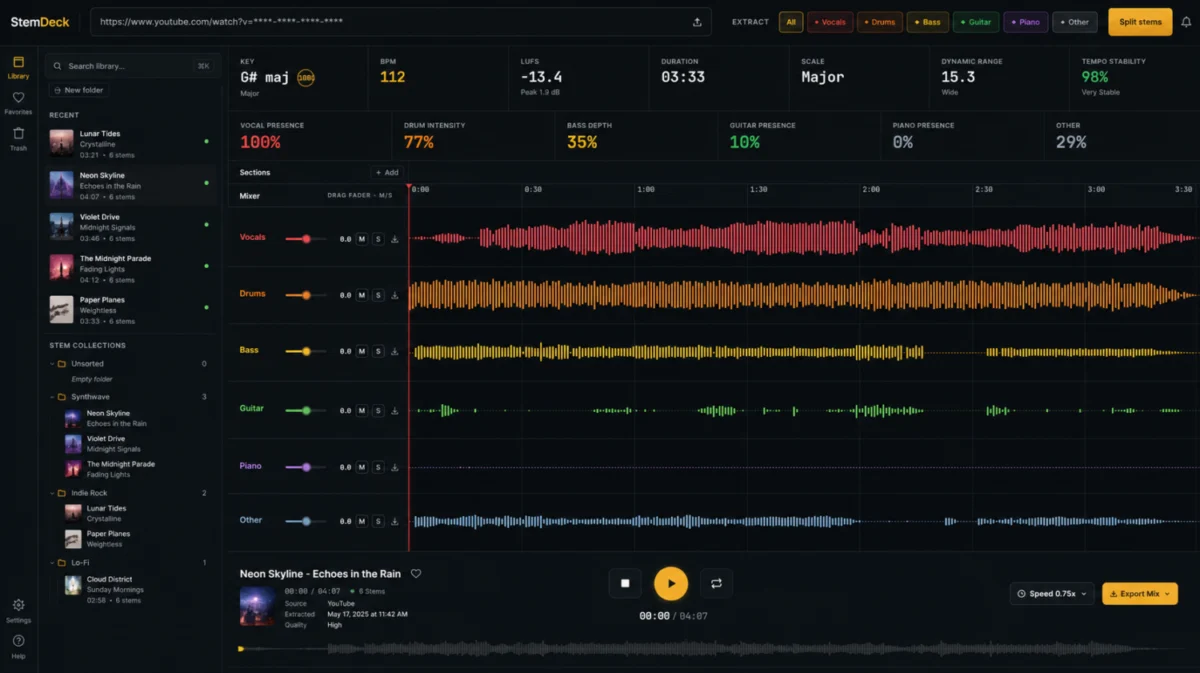
The landscape of music production and audio engineering has undergone a radical transformation with the advent of artificial intelligence, shifting from manual spectral editing to automated, high-fidelity source separation. The release of StemDeck, a free and open-source application designed for Linux, macOS, and Windows, marks a significant milestone in this evolution. By providing a localized, high-performance platform for isolating individual musical elements—such as vocals, drums, bass, piano, and guitar—StemDeck offers a robust alternative to subscription-based cloud services. This development reflects a broader industry trend toward the democratization of sophisticated audio tools, enabling creators to manipulate complex audio files without the need for expensive proprietary software or remote server processing.
The Evolution of Stem Separation Technology
To understand the significance of StemDeck, it is necessary to examine the historical trajectory of audio source separation. Traditionally, isolating a specific instrument or vocal track from a mixed stereo file was considered a "holy grail" of audio engineering. Early methods relied on phase cancellation or rudimentary equalization, which often resulted in "watery" artifacts and significant bleed from other instruments.
The breakthrough occurred in the late 2010s with the application of deep learning and convolutional neural networks (CNNs). In 2019, Deezer released Spleeter, an open-source library that utilized U-Net architectures to separate audio into various stems. This was followed by Meta’s (formerly Facebook) Demucs and various iterations of the MDX (Music Demixing) models, which significantly improved signal-to-noise ratios and reduced spectral interference.
StemDeck leverages these advancements, packaging complex machine learning models into a user-friendly desktop interface. Unlike its predecessors, which often required command-line proficiency or high-latency cloud uploads, StemDeck prioritizes a local-first workflow. This ensures that the user maintains full control over their data and processing power, a critical factor for professional producers and privacy-conscious hobbyists alike.
Technical Specifications and User Interface
StemDeck is engineered to handle a wide array of audio formats, ensuring compatibility across different production environments. The application supports standard formats including MP3, WAV, FLAC, and OGG/Opus, as well as video-container audio such as MP4 and M4A. A notable feature is its ability to process content directly from YouTube URLs, streamlining the workflow for transcriptionists and remix artists who frequently work with digital archives.
The platform provides a comprehensive suite of tools within a centralized, DAW-style multitrack mixer. Key functionalities include:
- Six-Stem Extraction: Users can split audio into vocals, drums, bass, guitar, piano, and a residual "other" track.
- Real-Time Monitoring: The mixer allows for muting, soloing, and level balancing of individual stems during playback.
- Visual Feedback: High-resolution waveform displays with zoom capabilities allow for precise navigation and region selection.
- Looping and Exporting: Users can define specific regions for looping—ideal for practicing instrumentals—and export either individual stems or custom-balanced mixes for further use in digital audio workstations (DAWs) like Ableton Live, Logic Pro, or FL Studio.
By operating entirely on the user’s local hardware, StemDeck eliminates the "quota" system prevalent in commercial alternatives. While cloud-based services often charge per minute of audio or limit the number of uploads, StemDeck’s performance is limited only by the processing power of the host machine’s CPU or GPU.
The Shift Toward Local AI Processing
The emergence of StemDeck highlights a pivotal shift in the software industry: the move away from Software as a Service (SaaS) and toward local execution of AI models. For years, the high computational requirements of neural networks necessitated the use of powerful remote servers. However, as modern consumer hardware—particularly Apple’s M-series chips and NVIDIA’s RTX graphics cards—has become increasingly capable of handling tensor operations, the need for cloud-based "stem-splitters" has diminished.
Privacy and data security serve as primary drivers for this transition. When using cloud-based services like Moises or LALAL.AI, users must upload their intellectual property to external servers, where it may be cached or used for further model training. StemDeck’s architecture ensures that no audio data ever leaves the user’s machine. This "zero-upload" policy is particularly appealing to professional musicians and labels working with unreleased material or sensitive masters.
Furthermore, the lack of a subscription model addresses the "subscription fatigue" currently affecting the creative software market. By offering a free, open-source alternative, the developers of StemDeck have positioned the tool as a public utility for the global music community, ensuring that financial barriers do not impede artistic exploration or educational pursuits.

Comparative Market Analysis
The market for stem separation is currently divided into three tiers: professional DAW integration, specialized commercial apps, and open-source projects.
- Professional DAW Integration: Modern DAWs, such as FL Studio 21 and Serato Studio, have begun integrating native stem separation features. These are highly convenient but often come with a high entry price and are tied to a specific production ecosystem.
- Commercial SaaS (Moises, LALAL.AI): These platforms offer polished user interfaces and mobile applications. They are optimized for users who may not have powerful local hardware but are willing to pay for the convenience of remote processing.
- Open-Source Solutions (StemDeck, UVR): Tools like StemDeck and Ultimate Vocal Remover (UVR) cater to power users and those seeking maximum control. While they may lack the marketing budget of commercial firms, they often provide more frequent updates to the underlying AI models, as they can quickly integrate the latest research from the open-source community.
The developer of StemDeck acknowledged this competitive landscape, stating that while commercial products might offer a more "polished" experience or mobile accessibility, StemDeck is the superior choice for users prioritizing local processing, privacy, and cost-efficiency.
Workflow Applications and Industry Impact
The implications of high-quality, accessible stem separation extend across several sectors of the music industry:
Education and Transcription
Music educators and students utilize stem separation to deconstruct complex arrangements. By isolating a bassline or a piano accompaniment, students can more accurately transcribe parts and understand the nuances of a performance. StemDeck’s looping and soloing features make it an essential tool for "ear training" and pedagogical analysis.
Remixing and DJing
The "remix culture" has been revitalized by AI separation. Producers can now extract acapellas or drum loops from legacy recordings that were never released as multitracks. This allows for a more creative re-imagining of classic tracks, though it also raises ongoing questions regarding copyright and fair use.
Karaoke and Performance
The ability to remove vocals or specific instruments allows performers to create high-quality backing tracks tailored to their specific needs. This has significant applications in the live performance circuit and the amateur karaoke market.
Forensic Audio and Restoration
Audio engineers tasked with restoring old or damaged recordings use stem separation to isolate and clean specific frequency bands. By separating "noise" or "bleed" from the primary signal, they can achieve a level of clarity that was previously impossible.
Chronology of Development and Availability
The development of StemDeck follows a timeline of increasing accessibility in AI audio tools. Throughout 2023 and 2024, various independent developers began experimenting with wrapping Python-based AI models into graphical user interfaces (GUIs). StemDeck emerged as a response to the need for a cross-platform, lightweight application that didn’t require the heavy installation footprint of full-scale research environments.
Released via GitHub, the project remains in active development. The open-source nature of the software allows the community to contribute to its codebase, reporting bugs and suggesting feature enhancements. This collaborative model ensures that as new, more efficient separation models are published by researchers, they can be integrated into StemDeck relatively quickly.
Conclusion: The Future of Audio Manipulation
StemDeck represents the democratization of technology that was, until recently, the exclusive domain of high-end recording studios and specialized tech firms. As AI models continue to shrink in size while increasing in accuracy, the distinction between a "mixed" track and a "multitrack" session will continue to blur.
While the legal industry continues to grapple with the copyright implications of AI-driven separation—specifically concerning the training data used for these models—the technical capability is now firmly in the hands of the public. StemDeck stands as a testament to the power of open-source development, providing a sophisticated, private, and free tool that empowers creators to deconstruct and reimagine the world of sound on their own terms. For the modern producer, educator, or enthusiast, StemDeck is not just a utility; it is a gateway to a deeper understanding of the architecture of music.
