

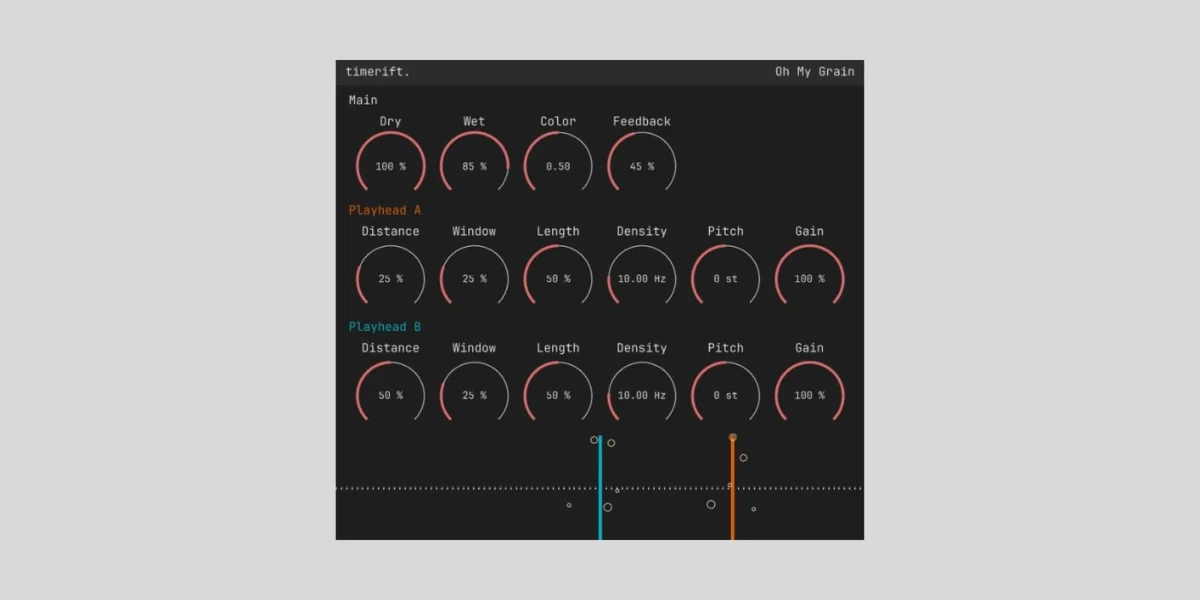
From the innovative developers at Timerift Audio comes Oh My Grain, a groundbreaking free granular delay plugin poised to significantly impact the digital audio production landscape. This new offering, available across macOS, Windows, and Linux as a VST3 plugin, enters a burgeoning market for creative effects, distinguishing itself with a sophisticated dual-playhead architecture and intuitive controls designed for both subtle textural enhancements and radical sound transformations. Its release marks a notable moment in the accessibility of advanced sound design tools, continuing a trend of high-quality freeware enriching the producer’s toolkit.
The Emergence of Granular Delay in Modern Production
The concept of granular synthesis, the underlying technology behind granular delay, traces its origins back to the mid-20th century. Pioneered by Hungarian-British physicist Dennis Gabor in the late 1940s and later explored extensively by avant-garde composers like Iannis Xenakis in the 1970s, granular synthesis involves dissecting a sound into tiny fragments, or "grains," typically ranging from 1 to 50 milliseconds in duration. By independently manipulating the characteristics of these individual grains—such as their duration, amplitude, pitch, and playback position—and then reassembling them, entirely new sonic textures, timbres, and movements can be created. This technique allows for the generation of everything from shimmering ambient soundscapes and dense, evolving drones to glitchy rhythmic patterns and otherworldly sonic environments.
In recent decades, with the advent of powerful digital signal processing (DSP) and the widespread adoption of Digital Audio Workstations (DAWs), granular synthesis has transitioned from the exclusive domain of academic research and experimental music into mainstream music production. Granular delays, a specific application of this technology, take an input signal, break it into grains, and then delay, pitch-shift, and manipulate these grains before replaying them. This differs significantly from traditional delays, which merely repeat the input signal at specified intervals. The result is a far more dynamic and textural echo effect, capable of transforming simple sounds into complex, layered sonic tapestries.
Oh My Grain: A Deep Dive into its Architecture and Features
Oh My Grain arrives at a time when producers are increasingly seeking tools that push beyond conventional effects. Its core innovation lies in its dual-playhead design, a feature that significantly enhances its sound-sculpting capabilities. Unlike single-playhead granular delays, which offer one stream of manipulated grains, Oh My Grain provides two independent processing engines, designated A and B. Each playhead can be configured with its own set of parameters, allowing for the creation of intricate, interwoven textures and polyrhythmic movements that would be difficult or impossible to achieve with simpler designs.
The independent control over each playhead is a critical advantage. Users can set distinct granular parameters for Playhead A and Playhead B, enabling a wide spectrum of creative possibilities. For instance, one playhead might be configured for short, dense, high-pitched grains to create a shimmering effect, while the other might be set for longer, sparser, lower-pitched grains to add a contrasting atmospheric drone. This dual-layer approach facilitates the construction of highly complex sonic environments from even the most basic input material.
Key granular parameters available for independent adjustment on each playhead include:
- Distance: This parameter typically controls the spacing between the playback of consecutive grains. Manipulating distance can create anything from a smooth, continuous wash of sound (short distance, high density) to distinct, stuttering repetitions (longer distance, lower density). In a dual-playhead setup, varying the distance between A and B can generate intricate rhythmic interplay.
- Length: Dictates the duration of each individual grain. Shorter lengths tend to produce sharper, more percussive or glitchy sounds, while longer lengths result in smoother, more sustained textures, blurring the boundaries between individual grains.
- Window: Refers to the shape of the amplitude envelope applied to each grain. A "windowing function" is crucial in granular synthesis to prevent audible clicks and pops that would occur if grains were simply cut abruptly. Common window shapes include Hanning, Hamming, and Gaussian. The choice of window subtly influences the attack and decay characteristics of each grain, affecting the overall smoothness or crispness of the texture.
- Density: Controls how many grains are generated and played back within a given timeframe. High density settings create thick, rich, and often continuous sounds, as grains overlap significantly. Lower densities produce sparser, more fragmented, or rhythmic textures. When combined with the dual-playhead system, varying density between A and B can create dynamic shifts between dense pads and sparse, evolving arpeggios.
- Pitch: Allows for the independent transposition of grains, either upwards or downwards. This is one of the most powerful parameters for creative sound design. Pitch manipulation can introduce harmonic content, create dissonant clusters, generate shimmering octave doublings, or produce dramatic swells and glissandos. With two independent pitch controls, Oh My Grain enables complex harmonic layering, transforming monophonic sources into rich, polyphonic textures.
Beyond the granular specifics of the playheads, Oh My Grain also incorporates global controls that shape the overall output. These include:
- Color: Often functions as a tonal shaper or filter, allowing users to adjust the brightness, warmth, or overall frequency response of the processed sound. This can be crucial for blending the granular effect seamlessly into a mix or for giving it a distinct sonic character, such as a vintage, dark, or sparkling quality.
- Feedback: A fundamental control in any delay effect, feedback determines how much of the processed signal is fed back into the input, creating decaying repetitions. In a granular delay, high feedback settings can lead to complex, evolving soundscapes, self-oscillation, and even runaway textures, offering deep experimental possibilities.
- Dedicated Dry/Wet Controls: Instead of a single master knob, Oh My Grain features dedicated controls for the dry (unprocessed) and wet (processed) signals. This level of precision is invaluable for mixing, allowing producers to carefully balance the original sound with the granular effect, from subtle enhancements to completely transformed audio.
Applications and Creative Potential
The versatility of Oh My Grain positions it as a highly valuable tool for a diverse range of musical genres and sound design tasks. Its ability to manipulate sound at such a fundamental level opens up avenues for creativity that extend far beyond conventional delay effects.
For ambient and electronic music producers, Oh My Grain can effortlessly generate evolving soundscapes, ethereal pads, and intricate rhythmic patterns. A simple sustained synth note can be transformed into a vast, shimmering texture that subtly shifts and breathes, maintaining listener engagement without becoming stagnant. The dual-playhead system is particularly adept at creating layers of intricate movement, perfect for drone music or complex atmospheric textures.
In film scoring and sound design, the plugin’s capacity for creating gritty textures and unsettling sonic atmospheres is immense. Imagine transforming a mundane recording of wind into a howling, distorted blizzard, or a simple bell toll into a haunting, metallic resonance. The ability to manipulate pitch and density independently across two playheads allows for the crafting of tension-building elements, sci-fi sound effects, or abstract sonic backdrops that enhance narrative and emotion. For instance, applying a low-pitched, high-density grain setting on one playhead and a high-pitched, sparse setting on the other can create a deeply unsettling, yet strangely beautiful, soundscape. The article’s suggestion of Sonuscore’s LUX Orchestral Strings Elements for Kontakt Player highlights this synergy, as orchestral elements often benefit from such textural augmentation for cinematic impact.
Even for more traditional instrumental processing, such as guitars or vocals, Oh My Grain offers unique possibilities. A dry guitar riff can gain a subtle, shimmering overtone, or be completely deconstructed into a swirling vortex of granular echoes. Vocals can be given an otherworldly, ethereal quality, or broken into stuttering, glitchy phrases, opening up new avenues for vocal effects that move beyond standard reverb and delay.
The straightforward interface and workflow of Oh My Grain are also significant advantages. Despite its powerful capabilities, Timerift Audio has evidently prioritized usability, ensuring that producers can quickly dive into sound design without being overwhelmed by overly complex menus or controls. This ease of use makes it accessible to beginners exploring granular synthesis for the first time, while still offering the depth required by seasoned professionals.
The Broader Impact of Freeware Innovation
The release of Oh My Grain is part of a larger, positive trend in the music technology industry: the increasing availability of high-quality freeware plugins. This phenomenon democratizes access to advanced tools, allowing aspiring producers, hobbyists, and those with limited budgets to experiment with sophisticated effects that were once exclusive to expensive commercial software. The ecosystem of freeware plugins, often championed by platforms like Bedroom Producers Blog, fosters innovation and creates a vibrant community of users and developers.
Timerift Audio’s decision to offer Oh My Grain for free aligns with this spirit of accessibility. While the direct commercial motivation for freeware can vary—from building brand recognition and attracting future customers for paid products to simply contributing to the creative community—the immediate benefit to producers is undeniable. It lowers the barrier to entry for complex sound design techniques, encouraging broader experimentation and pushing the boundaries of what is possible within digital audio.
The mention of TiagoLR’s "Sirial" plugin, another recent standout in the creative delay category, further underscores this period of innovation. TiagoLR has established a reputation for developing some of the most highly regarded freeware plugins, setting a high bar for quality and functionality. Oh My Grain, by joining this esteemed list, signals Timerift Audio’s commitment to delivering comparable value and creative utility. The continuous emergence of such sophisticated free tools ensures that the landscape of music production remains dynamic and exciting, constantly offering new avenues for sonic exploration without financial constraints.
In conclusion, Oh My Grain is more than just another free plugin; it is a meticulously crafted granular delay that offers exceptional depth and versatility. Its dual-playhead design, coupled with intuitive controls over key granular parameters and global settings, positions it as a formidable tool for creative sound design. By making such advanced capabilities freely available, Timerift Audio not only empowers a wider audience of music producers and sound designers but also contributes significantly to the ongoing evolution of digital audio processing. Its impact will likely be felt across numerous genres, fostering new sonic textures and inspiring countless creative endeavors.
