

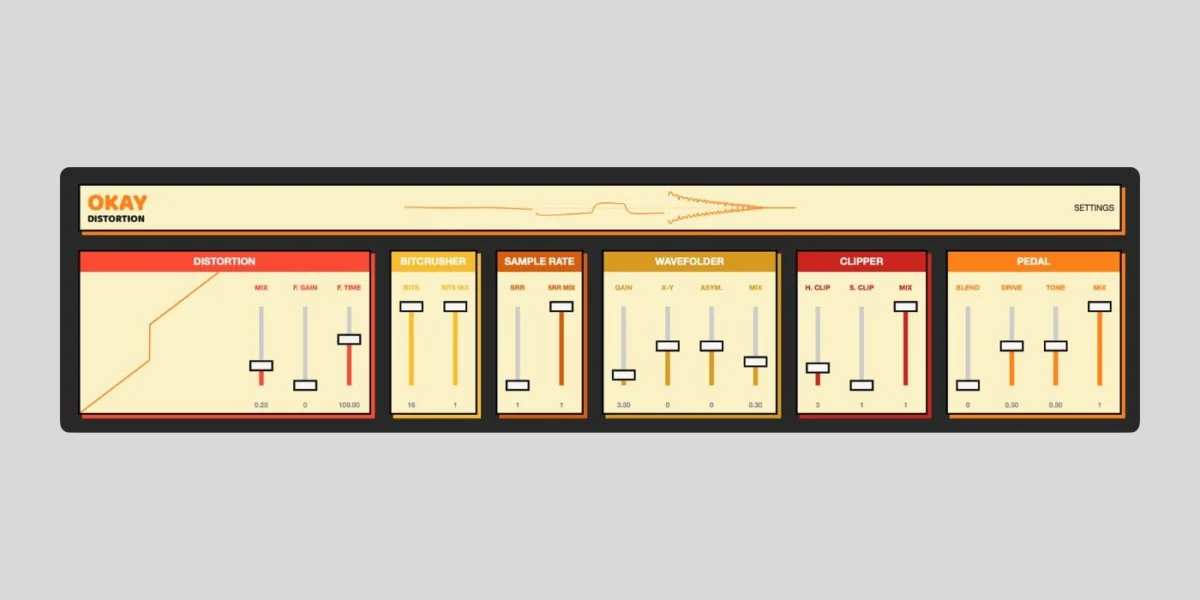
Okay Synthesizer, a developer recognized for its innovative audio tools, has officially released "Okay Distortion," a new, free distortion plugin. This standalone VST3 and AU compatible offering for macOS and Windows platforms features a sophisticated architecture comprising six distinct, layered distortion engines within a uniquely reorderable signal chain. The plugin’s release marks a significant expansion of its capabilities, having originated as a highly praised internal component of Okay Synthesizer’s "Bingo Drum Machine."
The decision to launch Okay Distortion as a dedicated, freely available product was reportedly influenced by the overwhelmingly positive reception of its integrated distortion module within the Bingo Drum Machine. Industry observers note that the module quickly garnered attention as one of the drum machine’s most compelling features, prompting the developer to extract and refine it into a standalone utility. This strategic move aligns with a growing trend in the audio software industry where developers, leveraging community feedback, transform popular features into accessible tools, thereby broadening their user base and brand recognition.
The Genesis of Okay Distortion: From Integrated Module to Standalone Powerhouse
The journey of Okay Distortion began not as an independent project but as a crucial sound-shaping element within Okay Synthesizer’s Bingo Drum Machine. In modern music production, distortion and saturation are indispensable tools, capable of imparting character, warmth, aggression, or even complete sonic transformation to audio signals. Within the context of a drum machine, a robust distortion engine is particularly valuable for sculpting percussive elements, adding punch to kicks, sizzle to snares, or grit to hi-hats, often defining the overall sonic aesthetic of a rhythm section.
The integrated distortion in Bingo Drum Machine was engineered to be versatile, offering a palette of textures that resonated strongly with users. Its ability to subtly enhance or drastically alter drum sounds quickly made it a focal point of discussions and user reviews surrounding the drum machine. This organic feedback loop, where a specific feature eclipses the overall product in terms of individual acclaim, often serves as a powerful indicator for developers regarding potential new product avenues. The subsequent decision by Okay Synthesizer to develop it into a standalone plugin reflects a responsive approach to user demand, transforming an internal asset into a widely available creative tool. This chronology underscores a responsive development philosophy, prioritizing user experience and community input.
Deconstructing the Distortion Engines: A Comprehensive Overview
Okay Distortion differentiates itself through its multi-engine design, offering a diverse array of distortion types that can be combined and reordered to produce a vast spectrum of effects. Each of the six engines possesses unique sonic characteristics and applications, providing sound designers and music producers with granular control over their audio.
-
Bitcrusher: This module operates by reducing the bit depth of the audio signal, leading to a noticeable degradation in fidelity and the introduction of aliasing artifacts. Bitcrushing is a quintessential lo-fi effect, often employed to impart a vintage digital texture reminiscent of early samplers or video game consoles. The severity of the effect is typically controlled by parameters dictating the bit depth reduction, yielding sounds ranging from subtle crunch to extreme digital harshness. In Okay Distortion, it provides a straightforward yet effective means of adding grit and digital coloration.
-
Sample Rate Reducer: Complementing the bitcrusher, the sample rate reducer lowers the number of samples per second used to represent the audio waveform. This process introduces aliasing noise and distorts the frequency spectrum, particularly at higher frequencies, resulting in a distinct lo-fi character. When combined with bitcrushing, sample rate reduction can create incredibly aggressive and unique digital artifacts, useful for industrial music, glitch effects, or retro-futuristic soundscapes. The interplay between these two digital degradation modules offers a wide range of textural possibilities.
-
Wavefolder: Unlike traditional clipping or saturation, which limit the amplitude of a signal, a wavefolder operates by "folding" signal peaks back into the waveform rather than simply truncating them. This non-linear process generates rich harmonic content that differs significantly from the odd or even harmonics produced by typical saturation or clipping. Wavefolding is a hallmark of certain modular synthesizers and is prized for its ability to create complex, metallic, and often iridescent timbres. The module in Okay Distortion is specifically noted to utilize the same code as its critically acclaimed implementation in the Bingo Drum Machine, suggesting a high level of fidelity and unique character. Its ability to generate harmonics without simply "squashing" the signal offers a more intricate approach to timbre manipulation.
-
Feedback Module: This engine introduces a dynamic element by routing the processed output of the entire signal chain back into its input. The principle of feedback involves taking a portion of a system’s output and feeding it back into its input, which can lead to various effects depending on the gain and delay applied. In Okay Distortion, a gain slider controls the amount of signal fed back, while a separate control adjusts the length of a delay line incorporated into the feedback loop. At low gain settings, this can add subtle weight and sustain, creating a sense of depth or subtle resonance. As the gain is increased, the module can quickly enter self-oscillation, leading to unpredictable and often chaotic sonic textures, which are highly valued in experimental sound design and noise music. The variable delay line length further expands the sonic palette, allowing for rhythmic or resonant feedback effects.
-
Soft/Hard Clipper: This module provides a versatile solution for managing and shaping audio dynamics. Clipping, in general, involves flattening waveform peaks that exceed a certain threshold. A soft clipper gently rounds off these peaks, introducing a form of saturation that can add warmth, density, and perceived loudness without harsh distortion. It is often used for subtle harmonic enhancement or as a mastering tool to add "glue" to a mix. A hard clipper, conversely, abruptly cuts off waveform peaks, leading to more aggressive distortion and a noticeable increase in perceived loudness and sustain. Both stages are integrated into a single module within Okay Distortion, allowing users to blend seamlessly between gentle saturation and aggressive limiting. This dual functionality makes it a fundamental tool for both subtle sonic enhancement and pronounced distortion.
-
Pedal Module: Emulating the characteristics of classic analog guitar pedals, this module offers a blend between two iconic stompboxes: the Boss DS-1 and the ProCo RAT. The Boss DS-1 is renowned for its distinctive hard-clipping distortion, characterized by a bright, edgy, and often harsh tone, widely used in rock and metal genres. The ProCo RAT, on the other hand, is celebrated for its versatile fuzz and distortion, capable of producing everything from gritty overdrive to thick, sustaining fuzz. The pedal module in Okay Distortion allows for a smooth crossfade between these two distinct analog circuit emulations, providing a broad spectrum of drive tones. A dedicated tone control functions like a filter, enabling further shaping of the blended sound. The inclusion of these emulations provides a bridge between the digital processing of other modules and the revered sounds of classic analog gear, offering familiar yet powerful distortion textures.
The Power of Reorderable Signal Chains and Parallel Blending
One of Okay Distortion’s most compelling features is the ability to freely reorder its six modules. This "killer feature," as it has been described, fundamentally alters the character of the output. The sequence in which distortion effects are applied profoundly impacts the resulting timbre. For instance, running a wavefolder before a clipper will yield a different harmonic structure and overall aggressiveness than running it after a clipper. The wavefolder’s complex harmonics, when subsequently clipped, will interact differently than if the clipped signal were then folded. This non-linear interaction between effects allows for an unparalleled degree of sonic experimentation and sound design flexibility.
Furthermore, each individual module is equipped with its own mix knob, facilitating parallel blending. This allows users to introduce a portion of the dry signal alongside the processed signal for each stage, offering finer control over the intensity and transparency of the effect. This, combined with a global dry/wet knob for the entire chain, ensures that Okay Distortion can be used for both subtle enhancement and extreme sonic transformation, maintaining clarity and punch when desired. The ability to blend effects in parallel, rather than solely in series, significantly expands the plugin’s utility, allowing for intricate layering and nuanced sound sculpting.
User Interface and Accessibility Considerations
Beyond its sonic capabilities, Okay Distortion emphasizes user experience through its interface design. The plugin features a "super lightweight" and clean graphical user interface (GUI), prioritizing clarity and ease of use. A notable personalization option is the built-in color picker, which allows users to customize the entire plugin interface to their preferred aesthetic. This seemingly minor detail contributes to a more engaging and personalized workflow, reducing visual fatigue and promoting creative interaction. The lightweight nature of the interface also implies optimized performance, minimizing CPU load, which is a crucial consideration for producers working on complex projects or less powerful systems.
Okay Distortion’s cross-platform compatibility further enhances its accessibility. Available in VST3 and AU formats, it supports both macOS (Universal Binary, ensuring compatibility with both Intel and Apple Silicon processors) and Windows operating systems. This broad compatibility ensures that a vast majority of digital audio workstation (DAW) users can integrate the plugin seamlessly into their production environments without compatibility concerns.
Implications for Music Production and the Free Plugin Landscape
The release of Okay Distortion as a free, high-quality plugin carries several significant implications for the music production community.
Firstly, it democratizes access to sophisticated sound design tools. For aspiring producers, students, or those on a budget, free plugins like Okay Distortion provide professional-grade capabilities without financial barriers. This fosters creativity and experimentation across a broader demographic, potentially lowering the entry barrier into advanced sound design techniques.
Secondly, it contributes to a vibrant ecosystem of free audio software. The quality and feature set of free plugins have steadily increased over the years, challenging the notion that superior tools must always come at a cost. Developers like Okay Synthesizer are instrumental in driving this trend, pushing the boundaries of what can be offered without charge. This benefits the entire community by raising the standard for all plugins, paid or free.
Thirdly, for Okay Synthesizer, this release serves as a strategic marketing move. By offering a compelling free product, they can introduce their development philosophy and audio engine quality to a wider audience. Users who appreciate Okay Distortion may be more inclined to explore their other offerings, such as the Bingo Drum Machine, thereby building brand loyalty and expanding their customer base through indirect means. This ‘freemium’ model, where a valuable tool is given away to build a community, has proven effective in the software industry.
Finally, the emphasis on a reorderable signal chain and a diverse array of distortion types encourages innovation in sound design. Producers are challenged to think creatively about signal flow and the interactions between different non-linear processes, moving beyond simple ‘turn a knob’ applications of distortion. This empowers users to craft truly unique and personalized sonic textures, pushing the boundaries of contemporary music production.
Conclusion
Okay Distortion represents a notable addition to the arsenal of free audio production tools. Its evolution from a popular internal component to a standalone, feature-rich plugin underscores a developer’s responsiveness to its user base. With its six distinct, reorderable distortion engines, comprehensive control over signal flow, and user-friendly interface, Okay Distortion is poised to become an indispensable asset for producers seeking to inject character, grit, and unique sonic textures into their music. Its availability across major platforms ensures broad accessibility, further cementing its potential impact on the diverse landscape of modern music production. The release is a testament to the ongoing innovation within the audio software industry, continually providing powerful tools to a global community of creators.
