

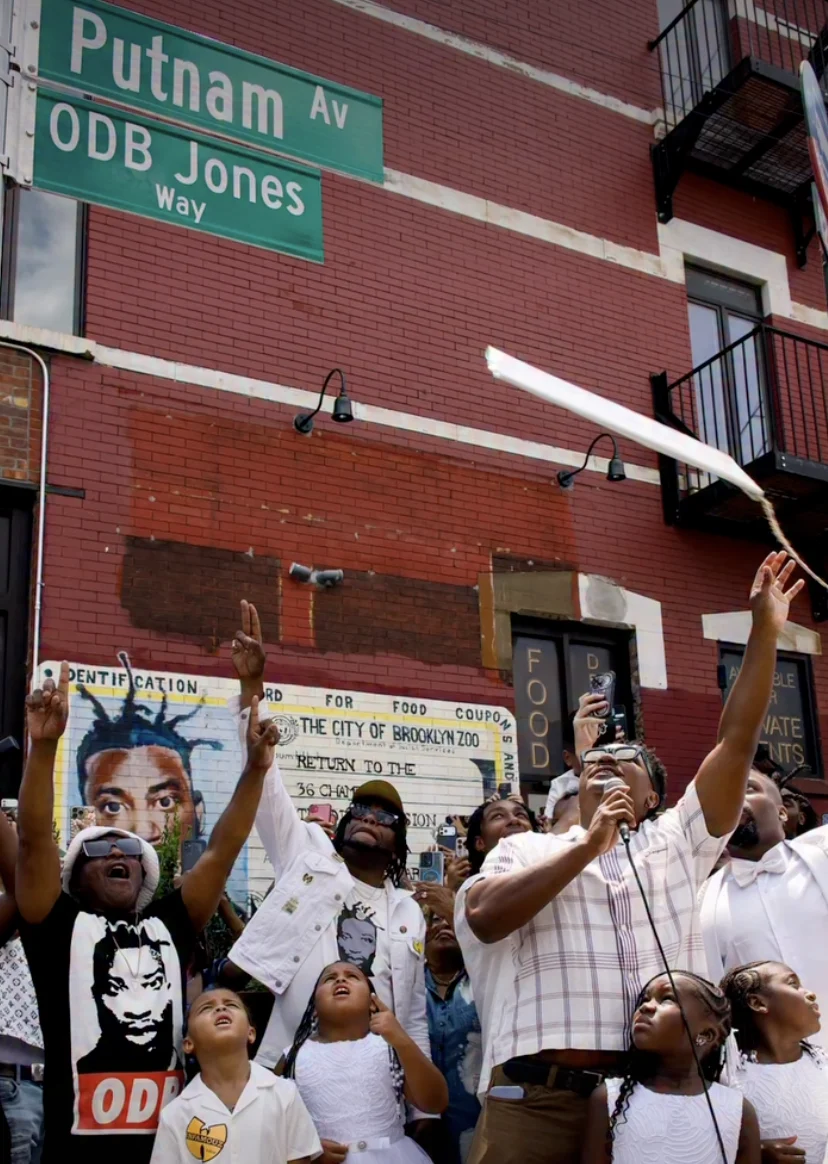
Brooklyn’s Bed-Stuy neighborhood has officially cemented the legacy of one of hip-hop’s most influential and idiosyncratic figures, Ol’ Dirty Bastard, with the renaming of a portion of Putnam Avenue. In an emotional and historically significant ceremony held yesterday, Putnam Avenue between Franklin and Classon Avenues was formally designated ODB Jones Way, a tribute to the Wu-Tang Clan co-founder, born Russell Tyrone Jones. The event brought together a confluence of family, friends, local community members, and government officials, celebrating the enduring impact of an artist whose unique style and unpredictable persona left an indelible mark on music and culture.
A Day of Remembrance and Celebration in Bed-Stuy
The unveiling of the new street sign at the corner of Franklin Avenue and Putnam Avenue marked a poignant moment for the Jones family and the broader hip-hop community. The chosen block holds deep personal significance; as confirmed by ODB’s brother, Ramsey Jones, in a video shared by NYC photographer Howard Weiss, it is the very block where their grandmother continues to reside. This familial connection underscored the grassroots, community-driven nature of the tribute, linking the global icon back to his most intimate roots. Adding to the historical resonance of the location, the block also prominently features a vibrant mural depicting the cover art of ODB’s seminal 1995 debut solo album, Return To The 36 Chambers: The Dirty Version, serving as a constant visual reminder of his artistic prowess.
The ceremony itself was described by attendees as a vibrant mix of reverence and celebration, reflecting ODB’s multifaceted personality. Speakers included members of the Jones family, who shared anecdotes and expressed profound gratitude for the city’s recognition. Local politicians, community organizers, and fellow artists also delivered remarks, emphasizing ODB’s impact not only on music but also on the cultural fabric of Brooklyn. The atmosphere was charged with collective memory, punctuated by applause, cheers, and moments of quiet reflection on the life and career of a true original. The presence of multiple generations, from ODB’s contemporaries to young fans, highlighted the timeless appeal and continuing relevance of his work.
Ol’ Dirty Bastard: A Life Forged in Brooklyn
Born Russell Tyrone Jones on November 15, 1968, in Brooklyn’s Fort Greene neighborhood, Ol’ Dirty Bastard’s journey from the streets of New York to global superstardom is a quintessential hip-hop narrative. His early life was steeped in the rich cultural tapestry of Brooklyn, a borough that would become synonymous with a generation of pioneering hip-hop artists. He honed his lyrical skills and distinctive vocal delivery alongside his cousins Robert Diggs (RZA) and Gary Grice (GZA), forming the nucleus of what would eventually become the legendary Wu-Tang Clan.
The Wu-Tang Clan, officially formed in the early 1990s in Staten Island (often referred to as ‘Shaolin’ in their mythology), revolutionized the hip-hop landscape. Their groundbreaking 1993 debut album, Enter the Wu-Tang (36 Chambers), introduced a raw, gritty, and intricate soundscape that defied prevailing commercial trends. ODB’s contributions were undeniably pivotal, characterized by his chaotic yet captivating flow, his guttural ad-libs, and his often-surreal lyrical content. Tracks like "Shimmy Shimmy Ya" and "Brooklyn Zoo" from his solo debut, Return To The 36 Chambers: The Dirty Version, released in 1995, cemented his status as a solo force. The album was both a critical darling and a commercial success, lauded for its uncompromising authenticity and ODB’s singular artistic vision. It debuted at number 7 on the Billboard 200 and sold over a million copies, achieving platinum status and solidifying his place in hip-hop’s pantheon.
Beyond his music, ODB was a captivating public figure. His unpredictable antics, candid interviews, and memorable appearances, including crashing the Grammy Awards stage in 1998, contributed to his larger-than-life persona. He embodied a spirit of defiant individuality that resonated deeply with fans and critics alike. However, his life was also marked by personal struggles, including legal issues and battles with substance abuse, which ultimately led to his untimely death on November 13, 2004, just two days shy of his 36th birthday. His passing, attributed to an accidental drug overdose, sent shockwaves through the music world, leaving a void that has never truly been filled. Despite the challenges, his artistic legacy has only grown in stature, with subsequent generations continuing to discover and appreciate his groundbreaking contributions.
The Campaign for ODB Jones Way: A Testament to Community Advocacy
The journey to rename a public thoroughfare in New York City is a meticulous and often lengthy process, requiring significant community support and political will. The campaign for ODB Jones Way was no exception, representing years of dedicated effort by family members, local activists, and hip-hop enthusiasts. Typically, such initiatives begin with a formal application to the local Community Board, demonstrating broad neighborhood consensus through petitions and public hearings. Following Community Board approval, the proposal advances to the City Council, where a local council member champions the legislation. The Council then votes on the resolution, which, if passed, requires the Mayor’s signature to become official.
For ODB Jones Way, the initiative gained significant momentum in recent years, driven by a growing recognition of hip-hop’s cultural importance and a desire to honor its foundational figures. Advocates highlighted ODB’s deep roots in Brooklyn, his undeniable artistic influence, and his role in shaping the identity of a generation. The fact that the chosen location is so intimately connected to his family history—his grandmother’s residence and the existing mural—strengthened the proposal, making it a truly authentic community tribute rather than merely a generic honorific. This alignment of personal history, artistic legacy, and community sentiment proved crucial in navigating the bureaucratic hurdles. The process, spanning several years, underscored the dedication of those who believed firmly in ODB’s rightful place in Brooklyn’s civic memory.
Brooklyn’s Enduring Connection to Hip-Hop History
The renaming of Putnam Avenue to ODB Jones Way is not an isolated incident but rather part of a broader trend recognizing Brooklyn’s unparalleled contributions to hip-hop culture. The borough has long been a crucible for musical innovation, producing an astonishing array of artists who have shaped the genre. From the lyrical prowess of The Notorious B.I.G. (Christopher Wallace) to the entrepreneurial genius of Jay-Z, the rhythmic innovations of Big Daddy Kane, and the conscious lyricism of Mos Def, Brooklyn’s influence is undeniable.
This civic recognition follows a precedent set by other significant street namings within the borough. Most notably, in 2019, St. James Place in Bed-Stuy was renamed Christopher Wallace Way, honoring The Notorious B.I.G., whose childhood home was on that very street. These acts serve as powerful affirmations of hip-hop’s evolution from a marginalized art form to a globally recognized cultural phenomenon, deserving of the same civic honors traditionally bestowed upon historical figures, artists, and leaders from other disciplines. Such namings not only celebrate individual artists but also acknowledge the collective creative spirit that defines these neighborhoods. They transform mundane street signs into vibrant landmarks that narrate the cultural history of the city, making the contributions of its residents tangible and permanent.
Official Responses and Broader Implications
The official ceremony yesterday elicited heartfelt responses from various stakeholders. Ramsey Jones, ODB’s brother, articulated the family’s immense pride and gratitude, stating that the renaming was a profound honor that validated his brother’s legacy and the sacrifices made. He emphasized the emotional significance of the street being the very block where their grandmother still lives, creating a lasting bond between ODB’s memory and his family’s enduring presence in the community.
Government officials present, including local council members and representatives from the Borough President’s office, echoed sentiments of community pride and cultural recognition. They underscored the importance of honoring local legends who have not only achieved global acclaim but have also remained deeply rooted in their neighborhoods. One official remarked, "This street naming is more than just changing a sign; it’s about acknowledging the rich cultural tapestry of Brooklyn and ensuring that the contributions of artists like Ol’ Dirty Bastard are permanently etched into our city’s landscape. It is a testament to the power of hip-hop as a voice for our communities." These statements reflect a growing understanding within civic institutions of hip-hop’s historical and cultural weight.
The establishment of ODB Jones Way carries significant broader implications. Firstly, it further legitimizes hip-hop as a significant American art form, deserving of public recognition and commemoration alongside other genres and cultural movements. This civic honor sends a clear message that the narratives and achievements of hip-hop artists are integral to the national story. Secondly, it strengthens the cultural identity of Bed-Stuy and Brooklyn, reinforcing their status as epicenters of creativity and innovation. Such landmarks can attract cultural tourism, stimulate local pride, and inspire future generations of artists and entrepreneurs within the community.
Moreover, the renaming contributes to the evolving landscape of public monuments and memorials, which are increasingly reflecting a more diverse and inclusive representation of cultural heroes. It challenges traditional notions of who deserves civic honor, expanding the definition to include those who have made profound impacts through contemporary cultural expressions. For the youth of Brooklyn, ODB Jones Way serves as a powerful symbol of possibility, demonstrating that artistry born from their streets can achieve global recognition and leave an everlasting mark. It transforms a simple street into a living memorial, a constant reminder of a creative spirit that continues to influence and inspire.
In essence, the transformation of Putnam Avenue into ODB Jones Way is more than a mere administrative change; it is a profound cultural statement. It recognizes the enduring power of Ol’ Dirty Bastard’s music and persona, honors his deep connection to Brooklyn, and celebrates hip-hop’s indelible place in the annals of American culture. It ensures that his legacy, once primarily experienced through sound waves, is now permanently woven into the very fabric of the city he called home, standing as a beacon for generations to come.
