

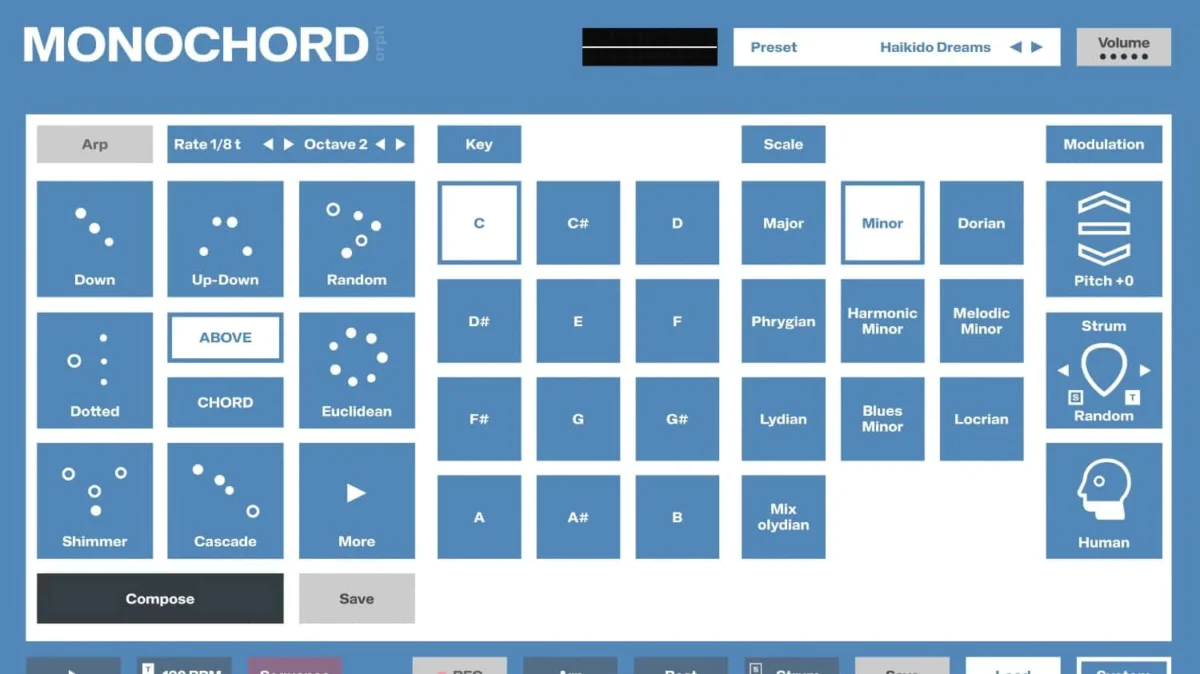
Orph Audio has officially announced the release of Monochord, a sophisticated chord instrument and harmony workstation designed to bridge the gap between complex music theory and intuitive sound design for users on both macOS and Windows platforms. As a hybrid software solution, Monochord functions as a chord trigger, a multi-engine synthesizer, a high-fidelity sampler, and a MIDI effect processor, all contained within a singular interface. This release marks a significant entry into the growing market of "intelligent" composition tools, aiming to assist musicians, film scorers, and electronic music producers in generating harmonically rich arrangements without requiring an exhaustive background in traditional musicology.
The architecture of Monochord is built around a unique 24-key interface, which deviates from standard piano roll layouts to focus specifically on chordal triggers and tonal relationships. Each key within this interface is capable of triggering a complete, professionally voiced chord, allowing for rapid experimentation with progressions that might otherwise require complex fingerings or manual MIDI programming. With a library of more than 600 distinct chords and 70 curated tonal sets, the software provides a vast harmonic palette that spans from basic triads to sophisticated jazz extensions and avant-garde dissonances.
Technical Architecture and Synthesis Engines
At the heart of Monochord’s sonic capabilities is a robust internal sound engine that leverages six distinct synthesis methodologies. By integrating multiple forms of sound generation, Orph Audio ensures that the workstation is not limited to a specific genre or era of music production. The inclusion of Frequency Modulation (FM), Virtual Analog, Wavetable, Additive, Granular, and Pulse Code Modulation (PCM) synthesis allows users to layer disparate textures to create complex, evolving timbres.
The FM engine provides the metallic, percussive, and bell-like tones popularized in the 1980s, while the Virtual Analog component offers the warmth and harmonic saturation associated with vintage hardware. The Wavetable and Additive engines cater to modern sound design requirements, offering precise control over harmonic overtones and digital movement. For more experimental applications, the Granular engine enables users to deconstruct samples into microscopic "grains," creating ethereal pads and atmospheric textures. Finally, the PCM engine serves as the foundation for the software’s extensive sample library.
This library is comprised of 425 sampled instruments, meticulously recorded from a variety of sources. These sources include rare vintage synthesizers, classic hardware samplers known for their specific "lo-fi" character, and a range of acoustic instruments. The diversity of the sample pool ensures that Monochord can transition seamlessly between organic, orchestral-style harmonies and grit-heavy electronic textures.
Advanced MIDI Functionality and DAW Integration
Beyond its internal sound generation, Monochord is designed to function as a central hub for a producer’s entire studio ecosystem. One of its most powerful features is the ability to output MIDI data to other software instruments or external hardware synthesizers. This allows producers to utilize Monochord’s harmonic intelligence—including its advanced arpeggiation and strumming algorithms—to drive their favorite third-party plugins within a Digital Audio Workstation (DAW).
The MIDI output functionality includes sophisticated humanization controls. In modern digital production, "grid-perfect" timing can often result in a sterile or robotic sound. Monochord addresses this by offering adjustable timing offsets and velocity variations that simulate the subtle imperfections of a human performance. The strumming engine, in particular, replicates the way a guitarist or harpist might roll through the notes of a chord, providing a level of realism that is difficult to achieve through manual mouse-clicking in a piano roll.
Monochord is available in multiple formats to ensure maximum compatibility across the industry. It supports VST3 and Audio Unit (AU) standards, making it compatible with major DAWs such as Ableton Live, Logic Pro, FL Studio, Cubase, and Studio One. Additionally, a standalone version is provided for musicians who wish to use the software for live performance or practice without the overhead of a full recording suite.
The Evolution of Harmonic Assistance Tools
The launch of Monochord occurs at a pivotal moment in the evolution of music technology. For decades, the barrier to entry for complex harmonic composition was a deep understanding of music theory or the physical dexterity required to play keyboard instruments. The industry has seen a gradual shift toward "assistive" technologies, beginning with simple chord memory functions on 1980s synthesizers and evolving into modern plugins like Scaler 2, Captain Chords, and Orb Producer.
Monochord distinguishes itself by combining these harmonic suggestions with a high-end internal sound engine. While many competitors focus solely on MIDI generation or simple sample playback, Monochord’s multi-engine synthesis approach positions it as a self-contained instrument rather than just a utility. This "all-in-one" philosophy reflects a broader trend in the software industry where producers favor streamlined workflows that minimize the need to jump between multiple windows and plugins.
Industry analysts note that tools like Monochord are increasingly essential in the fast-paced world of commercial music production. With shorter deadlines for television cues, advertisements, and social media content, the ability to generate high-quality harmonic foundations quickly is a significant competitive advantage.
Pricing, Availability, and Market Positioning
Orph Audio has positioned Monochord as a premium professional tool, reflected in its retail price of €139 (approximately US$139). Recognizing the shifting economic landscape of the software industry, the company has also introduced a rent-to-own option. This model, which has gained immense popularity through platforms like Splice, allows users to pay for the software in manageable monthly installments, eventually leading to full ownership. This move is seen as an effort to make professional-grade tools more accessible to independent creators and students who may not have the capital for a large upfront investment.
To further lower the barrier to entry, Orph Audio offers a 14-day fully functional demo. This allows potential users to integrate the workstation into their existing projects and evaluate its synthesis engines and MIDI capabilities before committing to a purchase.
Broader Implications for the Music Industry
The introduction of Monochord raises important questions about the democratization of music creation. On one hand, purists occasionally argue that assistive tools may lead to a homogenization of musical styles or a decline in traditional instrumental skills. However, the prevailing view among modern educators and industry professionals is that these tools serve as "force multipliers" for creativity. By handling the mathematical complexities of chord voicings and voice leading, Monochord allows the artist to focus on the emotional and structural aspects of their composition.
Furthermore, Monochord serves as an educational bridge. For a novice producer, seeing how a "C Major 9" chord is voiced across 24 keys can provide a practical, hands-on lesson in harmony that is more engaging than a textbook. For the seasoned professional, the workstation serves as a source of inspiration, offering "tonal sets" that might suggest harmonic directions they hadn’t previously considered.
As artificial intelligence continues to permeate the creative arts, Monochord represents a "human-in-the-loop" approach to technology. It does not compose the music for the user; rather, it provides a sophisticated set of building blocks and a refined interface that amplifies the user’s intent. The emphasis on "texture engines" and "humanization" suggests that Orph Audio is prioritizing the "feel" of the music—a quality that remains difficult for fully automated systems to replicate.
Conclusion and Future Outlook
With its comprehensive feature set, Monochord is poised to become a staple in the toolkits of contemporary producers. Its ability to act as both a sound source and a MIDI controller gives it a dual utility that justifies its place in a crowded market. As Orph Audio continues to develop the platform, the industry expects potential updates to include user-sample import capabilities, expanded tonal sets, and perhaps deeper integration with hardware controllers.
The release of Monochord is more than just a product launch; it is a reflection of the modern production landscape where the lines between instrument, teacher, and assistant are increasingly blurred. For the modern creator, the ability to turn a single keystroke into a lush, multi-layered harmonic landscape is no longer a luxury—it is a fundamental part of the creative process in the digital age. Orph Audio’s Monochord stands as a testament to this shift, offering a powerful, flexible, and musically intelligent solution for the next generation of sound designers and composers.
