

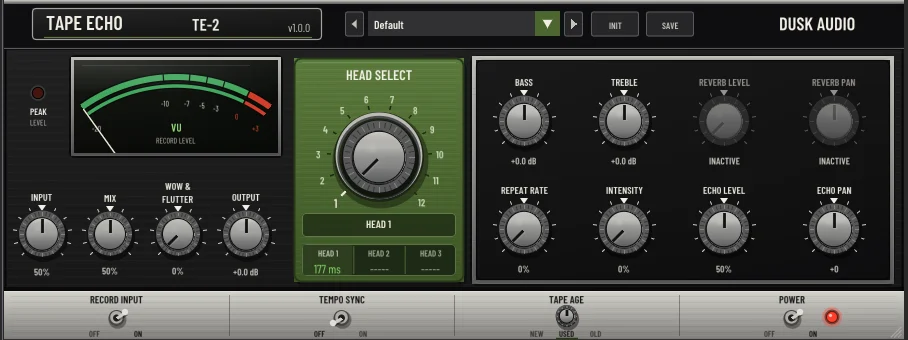
Dusk Audio has officially announced the launch of Tape Echo 2, a sophisticated digital signal processing (DSP) utility designed to recreate the intricate sonic characteristics of vintage tape-based delay units. As an unofficial, open-source tribute to the legendary Roland RE-201 Space Echo, Tape Echo 2 arrives as a comprehensive tool for musicians, producers, and sound designers seeking the warmth and unpredictability of analog hardware within a modern digital audio workstation (DAW) environment. The plugin is offered entirely free of charge, reflecting the developer’s commitment to accessible, high-quality audio software.
The release of Tape Echo 2 marks a significant update over its predecessor, introducing a refined modeling engine that simulates the entire signal path of a classic tape echo unit. This includes the record head, the playback heads, the output amplifier, and the mechanical nuances of the tape transport system. By focusing on the physical properties of tape—such as saturation, hiss, and mechanical irregularities—Dusk Audio provides a tool that transcends simple digital delay, offering a living, breathing emulation of mid-20th-century technology.
Technical Architecture and Mechanical Modeling
At the core of Tape Echo 2 is a three-head tape delay system coupled with a modeled spring reverb. Unlike standard digital delays that use mathematical offsets to create echoes, Tape Echo 2 simulates a virtual "motor" that drives a continuous loop of magnetic tape. The three playback heads are positioned at fixed mechanical ratios, meaning their timing is physically linked to the speed of the motor. When a user adjusts the "Repeat Rate," they are effectively changing the motor speed.
One of the most notable features of this emulation is the inclusion of motor inertia. In vintage hardware, changing the speed of the motor is not instantaneous; the physical mass of the flywheel and the tension of the tape cause a slight lag, resulting in a characteristic pitch glide or "shimmer" as the device settles into its new tempo. Tape Echo 2 replicates this behavior accurately, allowing for the creative "pitch-shifting" effects popularized by dub and psychedelic rock artists.
The plugin further enhances realism by modeling the degradative qualities of magnetic tape. Users can manipulate parameters such as "wow" (slow pitch fluctuations caused by motor inconsistencies) and "flutter" (rapid pitch variations caused by friction or capstan irregularities). Additionally, the software simulates tape hiss, level variations, and tape splice dropouts—the momentary loss of signal that occurs when the physical join in a tape loop passes over a playback head. These imperfections, often removed in modern digital recording, are precisely what give tape echo its sought-after "lo-fi" character.
The Integration of Spring Reverb and 12-Mode Configuration
Beyond the delay capabilities, Tape Echo 2 includes a dedicated spring reverb module. Modeled after the physical tanks found in vintage hardware, this reverb utilizes three unequal modeled springs to create a metallic, "boingy" resonance that is distinct from plate or hall reverbs. This combination of tape delay and spring reverb was the hallmark of the original Space Echo, providing a sense of depth and space that became a staple of 1970s production.
To facilitate ease of use, Dusk Audio has implemented a 12-mode selector. This dial allows users to cycle through various combinations of the three playback heads and the spring reverb. The modes are structured as follows:
- Modes 1–4: Various combinations of the three playback heads without reverb.
- Modes 5–11: Combinations of playback heads layered with the spring reverb circuit.
- Mode 12: Reverb only, allowing the plugin to function as a standalone spring reverb processor.
This structured approach mirrors the interface of the original hardware, providing a tactile and intuitive workflow for those familiar with vintage outboard gear.
Historical Context: The Legacy of the Roland RE-201
To understand the significance of Tape Echo 2, one must look at the history of the device it emulates. The Roland RE-201 Space Echo, introduced in 1974, revolutionized the way echoes were produced. Before its release, tape delays were often fragile, bulky, and prone to breaking during live performances. Roland’s innovation was the "free-floating" tape system, where the tape loop rested in a loose bin rather than being wound on reels, significantly reducing wear and tear.
The Space Echo became an essential component of the "Dub" genre in Jamaica, utilized heavily by producers like King Tubby and Lee "Scratch" Perry to create cavernous, self-oscillating soundscapes. It later found its way into the rigs of mainstream artists such as Pink Floyd, Radiohead, and Portishead. By releasing Tape Echo 2 as an open-source project, Dusk Audio is preserving this sonic legacy, ensuring that the unique "saturated" sound of the 1970s remains available to a new generation of bedroom producers who may not have the thousands of dollars required to purchase a vintage hardware unit.

The Open Source Philosophy in Audio Development
Dusk Audio’s decision to release Tape Echo 2 as a free and open-source plugin is a notable move in an industry often dominated by proprietary, high-cost software. Open-source audio software allows the community to inspect the code, suggest improvements, and even fork the project to create specialized versions. This transparency often leads to greater stability and longevity, as the software is not tied to the commercial success of a single entity.
Version 1.0.0 of Tape Echo 2 supports a wide array of platforms, including Linux, Windows, and macOS. It is available in several plugin formats, ensuring compatibility with almost every major DAW, including Ableton Live, FL Studio, Logic Pro, and REAPER. The inclusion of Linux support is particularly significant, as the professional audio landscape on Linux continues to grow, fueled by a demand for high-quality, open-source processing tools.
Market Analysis and Implications for the Industry
The release of Tape Echo 2 enters a crowded market of tape emulations. Paid versions from companies like Universal Audio (UAD Galaxy Tape Echo), Arturia (Delay Tape-201), and Soundtoys (EchoBoy) have long been the industry standards. However, the rise of high-quality free alternatives is shifting the landscape.
For many independent creators, the barrier to entry for "pro-level" sound is lowering. Tape Echo 2 provides a level of detail—specifically in its modeling of the record-to-output chain—that was previously reserved for premium plugins. The inclusion of self-oscillation, where the feedback loop builds upon itself to create a wall of sound, is a feature that requires precise mathematical modeling to prevent digital clipping while maintaining the "warm" distortion of analog tape. Dusk Audio’s success in implementing this feature for free challenges the pricing models of established software houses.
Furthermore, the "lo-fi" movement in modern music—spanning from Lo-fi Hip Hop to Synthwave—has created a massive demand for tools that can "degrade" digital audio in a pleasing way. Tape Echo 2 fits perfectly into this niche, offering "tape aging" controls that allow users to simulate a brand-new tape or a heavily worn, "dirty" loop that has seen years of use.
Technical Specifications and Availability
Tape Echo 2 is available for immediate download via the Dusk Audio website. The developer has confirmed that the plugin is designed to be lightweight on CPU resources despite its complex modeling, making it suitable for use across multiple tracks in a large session.
Key Features Summary:
- Three-Head Simulation: Accurate reproduction of the RE-201 head spacing.
- Mechanical Realism: Motor inertia and speed-glide physics.
- Analog Artifacts: Modeled wow, flutter, hiss, and splice dropouts.
- Saturation Engine: Non-linear modeling of the recording and output amplifiers.
- Spring Reverb: A three-spring tank simulation with 12 operational modes.
- Self-Oscillation: Capable of generating classic "feedback swells" without digital harshness.
- Cross-Platform: Native support for Windows, macOS, and Linux.
Conclusion and Future Outlook
The launch of Tape Echo 2 by Dusk Audio represents a merging of vintage aesthetics and modern software ethics. By providing a high-fidelity emulation of the Roland Space Echo for free, Dusk Audio is not only providing a valuable tool for musicians but also contributing to the growing ecosystem of open-source audio production.
As digital signal processing continues to evolve, the line between hardware and software becomes increasingly blurred. Tape Echo 2 serves as a testament to how far software modeling has come, capturing the "ghost in the machine"—the unpredictable, mechanical soul of analog gear—and placing it inside the computer. For producers looking to add character, space, and a touch of history to their tracks, Tape Echo 2 stands as a compelling and accessible solution in the current plugin marketplace.
With version 1.0.0 now stable, the community looks forward to potential updates, including MIDI learn capabilities, expanded tape types, or even further emulations of other classic echo units from the Dusk Audio laboratory. For now, Tape Echo 2 remains a definitive example of the power of community-driven audio development.
