

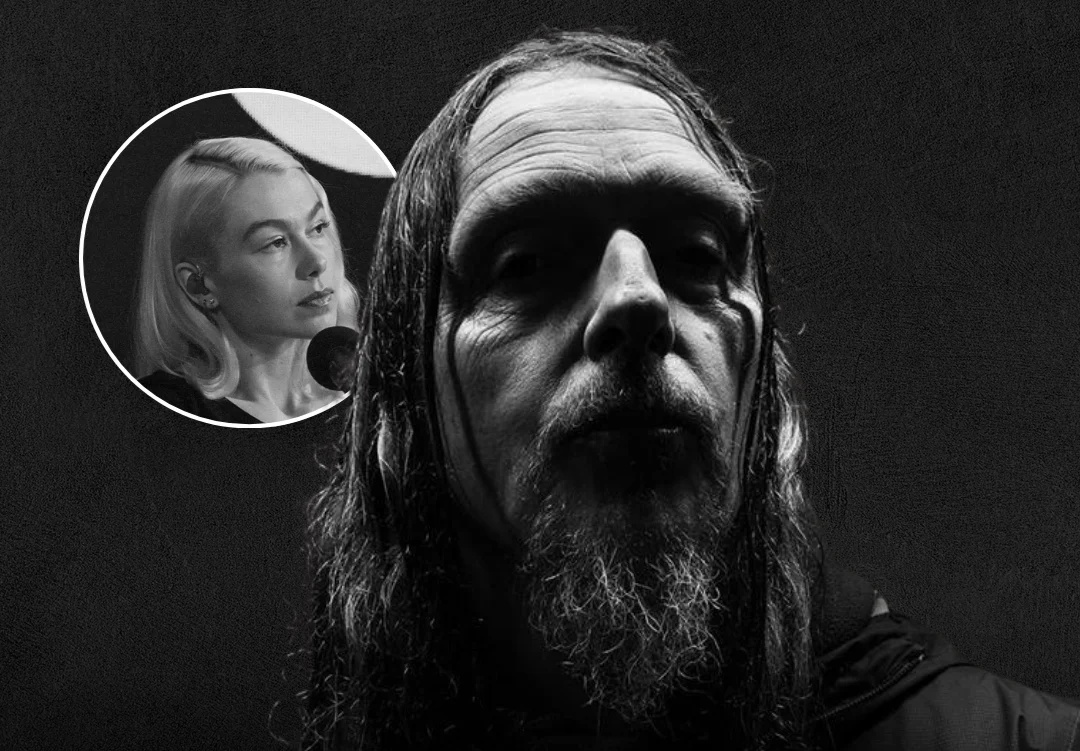
Last month marked a significant moment in the evolving career of indie music luminary Phoebe Bridgers, with the release of her highly anticipated album, Lost Weekend. Heralded as the breathtaking followup to her critically acclaimed 2020 masterpiece Punisher, Lost Weekend immediately garnered attention not only for its poignant lyricism and intricate soundscapes but also for its roster of intriguing collaborators. Among the most notable contributions was that of Justin Broadrick, the formidable figurehead behind industrial metal pioneers Godflesh and the post-metal/shoegaze outfit Jesu. This unexpected pairing between a celebrated indie-folk artist and a titan of experimental heavy music immediately piqued the interest of critics and fans across diverse musical spectra.
Broadrick recently shed light on this surprising collaboration in an interview with The Guardian, where he not only detailed his involvement in Lost Weekend but also revealed an ongoing artistic relationship with Bridgers, including an upcoming project for a film soundtrack. Concurrently, Bridgers herself is venturing into new artistic territory, making her acting debut in Lance Oppenheim’s forthcoming picture, Primetime. Inspired by the controversial television series To Catch A Predator, the film features Bridgers in a complex role as a decoy, further underscoring her multifaceted artistic expansion.
The Unlikely Alliance: Bridgers and Broadrick’s Collaborative Journey
The connection between Phoebe Bridgers and Justin Broadrick, while seemingly disparate, has a nascent history. The initial threads of their collaboration can be traced back to 2021 when Broadrick remixed "Favor," a track by Julien Baker, Bridgers’ bandmate in the acclaimed supergroup boygenius. Bridgers herself contributed backing vocals to the original song, creating an indirect early link between their artistic worlds. This remix showcased Broadrick’s ability to reimagine a track from outside his usual heavy music purview, hinting at his versatility.
The full-fledged collaboration for Lost Weekend began with a direct outreach from Bridgers. Broadrick recounted receiving an email from Bridgers requesting "Jesu-style stuff" for her new album. His initial reaction, he confessed, was one of disbelief: "I thought I was being scammed." This sentiment highlights the perceived chasm between their respective musical domains, with Broadrick having carved out a legendary career in the often-uncompromising worlds of industrial metal, grindcore (as a founding member of Napalm Death), and experimental post-metal. Godflesh, formed in 1987, is widely recognized for pioneering industrial metal, blending extreme metal with drum machines, synthesizers, and bleak, atmospheric soundscapes. Jesu, his subsequent project, explores a more melodic, shoegaze-inflected form of post-metal. Bridgers, by contrast, rose to prominence with her introspective, melancholic indie-folk, characterized by delicate melodies and profoundly honest lyricism.
Despite his initial skepticism, Broadrick embraced the opportunity, ultimately contributing guitar work to two tracks on Lost Weekend: "Bobby," an exalted love song that has been singled out for its emotional depth, and "Best Dressed," a hidden track exclusively available on physical editions of the album. This strategic placement suggests a deliberate intent to reward dedicated listeners and emphasize the unique nature of their collaboration.
Overwhelmed by the Mainstream: Broadrick’s Perspective
The experience proved to be a significant one for Broadrick, who openly expressed his awe at the scale of Bridgers’ success and the infrastructure surrounding her. When questioned about potential intimidation, he remarked, "The fact that she was so personable and we were immediate friends was brilliant for me, but I was overwhelmed by how big she is. I was literally sending music to Taylor Swift’s personal engineer! I’m catapulted into this huge, mainstream world, and I’m like, ‘How the fuck am I here?!’"
This statement offers a fascinating glimpse into the disparity between the independent, often niche, world Broadrick inhabits and the global phenomenon that Bridgers has become. Phoebe Bridgers has, in a relatively short period, ascended to the forefront of contemporary indie music, earning multiple Grammy nominations, achieving significant commercial success, and cultivating a devoted international fanbase. Her albums, particularly Punisher, have been lauded for their emotional resonance and intricate production, cementing her status as a critical and commercial darling. The mention of "Taylor Swift’s personal engineer" serves as a powerful metaphor for the vast operational scale of mainstream music production, a world far removed from the DIY ethos often associated with heavy and experimental genres.
A Continuing Partnership: Film Scores and Future Collaborations
The collaboration on Lost Weekend appears to be merely the beginning of their shared artistic journey. Broadrick divulged details of an upcoming project, stating, "She wanted me to play guitar and bass on a song for a film." He further added, reflecting Bridgers’ enthusiasm and proactive approach, "She said to me a few months ago, ‘I’m just going to keep hitting you up.’" This suggests a burgeoning and fruitful partnership, with Bridgers actively seeking Broadrick’s distinctive sonic contributions for a variety of projects. Such an ongoing collaboration underscores Bridgers’ commitment to pushing sonic boundaries and integrating diverse musical textures into her work, while also offering Broadrick an expanded platform for his unique instrumental voice. The prospect of Broadrick’s distinctive guitar and bass work gracing a film soundtrack promises to add an unexpected layer of atmosphere and intensity, potentially bridging the gap between his established sound and new cinematic contexts.
Bridgers Steps into the Cinematic Spotlight: Primetime
Beyond her musical endeavors, Phoebe Bridgers is also making significant strides into the world of film. The Hollywood Reporter recently published a feature detailing Primetime, an upcoming picture directed by Lance Oppenheim, which is set to feature Bridgers in her acting debut. The film draws inspiration from the controversial and widely discussed series To Catch A Predator, a program known for its investigations into online sexual predators. This choice of project indicates Bridgers’ willingness to engage with challenging and unconventional narratives, rather than opting for a more traditional or commercially safe acting debut.
Primetime is described as a project that delves into the complex and often murky world of online sting operations. THR reports that Bridgers plays a decoy, a character tasked with portraying both boys and girls to lure potential predators. This role demands a nuanced performance, requiring an actor capable of embodying vulnerability, deception, and a certain ambiguity.
Lance Oppenheim, the director, has a history with Bridgers, having known her prior to her breakthrough into mainstream fame. His insights into her abilities shed light on why he envisioned her for such a unique part. Oppenheim told THR: "I’ve always known her to have an incredibly deep, almost baritone speaking voice, and I was then amazed that someone who had such a deep speaking voice could produce this beautiful, angelic singing voice. With how she’s able to use her voice in different environments, I kept thinking, ‘That’s exactly what a decoy would do.’"
This observation by Oppenheim is critical. It highlights Bridgers’ natural vocal versatility—the stark contrast between her speaking and singing voices—and how this inherent ability translates directly to the demands of the decoy role. The character’s need to shift personas, to present different vocal registers and emotional tones, aligns perfectly with what Oppenheim perceives as Bridgers’ natural talent. Bridgers herself expressed initial hesitation about taking on the role, confessing, "I don’t really act, I’ve never done it, I don’t know how." Her candor underscores the bravery involved in stepping outside her established comfort zone and embracing a new artistic challenge. The film’s trailer, which features a brief cameo from Bridgers, offers a tantalizing glimpse into her on-screen presence.
Broader Implications and Artistic Evolution
These recent developments—the surprising collaboration with Justin Broadrick and her acting debut in Primetime—signal a significant period of artistic expansion and diversification for Phoebe Bridgers.
Musical Implications: The integration of Broadrick’s "Jesu-style stuff" into Lost Weekend exemplifies Bridgers’ commitment to genre-bending and pushing the boundaries of her indie-folk sound. Her previous album, Punisher, while deeply rooted in indie rock, also featured subtle experimental touches. Lost Weekend appears to escalate this exploration, demonstrating a willingness to incorporate heavier, more atmospheric, and industrial elements. This move not only enriches her own musical palette but also challenges conventional genre distinctions, potentially inspiring other artists to explore unexpected cross-pollinations. For Justin Broadrick, this collaboration offers unprecedented exposure to a broader, more mainstream audience, affirming his status as a versatile and influential musician beyond the confines of heavy music. It showcases his ability to adapt his signature guitar work to different contexts while retaining his distinctive sonic identity. The ongoing nature of their collaboration, particularly for film music, suggests a lasting impact, potentially leading to a new chapter in Broadrick’s extensive career.
Cinematic Implications: Bridgers’ foray into acting, particularly in a project as distinct as Primetime, marks a deliberate and impactful step. Rather than choosing a conventional or lighthearted role, she has embraced a complex character in a film that promises to be thought-provoking and potentially unsettling. This aligns with her reputation for artistic integrity and her willingness to explore darker, more challenging themes in her music. Primetime is produced by A24, a studio renowned for its distinctive, critically acclaimed, and often unconventional films, such as Everything Everywhere All at Once, Hereditary, and Lady Bird. A24’s involvement lends significant artistic credibility to the project and to Bridgers’ acting debut, suggesting a thoughtful selection process for both the film and its cast. This move could open doors for Bridgers in the film industry, allowing her to explore another facet of her creative expression and potentially leading to more acting roles or even contributions to film scores in a broader capacity. Her natural charisma and expressive presence, evident in her music videos and live performances, suggest a promising transition to the screen.
In conclusion, Phoebe Bridgers is cementing her status as a dynamic and boundary-pushing artist. Her recent work on Lost Weekend with Justin Broadrick and her upcoming acting role in Primetime collectively illustrate a profound commitment to artistic growth and a fearless approach to exploring new creative avenues. These endeavors not only enrich her own artistic output but also contribute to a broader cultural conversation about genre fluidity, unexpected collaborations, and the expanding roles of contemporary artists across different media. As Bridgers continues to navigate these diverse landscapes, her journey promises to remain one of the most compelling narratives in modern entertainment.
