

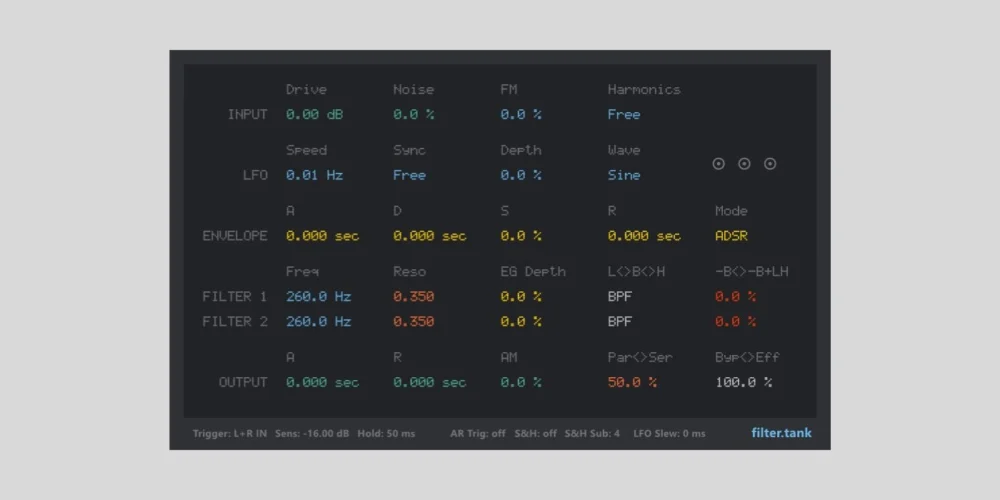
Developer Sender Spike has announced the release of filter.tank, a new free, modulated dual-filter plugin available as a 64-bit VST for Windows operating systems. The plugin draws significant inspiration from the Sherman Filterbank 2, a revered Belgian analog filter unit produced by Sherman Audio, known for its distinctive and often extreme sonic characteristics. This release marks a notable entry into the freeware plugin market, offering advanced filtering capabilities rooted in a legendary hardware design.
The Legacy of the Sherman Filterbank 2
To understand the significance of filter.tank, it is essential to appreciate the legacy of its muse: the Sherman Filterbank 2. Manufactured by Sherman Audio in Belgium, the Filterbank has achieved cult status among sound designers, electronic musicians, and producers for its unparalleled ability to sculpt, mangle, and animate audio. Launched in the late 1990s, the original Filterbank quickly gained notoriety for its aggressive resonance, nonlinear saturation, and a highly interactive control set that invited experimentation. It wasn’t merely a filter; it was an instrument capable of generating unique textures, self-oscillating drones, and rhythmic pulsations.
Key to the Filterbank’s mystique is its purely analog signal path, which imbues it with a warmth, grit, and unpredictable character that many purists argue cannot be replicated digitally. Its twin filters can be routed in parallel or series, each capable of morphing between low-pass, band-pass, and high-pass modes. The unit’s extreme resonance settings can push sounds into chaotic self-oscillation, creating screaming leads, throbbing basslines, or intricate rhythmic patterns. Coupled with envelope followers, LFOs, and a ring modulator, the Sherman Filterbank 2 became a staple in genres ranging from industrial and techno to experimental electronic music, often serving as a definitive tool for sonic destruction and creative sound design. The assertion that its sound is irreplicable in digital form underscores the challenge and ambition inherent in Sender Spike’s filter.tank project.
Sender Spike’s Digital Interpretation
Sender Spike acknowledges the formidable reputation of the Sherman Filterbank 2 and the widespread belief regarding its digital irreplicability. However, the developer contends that filter.tank achieves a remarkably close approximation of the original’s sonic essence, noting that the development process fostered an even deeper appreciation for the original hardware design. While not presented as a direct, bit-for-bit emulation, filter.tank is positioned as operating within the same "ballpark," offering the core character while introducing several enhanced features not present in the analog unit. This approach reflects a common strategy in modern plugin development: to capture the spirit and functionality of classic hardware while leveraging the flexibility and expanded possibilities of the digital domain.
The ongoing debate between analog fidelity and digital versatility remains a cornerstone of audio production discourse. Analog purists often highlight the subtle, non-linear behaviors, harmonic richness, and "mojo" that components like tubes, transistors, and capacitors impart on a signal. Digital proponents, conversely, emphasize perfect recall, parameter automation, limitless instances, and the ability to implement features impractical or impossible in hardware. Sender Spike’s filter.tank contributes significantly to this discussion by demonstrating how sophisticated digital modeling and creative design can bridge the perceived gap, offering a compelling alternative that respects its analog forebear while forging its own identity.
Core Architecture and Advanced Features
filter.tank is built around a robust dual-filter structure, mirroring the foundational design of the Sherman Filterbank. Each of these two filters boasts independent frequency and resonance controls, providing extensive sonic shaping capabilities. This independent control allows users to create complex filter sweeps, multi-band effects, or layered textures that would be challenging with a single filter unit.
A standout feature is the continuous morphing capability between parallel and serial routing for the two filters. In parallel mode, input audio is split and processed by both filters simultaneously before being recombined. This setup is ideal for broad, stereo-widening effects, or for applying different filtering characteristics to distinct frequency ranges without one affecting the other directly. Conversely, serial mode processes the audio through the first filter, then feeds its output into the second filter. This cascading arrangement can lead to far more aggressive and transformative sonic alterations, enabling intricate interactions between the filters’ settings and pushing the sound into extreme territories of resonance and saturation. The ability to continuously morph between these two states offers a spectrum of possibilities, allowing for nuanced transitions and dynamic sound evolution.
Further enhancing its versatility, each filter in filter.tank can continuously morph through lowpass, bandpass, and highpass modes. This smooth transition, rather than discrete switching, provides a fine-grained control over the filter’s characteristic, enabling subtle shaping or dramatic shifts in spectral content.
The resonance control within filter.tank is a particularly engaging aspect, described by the developer as becoming "very wild at higher settings." This behavior is central to the Sherman Filterbank’s appeal and is meticulously recreated here. High resonance can lead to self-oscillation, where the filter generates its own tones, often harmonically related to the cutoff frequency. Applying this to percussion loops, as suggested by the developer, can create "dancing filter effects" – rhythmic, dynamic shifts in timbre that can transform a static beat into a vibrant, evolving soundscape. This aggressive resonance is a hallmark of the analog inspiration and is faithfully represented, albeit with a crucial caution regarding extreme frequencies, which will be elaborated upon.
Beyond the core filtering, filter.tank integrates several sophisticated modules:
- Input Drive: Offering up to +30 dB of gain, the input drive section allows users to push the signal into the filters, inducing saturation and harmonic distortion that further contributes to the plugin’s character. This mimics the behavior of analog circuits when driven hard, adding warmth, grit, and compression.
- Harmonics Control: This unique feature links Filter 2’s frequency to Filter 1 in musically relevant intervals. This intelligent linking facilitates the creation of complex, harmonically rich textures and resonant peaks that maintain musical coherence, simplifying the process of designing intricate filter patterns.
- Noise Section: The inclusion of white noise, clock noise, and feedback noise provides additional sound design possibilities. Noise can be blended with the input signal to add texture, grit, or serve as a source for the filters themselves, particularly when exploring self-generating soundscapes or aggressive textural effects. Feedback noise, in particular, can lead to highly experimental and volatile sonic results.
Modulation Capabilities
Modulation is key to transforming static filter settings into dynamic, evolving soundscapes, and filter.tank offers a comprehensive suite of modulation sources:
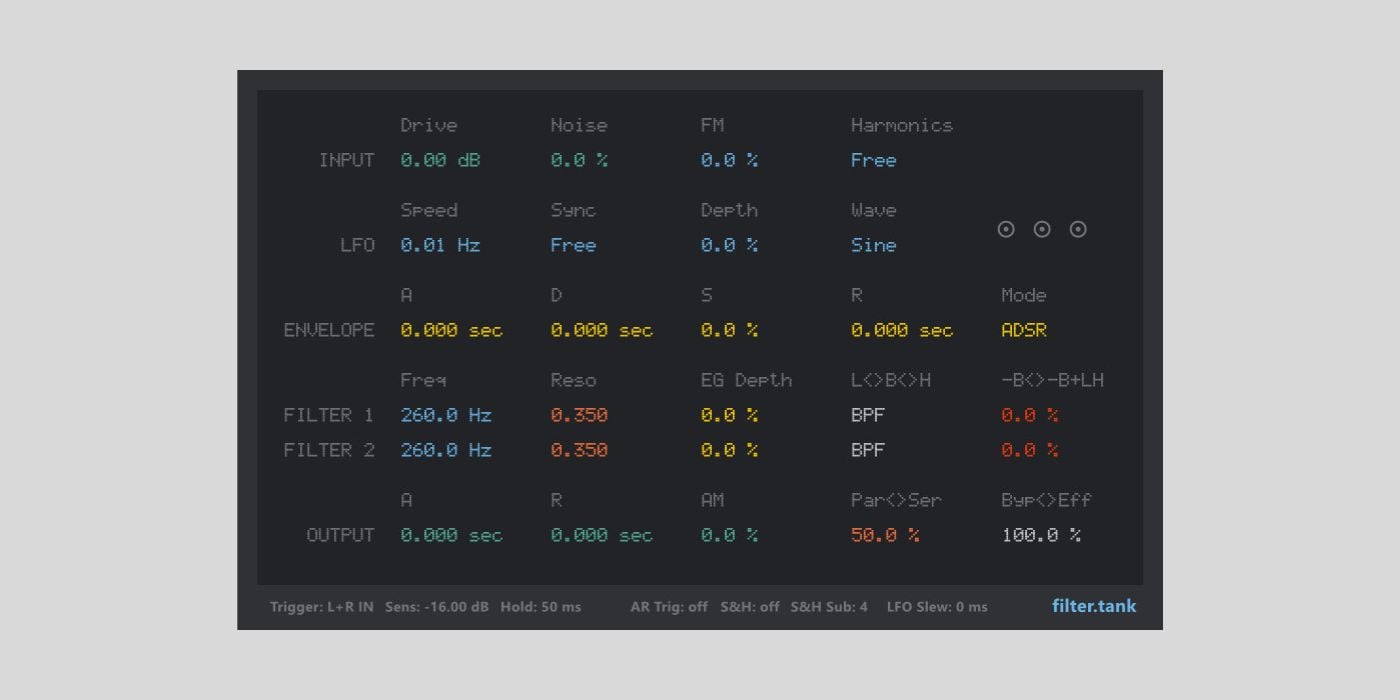
- Tempo-Syncable LFO: A low-frequency oscillator with six selectable waveforms (sine, triangle, saw up, saw down, square, random) can be synchronized to the host DAW’s tempo. This allows for rhythmic filter sweeps, pulsating effects, or subtle, undulating movements, making filter.tank highly adaptable for groove-oriented music production.
- Filter Envelope: This versatile module can operate in either ADSR (Attack, Decay, Sustain, Release) mode for traditional envelope shaping, or as an envelope follower. In ADSR mode, it provides precise control over the filter’s response to a triggered event. As an envelope follower, it dynamically reacts to the amplitude of the input signal, allowing for expressive "wah" effects, dynamic ducking, or rhythmic filtering that breathes with the audio.
- FM (Frequency Modulation) from Input Signal: This powerful feature allows the incoming audio signal to directly modulate the filter’s cutoff frequency. This can generate complex, metallic, bell-like, or vocal-like timbres, pushing the filter beyond conventional subtractive synthesis into more experimental and spectral manipulation.
- AM (Amplitude Modulation) / Ring Modulation: AM, often referred to as ring modulation in audio processing, multiplies the input signal by a modulator (in this case, an internal oscillator or potentially another source), creating non-harmonic overtones and sidebands. This results in dissonant, robotic, or clangorous sounds, adding another layer of aggressive sound design potential.
- Gate Trigger: The internal gate can be triggered by various sources – audio input, MIDI signals, or DAW automation. This flexibility ensures that the filter’s dynamic responses can be precisely controlled and integrated into any production workflow, from rhythmic gating to complex envelope interactions.
This extensive modulation matrix ensures that filter.tank is not merely a static filter but a highly interactive and dynamic sound processing tool, capable of profound sonic transformations.
Sender Spike’s Developing Ecosystem
filter.tank is the third standalone effect plugin to emerge from Sender Spike’s ongoing development work on SN Zero, an FM synthesizer initially featured in January. The first such release was qb, a multimode distortion plugin covered in February. These plugins were originally conceived as integral components of SN Zero’s output stage, designed to enhance and color the synthesizer’s sound. However, the decision to release them as separate, independent plugins represents a strategic move by Sender Spike.
This modular approach offers significant advantages for producers and the developer alike. For users, it means these high-quality effects can be deployed with any audio source within a DAW, not just SN Zero. This maximizes their utility and provides greater creative flexibility. For Sender Spike, it allows for individual refinement and distribution of these modules, potentially reaching a broader audience who may be interested in a specific effect without necessarily needing the entire synthesizer. This strategy aligns with a growing trend in the plugin market towards standalone, specialized tools that can be mixed and matched within a user’s preferred signal chain. The release of filter.tank, following qb, reinforces Sender Spike’s commitment to building a cohesive yet versatile ecosystem of high-quality, free audio tools.
Unique User Interface and Usability Considerations
One of filter.tank’s most distinctive characteristics is its entirely text-based user interface. Unlike the prevalent graphical user interfaces featuring virtual knobs, sliders, and visualizers, filter.tank displays all parameters as numerical values – hertz for frequencies, milliseconds for times, percentages for levels, and so forth. This design choice offers both advantages and unique considerations for users.
The primary benefit of a text-based interface is precision. Users can directly input or precisely adjust values, which can be advantageous for detailed sound design or for recalling exact settings. This numerical approach can appeal to those who prioritize accuracy over visual representation. Furthermore, the minimalist aesthetic lends filter.tank a clean, retro vibe, reminiscent of early computer interfaces or classic hardware units with segmented displays. This unique presentation helps it stand out in a crowded plugin market.
However, this interface may present a learning curve for users accustomed to highly visual GUIs. The absence of traditional knobs and sliders might initially feel less intuitive for quick, expressive adjustments. While some users may appreciate the "added precision" and the "retro vibe," others might prefer more immediate visual feedback on parameter changes. Nonetheless, the design decision underscores Sender Spike’s commitment to a distinct user experience and highlights the diversity of approaches in plugin interface design.
Critical Safety Advisory
A crucial aspect of filter.tank’s functionality, directly linked to its powerful resonance capabilities, is its potential to generate extremely loud and high-frequency sounds. The developer explicitly warns that these frequencies "may damage hearing or equipment." This is not an uncommon characteristic for filters capable of aggressive self-oscillation and extreme feedback, particularly those inspired by units like the Sherman Filterbank 2.
Therefore, users are strongly advised to place a limiter immediately after filter.tank in their signal chain. A limiter will prevent the output signal from exceeding a predetermined threshold, thereby safeguarding both monitoring equipment (speakers, headphones) and, more importantly, the user’s hearing. This advisory highlights the potent capabilities of the plugin and Sender Spike’s responsible approach to user safety, ensuring that users can explore filter.tank’s vast sonic potential without risking damage.
Accessibility and Impact on the Freeware Landscape
filter.tank is offered completely free of charge, reinforcing Sender Spike’s contribution to the growing repository of high-quality freeware plugins. Its availability as a 64-bit VST plugin for Windows ensures compatibility with a vast majority of modern digital audio workstations. The download size is remarkably small, approximately 150 KB, and requires no user registration or sign-up, providing frictionless access to the software.
The release of filter.tank is significant for the freeware plugin landscape. It demonstrates that sophisticated sound design tools, inspired by premium analog hardware, can be made accessible to all producers regardless of budget. This democratization of tools empowers aspiring musicians and seasoned professionals alike to experiment with advanced sound processing techniques. For the broader plugin market, such high-quality free releases can push boundaries, setting new expectations for functionality and sonic character even among commercial offerings.
In conclusion, Sender Spike’s filter.tank stands as a compelling digital interpretation of the iconic Sherman Filterbank 2. By offering a meticulously crafted dual-filter with extensive modulation capabilities, a unique text-based interface, and a commitment to sonic fidelity and experimental design, filter.tank is poised to become a valuable tool for sound designers, electronic musicians, and anyone seeking to explore the outer limits of audio manipulation, all without financial barrier. Its release further solidifies Sender Spike’s reputation as an innovative developer dedicated to expanding the creative toolkit available to the production community.
