

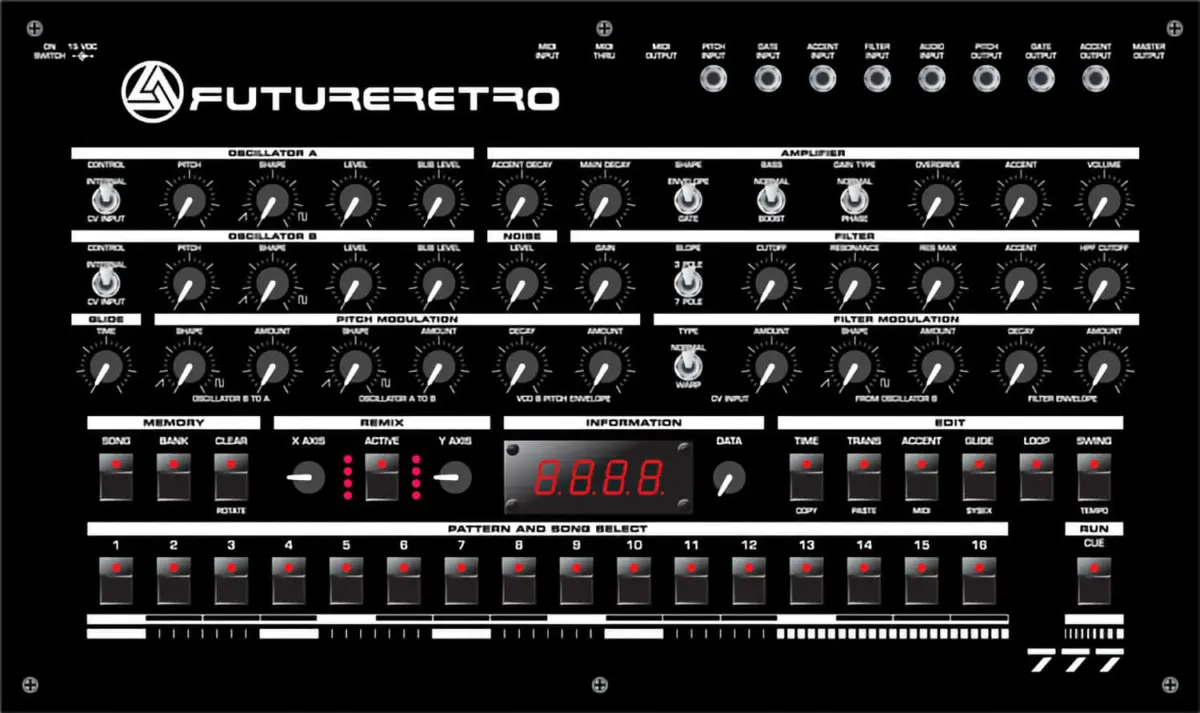
The electronic music community has received a significant demonstration of the newly reissued Future Retro 777 through a high-intensity performance by synthesist Nathan King, known online as ZafroSoundz. This demonstration marks a pivotal moment for enthusiasts of the "acid" sound, as the Future Retro 777 has long been considered one of the most powerful and aggressive monophonic synthesizers ever produced. King’s performance, which he characterized as a "hard techno jam," utilizes the updated hardware to produce the complex, distorted basslines that earned the original 1998 unit its cult status. By integrating the 777 with modern production tools such as the Roland MC-707 and the Dreadbox/Polyend Medusa, King provides a contemporary context for a machine that many feared had been lost to history following the original company’s closure.
The Resurrection of an Analog Icon
The appearance of the "new" Future Retro 777 represents the culmination of a tumultuous period for the brand. Future Retro, founded by Jered Flickinger, became a household name in the boutique synthesizer world during the late 1990s. The original 777 was designed as a "supercharged" alternative to the Roland TB-303, offering far more synthesis depth, modulation options, and a more aggressive sonic profile than the original silver box. However, after decades of operation, Future Retro announced it was ceasing operations in mid-2022, citing global supply chain issues and the rising costs of components.
The brand’s subsequent revival under new management has been met with cautious optimism by the synthesizer community. The reissue of the 777 is the flagship project of this new era. While maintaining the core analog circuitry that defined the original’s sound, the new version benefits from modern manufacturing tolerances and updated components, ensuring better stability and longevity. Nathan King’s acquisition of the unit on the Friday preceding his video release highlights that these units are now actively reaching the hands of performers, signaling that the production transition from the original Flickinger designs to the new manufacturing framework is complete.
Performance Analysis: The "Filth" of the 777
In his demonstration, Nathan King focuses on the 777’s ability to generate what he describes as "filth"—a term used in electronic music to denote rich harmonic distortion, aggressive resonance, and raw, unpolished analog textures. The Future Retro 777 is uniquely equipped for this task due to its distinct filter architecture. Unlike the standard 4-pole filters found in many synthesizers, the 777 features a selectable 3-pole and 7-pole low-pass filter. The 3-pole setting provides a classic, rubbery acid sound, while the 7-pole setting offers an incredibly steep roll-off that creates a massive, heavy-hitting low end and piercing resonance.
The jam demonstrates the 777’s internal sequencer, which has historically been praised for its intuitive yet deep programming capabilities. King utilizes the machine’s ability to manipulate accents, slides, and filter cutoffs in real-time, which are essential elements of the hard techno genre. The 777’s architecture includes an integrated overdrive circuit and a sophisticated modulation section that allows the oscillator to be pushed into extreme territories, a feat King highlights throughout the performance as the bassline evolves from a steady pulse into a screaming, distorted lead.
Supporting Hardware and Signal Flow
To provide a full-bodied techno arrangement, King paired the Future Retro 777 with two other notable pieces of equipment, creating a hybrid setup that bridges analog grit with digital flexibility:
- Roland MC-707 Groovebox: This unit serves as the central hub of the performance. The MC-707 acts as the master clock, the drum machine, and the primary mixer. By routing the 777 through the MC-707’s inputs, King is able to apply master-grade effects and perform real-time mixing of the various elements. The drums provided by the MC-707 offer the industrial, high-BPM foundation necessary for the hard techno style, allowing the 777 to occupy the mid-to-low frequency space without competition.
- Dreadbox/Polyend Medusa: For the background riffs and atmospheric textures, King employed the Medusa. As a hybrid synthesizer featuring both analog and digital oscillators alongside a unique grid-based controller, the Medusa provides a melodic counterpoint to the 777’s monophonic aggression. The interplay between the Medusa’s polyphonic capabilities and the 777’s focused monophonic drive creates a dense, professional soundstage.
This configuration illustrates the versatility of the 777 in a modern live-performance rig. Rather than acting as a standalone curiosity, the synth functions as a primary voice within a sophisticated MIDI-synced ecosystem.
Technical Evolution: From 1998 to the Present
The original Future Retro 777 was released at a time when the market was saturated with TB-303 clones. However, Flickinger’s design stood out because it did not merely replicate the 303; it expanded upon it. The 777 featured an all-discrete analog signal path, two sub-oscillators, and an extensive CV/Gate interface that allowed it to communicate with modular systems—a feature that was ahead of its time in the late 90s.
The new iteration of the 777 retains these features but addresses some of the original’s limitations. Modern users expect high-speed MIDI communication and stable tuning across multiple octaves, areas where the new units reportedly excel. Furthermore, the "new" 777 arrives in an era where "Acid Techno" has seen a massive resurgence in global club culture. This cultural shift has created a high demand for hardware that can deliver "authentic" analog sounds without the fragility or exorbitant secondary-market prices of vintage 1980s or 1990s equipment.
Market Implications and Brand Reception
The release of this "First Jam" by a respected synthesist like Nathan King serves as a de facto field test for the industry. Reactions from the synthesizer community suggest that the reissue successfully captures the "DNA" of the original unit. For the revived Future Retro brand, this is a critical victory. The synthesizer market is currently highly competitive, with large-scale manufacturers like Behringer producing low-cost clones and boutique makers offering high-end, hand-built units.
The Future Retro 777 occupies a middle ground—it is a premium, boutique instrument with a pedigree, yet it offers a specific sonic character that mass-produced clones often struggle to replicate. By positioning the 777 as a tool for "hard techno" and "filth," the brand is successfully targeting a demographic of professional and semi-professional producers who prioritize character and "vibe" over mere affordability.
Chronology of the Future Retro 777
- 1998: Jered Flickinger releases the original Future Retro 777. It quickly becomes a staple in the gear racks of acid techno and trance producers.
- Early 2000s: Production of the 777 ceases as Future Retro moves on to other designs like the Revolution (a circular sequencer synth) and the XS (a semi-modular desktop synth).
- 2010s: The 777 becomes a "holy grail" item on the used market, often selling for several times its original retail price.
- May 2022: Future Retro announces it is closing its doors, leading to a spike in interest for its legacy products.
- Late 2022 – 2023: Investors and collaborators work to revive the brand, securing the rights and the technical schematics to Flickinger’s designs.
- 2024: The new Future Retro 777 begins shipping to customers. Nathan King releases the first major performance demonstration of the production unit.
The Future of the "Super-303" Category
The success of the 777 reissue likely paves the way for the return of other Future Retro classics, such as the Zillion (a DNA-inspired sequencer) or the Mobius. More importantly, it validates the "super-303" category—a segment of the market dedicated to synthesizers that take the basic premise of a bassline sequencer and push it into the realm of semi-modular synthesis.
Nathan King’s performance is more than just a musical demonstration; it is a proof of concept. It proves that the analog designs of the 1990s still have a place in the digital-heavy production environments of the 2020s. As King noted, the machine is a "Beast," and its ability to cut through a dense mix of digital drums and hybrid riffs suggests that the Future Retro 777 will remain a formidable force in electronic music for years to come.
In conclusion, the reintroduction of the Future Retro 777 into the marketplace, as evidenced by Nathan King’s recent performance, represents a successful bridge between synthesizer history and modern musical needs. The unit’s ability to produce aggressive, high-fidelity analog textures ensures its relevance in a genre that continues to value raw power and tactile control. As more units reach the hands of artists worldwide, the 777 is poised to reclaim its title as a cornerstone of the techno production world.
