

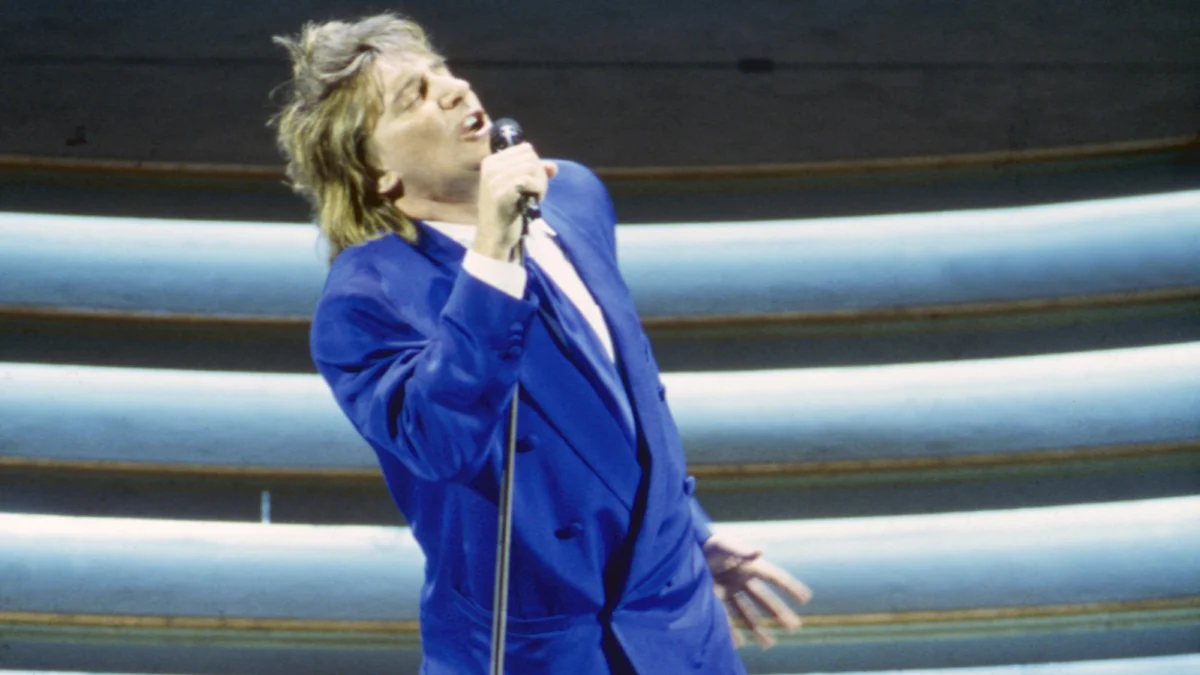
The 1993 release of Rod Stewart’s live acoustic rendition of Have I Told You Lately remains a definitive moment in the trajectory of adult contemporary music, marking the convergence of a legendary songwriter’s work and a superstar interpreter’s peak commercial era. Originally penned and recorded by the Northern Irish singer-songwriter Van Morrison, the track underwent a significant cultural transformation when Stewart included it in his MTV Unplugged session. While many listeners associate the romantic ballad primarily with Stewart’s gravelly, emotive delivery, the song’s history is a complex narrative of cross-genre success, strategic career shifts, and the enduring power of a well-crafted melody.
The Genesis: Van Morrison’s Avalon Sunset
To understand the impact of Rod Stewart’s version, one must first examine the song’s origins within the discography of Van Morrison. Written during a period of spiritual reflection for Morrison, Have I Told You Lately was the lead single from his 19th studio album, Avalon Sunset, released in 1989. The original recording is characterized by its understated elegance, featuring a prominent piano melody and Morrison’s soulful, jazz-inflected vocals.
At the time of its release, Morrison’s version was a significant success in its own right. It reached the Top 15 on the Billboard Adult Contemporary chart and performed well in the United Kingdom and Ireland. Critics often noted that the song occupied a unique space in Morrison’s catalog; while it functioned perfectly as a secular love song, the lyrics—referring to a "morning sun" that "greets the day with hope and comfort"—were interpreted by many as a spiritual hymn directed toward a higher power. This duality allowed the song to resonate with a broad demographic, setting the stage for its eventual status as a standard in the Great American Songbook tradition.
The Vagabond Heart Sessions and the Initial Release
Rod Stewart’s relationship with the song began two years after Morrison’s debut. In 1991, Stewart released Vagabond Heart, an album that signaled a return to form for the singer after a period of experimental pop in the late 1980s. The album was a powerhouse of collaborative effort, featuring production work from industry titans such as Trevor Horn and Richard Perry.
On the original tracklist of Vagabond Heart, Have I Told You Lately was positioned as an album cut rather than a lead single. At the time, the promotional focus of Warner Bros. Records was directed toward other high-profile tracks. The album yielded several major hits, including the Tina Turner duet "It Takes Two," the bagpipe-infused "Rhythm of My Heart," and "The Motown Song." Stewart also included a cover of Tom Waits’ "Downtown Train," further cementing his reputation as a master of the "re-imagined" hit.
Because Vagabond Heart was already saturated with successful singles, Have I Told You Lately remained a hidden gem for nearly two years. It was not until Stewart participated in the MTV Unplugged series that the song’s full commercial potential was realized.
The 1993 Unplugged Phenomenon
In the early 1990s, the MTV Unplugged franchise was at the zenith of its cultural influence. Following the massive success of Eric Clapton’s acoustic session, the network sought other rock icons who could translate their electric energy into an intimate, sophisticated setting. Stewart’s session, later released as the album Unplugged…and Seated, was particularly notable for reuniting him with his former Faces bandmate, guitarist Ronnie Wood.
The live performance of Have I Told You Lately captured a vulnerability in Stewart’s voice that resonated deeply with the public. Stripped of the synthesizers and heavy production of the era, the song’s lyrical sincerity became the focal point. Released as a single in 1993 to promote the live album, the version skyrocketed to No. 1 on the Billboard Adult Contemporary chart and reached No. 5 on the Billboard Hot 100.
The success of the Unplugged version was a statistical anomaly in the music industry. It is rare for a live cover of a four-year-old song to outperform the original and several other contemporary studio recordings. The Unplugged…and Seated album eventually achieved triple-platinum status in the United States, selling over three million copies, largely propelled by the ubiquity of Have I Told You Lately on radio and television.
Lyrical Analysis and Universal Appeal
The enduring popularity of the song can be attributed to its lyrical simplicity and emotional transparency. The opening lines—"Have I told you lately that I love you / Have I told you there’s no one else above you"—employ a directness that is rare in contemporary songwriting. The imagery of the "morning sun" and the easing of "troubles" provides a sense of sanctuary, a theme that Stewart’s raspy delivery emphasized with a sense of lived experience.
Musicologists have noted that Stewart’s arrangement, which heavily utilized strings and a soft piano accompaniment, transformed the song from a spiritual meditation into the quintessential wedding ballad. The song’s structure, which avoids complex bridges in favor of a recurring, comforting chorus, makes it easily digestible for a mainstream audience while maintaining a high level of musical integrity.
Van Morrison’s Continued Success and the 1995 Grammy
While Stewart’s version dominated the airwaves, Van Morrison continued to see professional benefits from the song’s resurgence. In 1995, Morrison revisited the track for The Long Black Veil, a collaborative project with the Irish folk group The Chieftains. This version leaned into Morrison’s Celtic roots, incorporating traditional instrumentation that provided a stark contrast to Stewart’s polished pop-rock arrangement.
This collaboration proved to be a critical triumph. At the 38th Annual Grammy Awards, Morrison and The Chieftains won the award for Best Pop Collaboration with Vocals. This win was significant as it marked Morrison’s first Grammy Award, a surprising fact given his decades of influence. The victory also highlighted the song’s versatility; within six years, it had been a soft-rock hit for Morrison, a global pop phenomenon for Stewart, and a Grammy-winning folk collaboration.
Stewart as the Master of the Interpretive Cover
Rod Stewart’s success with Have I Told You Lately was not an isolated incident but rather a cornerstone of a broader career strategy. Throughout his tenure in the music industry, Stewart has demonstrated a keen ear for songs written by other artists that he could imbue with his own signature style.
His history of successful covers includes:
- "The First Cut Is the Deepest" (1976): Originally by Cat Stevens, Stewart’s version became a definitive 1970s anthem.
- "This Old Heart of Mine" (1975/1989): Initially a hit for The Isley Brothers, Stewart’s reimagining (especially his later version with Ronald Isley) brought the track to a new generation.
- "Downtown Train" (1989): Stewart took Tom Waits’ gritty, underground track and turned it into a polished Top 5 hit.
- "Broken Arrow" (1991): Originally by Robbie Robertson, Stewart’s version on Vagabond Heart showcased his ability to handle complex, narrative songwriting.
This ability to "curate" music led Stewart to his highly successful Great American Songbook series in the 2000s, where he covered standards from the 1930s and 40s. Industry analysts suggest that Have I Told You Lately served as the proof of concept for Stewart’s later career, demonstrating that his voice was perfectly suited for timeless, melodic ballads that transcended the rock genre.
Comparative Industry Impact
The legacy of Have I Told You Lately is also reflected in the sheer volume of artists who have sought to record their own versions. The song has been covered by a diverse array of performers, including:
- Kenny Rogers: Bringing a country-pop sensibility to the track.
- Barbara Mandrell: Furthering the song’s reach into the Nashville market.
- Andy Williams and Barry Manilow: Solidifying the song’s status as a standard for traditional pop vocalists.
- Della Reese: Providing a gospel-infused interpretation that harkened back to Morrison’s original spiritual intent.
According to data from performing rights organizations, Have I Told You Lately remains one of the most-performed songs at private events, particularly weddings and anniversaries, worldwide. Its consistent radio airplay on "Gold" and "Adult Contemporary" stations ensures a steady stream of royalty revenue, illustrating the long-term financial viability of high-quality songwriting coupled with iconic performance.
Broader Implications for the Music Industry
The trajectory of Have I Told You Lately offers a case study in the importance of "song-plugging" and timing in the music business. It illustrates how a song can exist in the public consciousness for years as a moderate success before a specific performance—in this case, the MTV Unplugged session—elevates it to the level of a cultural touchstone.
Furthermore, the song highlights the symbiotic relationship between songwriters and interpreters. While Van Morrison provided the foundation and the initial vision, Rod Stewart provided the platform and the specific vocal texture that allowed the song to reach its maximum audience. The fact that Morrison eventually won a Grammy for a different version of the same song suggests that Stewart’s success did not cannibalize Morrison’s legacy but rather enhanced the song’s overall "brand equity."
In the modern streaming era, Have I Told You Lately continues to perform well. On platforms like Spotify and YouTube, Stewart’s Unplugged version remains one of his most-streamed tracks, often outpacing his faster rock hits from the 1970s. This enduring digital presence confirms that the song’s appeal is not merely nostalgic but is rooted in a fundamental musicality that continues to attract new listeners.
As Rod Stewart continues to tour and perform, Have I Told You Lately remains a mandatory inclusion in his setlist, often serving as the emotional climax of his shows. It stands as a testament to a period in the early 1990s when a simple, sincere ballad could cut through the noise of the burgeoning grunge and hip-hop movements to become a global anthem of affection. For both Stewart and Morrison, the song represents a career-defining achievement that bridged the gap between soul, rock, and traditional pop.
