

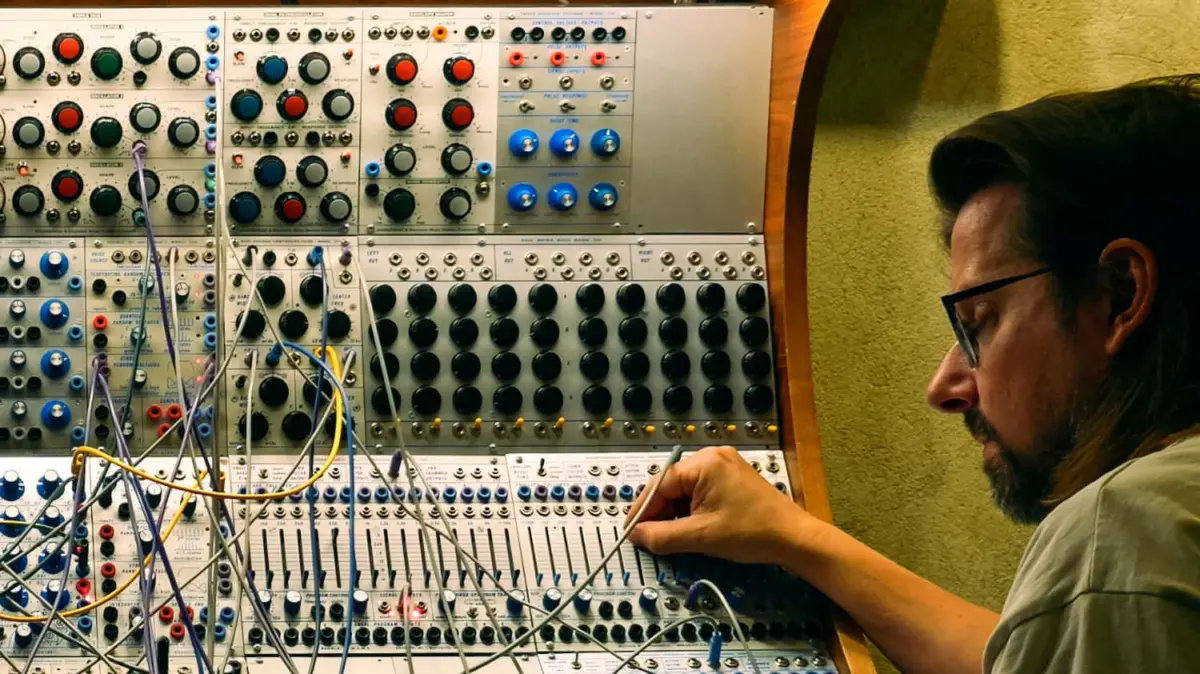
In a significant contribution to the documentation of electronic music history, Berlin-based composer and synthesist Hainbach has released a comprehensive visual and auditory exploration of the modular systems developed by Don Buchla. This study, conducted during a recent residency at the EMS Elektronenmusikstudio in Stockholm, provides a rare look at the evolution of "West Coast" synthesis through three generations of instruments: the System 100, the System 200, and the modern 200e. The project serves not only as a technical showcase but also as a historical record of the instruments that fundamentally altered the trajectory of electronic sound design in the 20th and 21st centuries.
A Historical Residency at EMS Stockholm
The Elektronmusikstudion (EMS) in Stockholm, founded in 1964, remains one of the world’s premier centers for electroacoustic music and sound art. It is uniquely positioned as a repository for some of the most significant electronic instruments ever created. Hainbach’s residency allowed for a chronological study of Don Buchla’s work, moving from the mid-1960s to the early 2000s.
The residency focused on the specific ergonomic and sonic philosophies that Don Buchla championed. Unlike his contemporary Robert Moog, who sought to make the synthesizer accessible to traditionally trained musicians by incorporating a piano-style keyboard, Buchla viewed the synthesizer as a radical new instrument that required a radical new interface. His designs often replaced keys with touch-sensitive plates and sequencers, encouraging a more experimental, non-linear approach to composition.
The Genesis of West Coast Synthesis: The System 100
The journey documented by Hainbach begins with the System 100, a series commissioned in 1963 by Morton Subotnick and Ramon Sender for the San Francisco Tape Music Center. The System 100 represents the birth of what is now commonly referred to as "West Coast Synthesis."
Technically, the System 100 was revolutionary. While East Coast synthesis (Moog) focused on subtractive methods—starting with a harmonically rich waveform and filtering it down—Buchla’s West Coast approach focused on additive and FM (Frequency Modulation) techniques. The System 100 utilized complex oscillators and waveshapers to build timbre from the ground up.
During the EMS residency, Hainbach utilized an exact replica of the System 100. This allowed for an exploration of the raw, primitive power of the early 100-series modules. These instruments were characterized by their lack of traditional tuning stability, which Buchla viewed not as a flaw, but as a feature of a "voltage-controlled studio" meant for exploration rather than conventional performance.
The Evolution of Complexity: The System 200 Series
In 1970, Buchla introduced the System 200, also known as the Electric Music Box. This system expanded the palette of the 100 series with more sophisticated control voltages and a wider array of modules. At EMS Stockholm, Hainbach had access to both an original System 200 and a large, mixed System 200 configuration.
The 200 series introduced several modules that have since become legendary in the modular synthesizer community. Among these is the Model 259 Programmable Complex Waveform Generator, which features two oscillators that can modulate one another in various ways, creating metallic, percussive, and vocal-like timbres. Another hallmark of the 200 series is the Model 292 Low Pass Gate, which combines the characteristics of a low-pass filter and a VCA (Voltage Controlled Amplifier) to create a natural, "plucked" sound reminiscent of acoustic instruments.
The System 200 represented the peak of analog modular design for Buchla. It emphasized the concept of "Source of Uncertainty," a module (Model 266) designed to generate random voltages and noise, further cementing Buchla’s philosophy that the machine should be a collaborative partner in the creative process rather than a passive tool.
The Digital Transition: The Buchla 200e
The final stage of the chronological exploration involves the 200e, a system Don Buchla introduced in 2004. The "e" stands for "electric," but the system is fundamentally a hybrid of analog sound paths and digital control. The 200e was Buchla’s response to the demands of modern performers who required the ability to save and recall patches—a feat nearly impossible on purely analog modular systems.
The 200e retains the core sonic identity of the original 200 series but adds high-density modules and internal bus connections that reduce the need for physical patch cables. At EMS, Hainbach explored how the 200e integrates with the earlier systems. The 200e allows for complex, multi-layered performances where an entire state of the machine can be changed with the push of a button, bridging the gap between the experimental studio origins of the 100 series and the needs of the contemporary live stage.
Sonic Documentation: The Buchla Stories Project
Parallel to the video documentation, Hainbach released "Buchla Stories," an album composed and recorded entirely during his time at EMS. The album serves as a practical application of the theories explored in his technical overview. By opting for a "pay-what-you-want" model on Bandcamp, the artist has made these rare sounds accessible to a global audience, many of whom will never have the opportunity to interact with an original Buchla system.
The recordings highlight the specific textures of the Stockholm systems. Listeners can hear the interplay between the "Source of Uncertainty" and the "Complex Waveform Generators," resulting in a soundscape that is at once organic and alien. The album serves as a testament to the enduring relevance of Buchla’s designs, proving that instruments over 50 years old can still produce sounds that feel contemporary and avant-garde.
Technical Analysis and Industry Implications
The modular synthesizer market has seen a massive resurgence over the last decade, primarily through the Eurorack format. While Moog-style subtractive synthesis dominated the 1980s and 90s, the modern era is heavily influenced by Buchla’s "West Coast" philosophy. Companies like Make Noise, TipTop Audio, and even Buchla’s successor, Buchla U.S.A., have brought these concepts to a new generation of musicians.
Data from industry analysts suggest that the "boutique" synthesizer market, which includes modular components, has grown by over 15% annually since 2018. A significant portion of this growth is attributed to the popularity of West Coast synthesis modules. By documenting the original hardware at EMS Stockholm, Hainbach provides a reference point for developers and musicians alike, ensuring that the original intent of these circuits is understood.
The rarity of these systems cannot be overstated. An original Buchla 200 system can command prices upwards of $50,000 on the secondary market, if one can even be found. The preservation efforts by institutions like EMS and the documentation by artists like Hainbach are critical for the continued study of electronic music history.
The Philosophical Legacy of Don Buchla
Don Buchla passed away in 2016, but his influence remains a cornerstone of electronic music theory. His rejection of the "black and white" keyboard was a rejection of the idea that electronic music should be a mere imitation of traditional instruments. He famously stated that a keyboard is "dictatorial," and his instruments were designed to liberate the user from those constraints.
Hainbach’s exploration emphasizes this sense of liberation. By moving between the 100, 200, and 200e, he illustrates a consistent vision: the synthesizer as a means of exploring the fundamental nature of sound and electricity. This philosophy has implications beyond music; it influences user interface (UI) design, human-computer interaction, and the way we perceive the relationship between technology and art.
Contemporary Significance and Future Impact
The release of this video and the accompanying album comes at a time when digital fatigue has led many creators back to tactile, analog interfaces. The Buchla systems represent the pinnacle of this tactile experience. The use of touch plates, sliders, and patch cables forces a physical engagement with the sound that is often lost in software-based production.
As educational institutions increasingly incorporate electronic music into their curricula, resources like Hainbach’s Buchla study become essential. They provide a clear, high-fidelity look at the evolution of synthesis technology. Furthermore, the collaboration between an independent artist and a state-funded institution like EMS Stockholm highlights the importance of public support for the arts in preserving cultural heritage.
In conclusion, "The Modular Synthesizers of Don Buchla – System 100, 200, 200e" is more than a gear demonstration. It is a comprehensive historical document that captures the essence of a visionary inventor’s work. Through the lens of Hainbach’s residency at EMS Stockholm, the electronic music community gains valuable insight into the past, present, and future of sound synthesis. The project ensures that while the hardware may be rare and aging, the ideas and sounds of Don Buchla continue to resonate in the modern era.
