

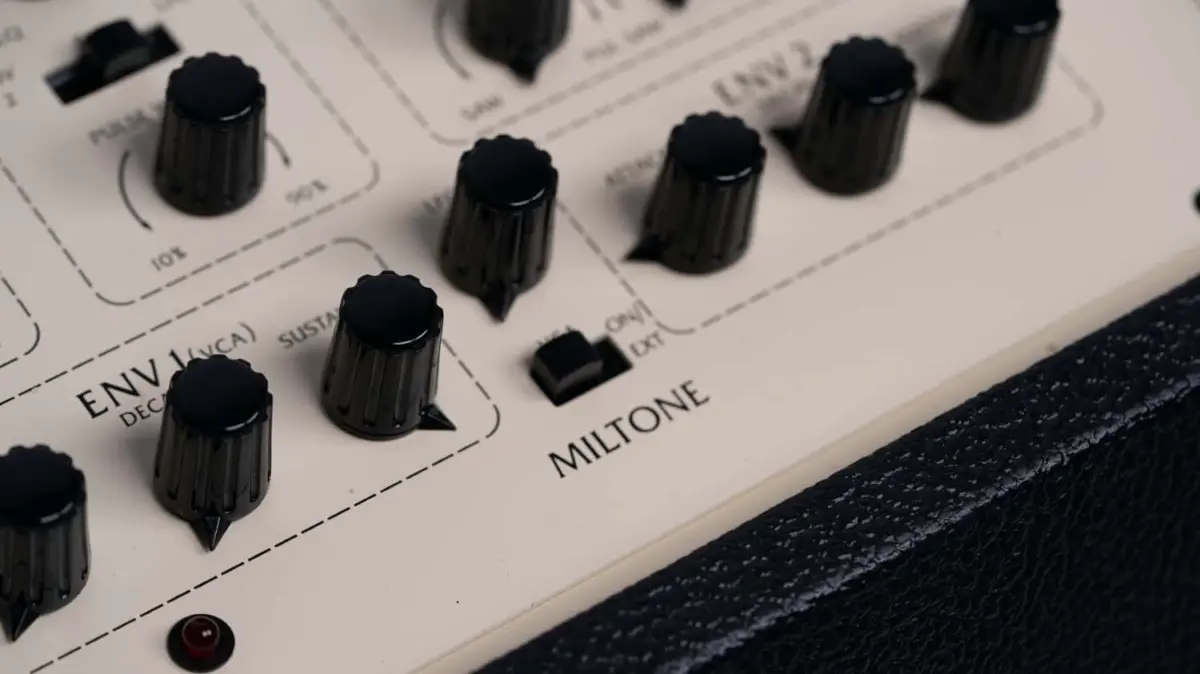
The landscape of modern music production is currently witnessing a significant renaissance in analog synthesis, driven by a desire for the tactile interface and harmonic complexity of 20th-century hardware. At the forefront of this movement is the Miltone 4EXP, a meticulously engineered component-level clone of the legendary Oberheim Four Voice (FVS-1). Recently highlighted by prominent synthesist and historian Alex Ball, the 4EXP represents a bridge between the pioneering engineering of the 1970s and the rigorous production standards of the contemporary boutique instrument market. Designed and manufactured in France, the 4EXP serves a dual purpose: it operates as a standalone polyphonic synthesizer and functions as a high-fidelity expander capable of transforming an original Oberheim Four Voice into a formidable Eight Voice system.
The Legacy of the Oberheim Four Voice
To understand the significance of the Miltone 4EXP, one must first examine the historical weight of its predecessor. Introduced in 1975 by Tom Oberheim, the Oberheim Four Voice (FVS-1) was a landmark achievement in electronic music. It was one of the first commercially available polyphonic synthesizers, predating the more streamlined "all-in-one" polyphonic designs like the Sequential Circuits Prophet-5 or the Roland Jupiter-8.
The architecture of the FVS-1 was unique and notoriously complex. Unlike later polyphonic synthesizers that used a single set of controls to govern all voices, the Four Voice was essentially four individual Synthesizer Expander Modules (SEMs) housed in a single chassis and linked by a digital scanning keyboard. This "discrete polyphony" meant that every parameter—oscillator tuning, filter cutoff, envelope stages—had to be set manually on each of the four modules. While this presented a significant challenge for live performance and rapid patch changes, it resulted in a sonic character that remains unrivaled. The slight variations between the four modules created a natural chorusing effect and a depth of sound that became the hallmark of the "Oberheim sound."
Technical Specifications and Engineering Fidelity
The Miltone 4EXP is not a digital emulation or a modern "inspired-by" redesign; it is a component-level recreation. This means the internal circuitry mirrors the original SEM architecture, utilizing discrete components to ensure that the voltage-controlled oscillators (VCOs), filters, and envelopes behave with the same organic unpredictability as the 1975 originals.
Each of the four voices in the 4EXP consists of a faithful SEM reproduction featuring:
- Two Voltage Controlled Oscillators (VCOs): Providing saw and pulse waveforms with hard sync capabilities.
- Multi-mode Filter: The centerpiece of the SEM sound, featuring a 12dB per octave slope with low-pass, high-pass, band-pass, and notch modes. This filter is renowned for its "creamy" texture and its ability to maintain low-end presence even at high resonance levels.
- Two Envelope Generators: Simple but effective ADS (Attack, Decay, Sustain) envelopes tailored for percussive or ambient textures.
- Low-Frequency Oscillator (LFO): For pitch and filter modulation.
Miltone has integrated these classic components into a frame that respects the original’s aesthetic while providing modern stability. According to Alex Ball’s technical assessment, the build quality is executed to an exceptionally high standard, addressing the mechanical and thermal stability issues that often plagued vintage 1970s units.
Operational Versatility: Standalone vs. Expander
One of the most compelling features of the 4EXP is its flexibility within a studio environment. As a standalone unit, it provides musicians with a four-voice polyphonic powerhouse that occupies significantly less space than a vintage FVS-1. However, its role as an "expander" is what truly distinguishes it for collectors and high-end studios.
In the mid-1970s, Oberheim offered the Eight Voice (EVS-1), which was essentially two Four Voice units coupled together. These machines are incredibly rare today and often command prices exceeding $30,000 on the secondary market. The Miltone 4EXP is designed to interface directly with original Oberheim hardware, allowing owners of a vintage Four Voice to expand their polyphony to eight voices. This integration is seamless, maintaining the voltage standards required to keep the vintage and modern units in perfect synchronization.
MIDI and Control Voltage Integration
While the internal signal path of the 4EXP remains strictly analog, Miltone has updated the control interface to meet the demands of the 21st-century studio. The unit features robust MIDI implementation, allowing for stable pitch tracking and gate triggering from digital audio workstations (DAWs) or modern MIDI controllers.
Furthermore, the 4EXP retains extensive Control Voltage (CV) and Gate connectivity. This allows for complex "split" configurations, where different voices can be triggered by different sequencers or keyboard zones. In his demonstration, Alex Ball highlights the "Deux Plus Deux Plus Deux" configuration, showing how the unit can be partitioned to handle multiple melodic and rhythmic lines simultaneously, effectively acting as a multi-timbral workstation.
Comparative Analysis: The "Riff Off"
A critical component of evaluating any clone is a direct comparison with the original hardware. In the video analysis, Alex Ball conducts a "Riff Off" between the Miltone 4EXP and an original vintage Oberheim unit. The results underscore the precision of Miltone’s engineering.
The primary difference noted in such comparisons is often the "age" of the components. Vintage units often suffer from "component drift," where capacitors and resistors have aged over 40 years, leading to a darker or more "saturated" sound. The 4EXP, using fresh components, offers a brighter, punchier response that arguably represents how the original Oberheim units sounded when they first left the factory in the 1970s. The harmonic profile of the 12dB multi-mode filter in the Miltone unit was found to be virtually indistinguishable from the original SEM, capturing the signature resonance and phase characteristics that define the brand.
Timeline of the Polyphonic Evolution
The release of the Miltone 4EXP sits within a broader historical timeline of polyphonic development:
- 1974: Tom Oberheim releases the SEM as a backup for the Minimoog.
- 1975: The Four Voice (FVS-1) is released, combining four SEMs with a digital keyboard.
- 1977: The Eight Voice (EVS-1) is introduced.
- 1978: The Prophet-5 is released, introducing patch memory and a more compact design, leading to the eventual decline of the bulky "Voice" systems.
- 2010s: A resurgence in analog interest leads Tom Oberheim to re-release standalone SEM modules.
- 2020s: Boutique manufacturers like Miltone begin producing high-end, component-level clones to satisfy the demand for rare, vintage architectures.
Market Implications and Industry Reaction
The arrival of the Miltone 4EXP arrives at a time when the "clone" market is divided into two distinct segments. On one end, companies like Behringer produce mass-market, low-cost recreations of classic synths. On the other end, boutique firms like Miltone, GRP, and Moog (with their re-issue series) focus on high-fidelity, premium instruments that prioritize historical accuracy and build longevity over price.
The 4EXP is firmly positioned in the premium boutique category. Industry analysts suggest that the demand for such units is driven by professional composers and top-tier studios who require the "Oberheim sound" but cannot risk the unreliability and maintenance costs associated with 50-year-old electronics. By providing a reliable, warrantied alternative that integrates with original hardware, Miltone has carved out a niche that appeals to both purists and modern professionals.
Conclusion and Future Outlook
The Miltone 4EXP is more than a simple exercise in nostalgia; it is a sophisticated piece of musical engineering that preserves one of the most important sonic palettes in the history of electronic music. By offering the ability to expand original systems or stand alone as a modern classic, it ensures that the unique "discrete polyphony" of the SEM architecture remains accessible to a new generation of artists.
As Alex Ball concludes in his assessment, the 4EXP succeeds because it does not attempt to "improve" the original design with modern digital conveniences that might compromise the signal path. Instead, it honors the 1975 vision of Tom Oberheim, providing the raw, unadulterated power of four (or eight) independent analog voices. For the synthesis community, the Miltone 4EXP represents the gold standard of what a modern recreation should be: respectful of the past, built for the present, and engineered to last well into the future. Detailed specifications and ordering information can be found on the official Miltone website, marking a new chapter for the enduring legacy of the Four Voice.
