

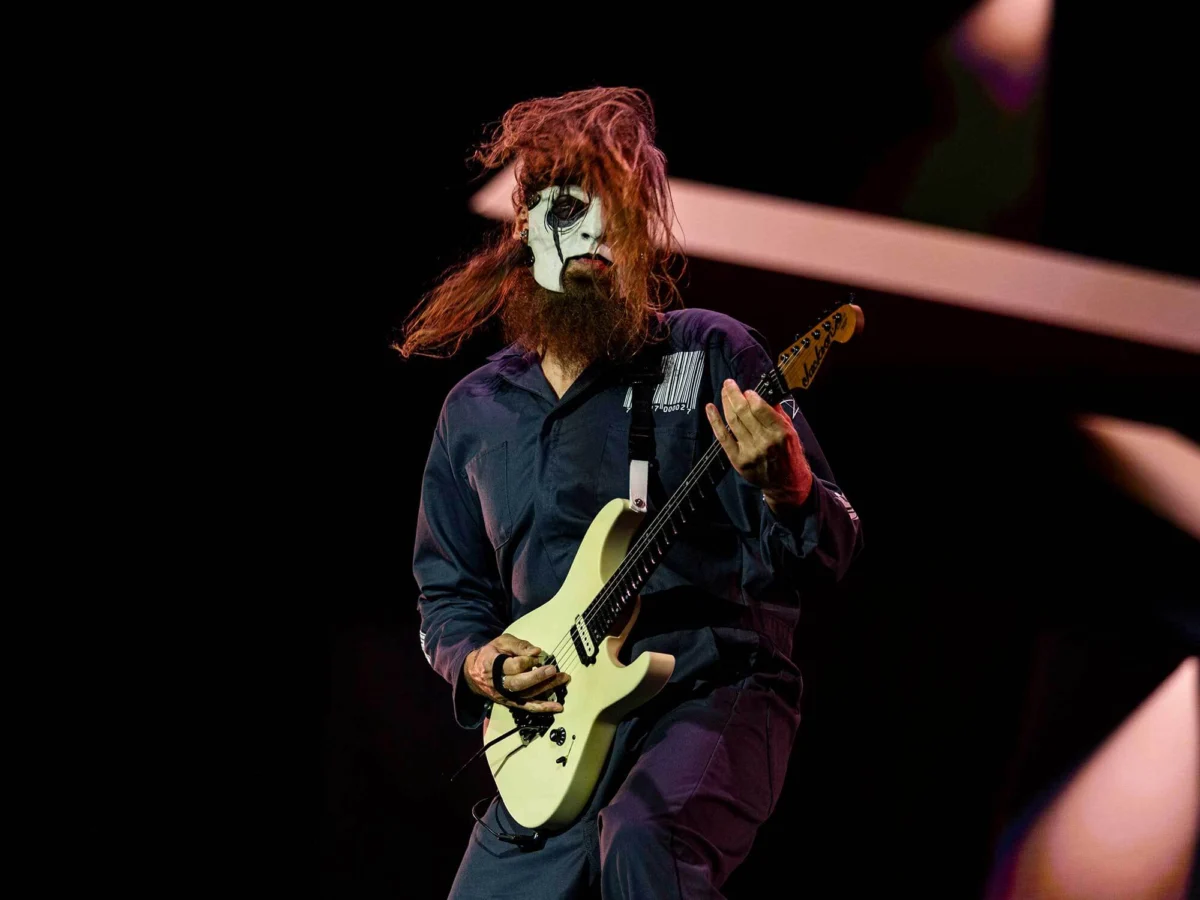
Despite his revered status as one of modern metal’s most iconic and technically proficient guitarists, Jim Root of Slipknot recently revealed a surprising period of profound self-doubt and disillusionment that led him to initially decline an invitation to join the nascent Iowa metal outfit. This candid admission, shared during an interview on the RIDE BYND podcast with Ben Giese, illuminates a formative chapter in Root’s life, showcasing a journey from near-abandonment of his musical ambitions to becoming an indispensable force in one of the most successful and influential heavy metal bands of the 21st century. His narrative offers a powerful counterpoint to the myth of an artist’s linear path to success, underscoring the often-unseen struggles that precede monumental achievements.
The Crucible of Des Moines: Early Life and Disillusionment
Before his signature masks and ferocious guitar work became synonymous with Slipknot’s global dominance, Jim Root was an aspiring musician grappling with the harsh realities of unfulfilled dreams in Des Moines, Iowa. Born in 1971, Root’s early years were spent honing his craft in various local bands, developing the foundational skills that would later define his distinctive style. However, by the late 1990s, the dream of "making it" in the music industry seemed increasingly remote. As he approached his late twenties, an age often perceived as a critical juncture for emerging artists, Root found himself at a crossroads, battling a pervasive sense of failure and a growing bitterness.
"I was bitter, because I had passed 18 years old and didn’t ‘make it,’" Root confessed on the podcast, articulating a sentiment common among countless aspiring artists who face the daunting prospects of professional music careers. This personal struggle was compounded by difficult domestic circumstances. His parents’ divorce led him to move in with his mother, a period he describes as an effort to support her emotionally. Professionally, his musical aspirations had seemingly evaporated. He was employed in a seasonal screen-printing job, a stark contrast to the stages he would eventually command, and would collect unemployment benefits during the winter months. In a telling testament to his detachment from music, Root revealed he didn’t even own a guitar at that time, having sold or pawned his instruments, though he still possessed an amplifier as a lingering relic of his past passion. "I’d given up," he stated plainly, encapsulating a moment of deep resignation. "I’d resigned myself to the fact that music was just gonna be done." This period painted a picture of a musician who had, for all intents and purposes, hung up his axe, convinced his moment had passed.
Slipknot’s Genesis: A Band Forged in Fire
Concurrently, in the same unassuming city of Des Moines, a musical anomaly was brewing. Slipknot, originally formed in 1995, was rapidly evolving into a nine-piece collective known for its aggressive sound, theatrical masks, and chaotic live performances. The band, which then featured original frontman Anders Colsefni, drummer Joey Jordison, and guitarist Donnie Steele, among others, was a force of raw, unbridled energy. Their music, a brutal fusion of death metal, thrash, and nascent nu-metal elements, was already pushing boundaries and garnering a cult following within the local scene. The band members, driven by an intense creative vision and an uncompromising work ethic, were renowned for their technical prowess and relentless pursuit of sonic extremity.
Slipknot’s early years were characterized by a relentless touring schedule within Iowa and surrounding states, cultivating a formidable reputation for their visceral live shows. The collective’s distinct visual aesthetic, featuring matching jumpsuits and individually crafted masks, served as both a barrier and an amplifier for their intense musical identity. By 1998, they had released their independent debut, Mate. Feed. Kill. Repeat., a raw and experimental offering that hinted at the colossal sound they would soon unleash. However, as the band refined its lineup and sound, preparing for a major label push, they were actively seeking to solidify their guitar section, a critical component for their layered and intricate compositions. The band members at this stage, particularly the late Joey Jordison, were recognized as exceptionally talented and dedicated musicians, raising the bar for any potential new recruit.
The Fateful Call: A Moment of Self-Doubt
It was against this backdrop of personal despondency and Slipknot’s burgeoning intensity that the initial call came to Jim Root. The invitation, extended by then-frontman Anders Colsefni, was an unexpected lifeline thrown to a man who had seemingly drowned his musical aspirations. However, instead of seizing the opportunity, Root hesitated, his deep-seated insecurities overriding any immediate excitement.
"When that happened, I think Donnie Steele was the guitar player at the time," Root recalled. "Joey [Jordison, late first drummer of Slipknot] was the drummer… They were players, man… And I hadn’t been playing for so long. I just didn’t feel like my ability was good enough to join their band." His reluctance stemmed not from a lack of interest in Slipknot’s music or potential, but from a perceived inadequacy in his own skill set, dulled by years of disengagement from his instrument. The formidable talent and commitment of existing members like Jordison, a drummer widely considered one of the greatest in modern metal history, loomed large in Root’s mind, creating a chasm between his current state and the band’s demanding standards.
This initial refusal was a powerful manifestation of imposter syndrome, a psychological pattern in which an individual doubts their accomplishments and has a persistent internalized fear of being exposed as a "fraud." Root’s frank admission, "I didn’t say no to them for any other reason than I just didn’t feel like I was ready for it. I didn’t feel like I could play up to the potential that they needed as a guitar player. Self-defeating, maybe, a little bit," perfectly encapsulates this phenomenon. It speaks to the immense pressure artists can place on themselves, often underestimating their own capabilities, especially after a period of professional stagnation. For Slipknot, Root’s initial "no" was likely a minor setback in their relentless search for the right personnel, but it underscores the internal battle he was fighting, a battle that countless creatives face when confronted with a potentially life-changing opportunity.
A Second Chance: Embracing the Challenge
Despite Root’s initial rejection, the trajectory of both his life and Slipknot’s continued to converge. The band underwent further lineup changes, most notably the departure of Anders Colsefni and the arrival of Corey Taylor as frontman, as well as the solidification of Mick Thomson as the primary guitarist. Slipknot eventually signed with Roadrunner Records in 1998, a pivotal moment that set the stage for their global breakthrough.
It was in early 1999, as Slipknot was preparing to record their seminal self-titled debut album, that the opportunity for Root resurfaced. This time, the circumstances were different. The band, now with a clearer vision and a major label backing, extended the invitation once more. Perhaps Root’s own mindset had shifted, or the undeniable momentum of Slipknot was too compelling to ignore. He eventually accepted, joining as the band’s second guitarist, completing the formidable duo with Mick Thomson. His arrival was crucial, providing a complementary technicality and melodic sensibility that would prove vital to the band’s evolving sound. Root quickly adapted, bringing a fresh perspective and renewed vigor to the band’s aggressive sonic landscape. His integration was seamless, and he rapidly became an integral part of the band’s visual identity and musical core, adopting his own mask and number (#4) within the collective. This decision proved to be the most significant career move of his life, transforming him from a disillusioned screen-printer to a foundational member of a band poised for global domination.
The Reign of the Nine: Slipknot’s Dominance with Root
With Jim Root firmly in place, Slipknot unleashed their self-titled debut album on June 29, 1999. The record was an immediate shockwave through the music industry, redefining heavy metal with its raw aggression, intricate compositions, and an unyielding intensity. It quickly went Platinum in the United States and achieved similar success internationally, propelling the band onto the global stage. Root’s contributions, alongside Mick Thomson, provided a dual-guitar attack that was both brutal and precise, underpinning Corey Taylor’s visceral vocals and Joey Jordison’s frenetic drumming. Tracks like "Wait and Bleed" and "Spit It Out" became instant anthems, showcasing the band’s unique blend of chaos and melody.
The band’s follow-up, Iowa, released in 2001, solidified their status as a dominant force. A darker, heavier, and more abrasive album, Iowa debuted at number three on the Billboard 200 chart and garnered critical acclaim for its uncompromising brutality. Root’s intricate lead work on tracks such as "People = Shit" and "The Heretic Anthem" demonstrated his growing influence on the band’s sound. Subsequent albums like Vol. 3: (The Subliminal Verses) (2004), which spawned Grammy-winning track "Before I Forget," and All Hope Is Gone (2008), their first album to debut at number one on the Billboard 200, continued to showcase Root’s evolving musicianship. His distinctive style, characterized by sweeping legato runs, intricate arpeggios, and heavy, syncopated riffs, became a cornerstone of Slipknot’s sonic identity.
Over the nearly 25 years since he joined, Slipknot has ascended to the very pinnacle of the music world. They have released seven critically acclaimed studio albums, with six of them reaching the top ten of the Billboard 200, and several achieving multi-platinum status. Their relentless touring schedule has seen them headline virtually every major rock and metal festival across the globe, including Ozzfest, Download Festival, Rock am Ring, and their own curated Knotfest. Their sold-out arena shows are legendary, characterized by their explosive energy, elaborate stage production, and the fervent devotion of their massive fanbase, known as the "Maggots." Slipknot has garnered numerous accolades, including a Grammy Award for Best Metal Performance, cementing their legacy as a quintessential force in modern metal and a band that continually pushes artistic boundaries.
Beyond the Fretboard: The Signature Telecaster and Innovation
Beyond his transformative role in Slipknot’s success, Jim Root has also made an indelible mark as a gear innovator, particularly through his signature Fender Telecaster models. The Fender Telecaster, traditionally associated with country, blues, and softer rock artists, stands in stark contrast to the aggressive aesthetic typically favored by metal guitarists. Root, however, embraced this unconventional choice, transforming it into a metal-ready monster.
His signature Telecaster models, produced by Fender, are a testament to his practical approach to guitar design. Root stripped away unnecessary frills, streamlining the guitar for maximum playability and aggressive tone. Key modifications include the installation of active EMG pickups, known for their high output and clarity, which are essential for the heavy, distorted sound of modern metal. He opted for a single volume knob and a three-way selector switch, eschewing tone controls for a direct, no-nonsense signal path. The aesthetic is equally minimalist: typically featuring a matte finish, a hardtail bridge, and a lack of pickguard, creating a sleek, almost brutalist design.
Root explained his philosophy in a video with Fender, articulating why the Telecaster, to him, is like a "timeless pair of sunglasses." He stated, "Everybody thought I should be coming out with some pointy metal guitar that’s got 12 points or whatever. No, how about we just do a classic slab iconic guitar?" He continued, "Guitars, in my opinion, are like sunglasses. The classics never go out of style. They’ll always be there. People will make their version of it, but there’s only one Fender Telecaster." This perspective not only reflects his personal taste but also challenged prevailing stereotypes within the metal community, demonstrating that a classic design, with the right modifications and player, can be as potent and relevant as any purpose-built metal axe. His signature Telecaster has inspired countless guitarists to look beyond genre-specific instruments and embrace personal preference and functional design.
Legacy and Inspiration: A Testament to Perseverance
Jim Root’s journey from disillusioned musician to metal icon is a powerful narrative of perseverance, self-belief, and the unpredictable nature of opportunity. His initial hesitation to join Slipknot, rooted in genuine self-doubt, provides a relatable human dimension to an artist who now commands stages worldwide. It serves as a potent reminder that even those who achieve the highest levels of success often contend with internal struggles and moments of profound uncertainty.
His enduring impact on metal guitar playing is undeniable. Root’s unique style, which marries crushing riffs with intricate, melodic leads, has influenced a generation of guitarists. He has proven that technical prowess can be wielded with both aggression and musicality, elevating the role of the guitar within the extreme metal landscape. Furthermore, his unconventional choice and successful adaptation of the Fender Telecaster in a metal context have broken down traditional barriers in guitar design and encouraged innovation within the industry.
In a genre often characterized by bravado and unwavering confidence, Jim Root’s candidness about his past insecurities offers a refreshing and inspiring perspective. His story is a testament to the fact that talent, when coupled with resilience and the willingness to embrace a second chance, can overcome even the deepest self-doubt, ultimately leading to an extraordinary and influential career. As Slipknot continues to evolve and innovate, Jim Root remains an integral part of their artistic core, a living embodiment of the power of passion rediscovered and potential fully realized.
