

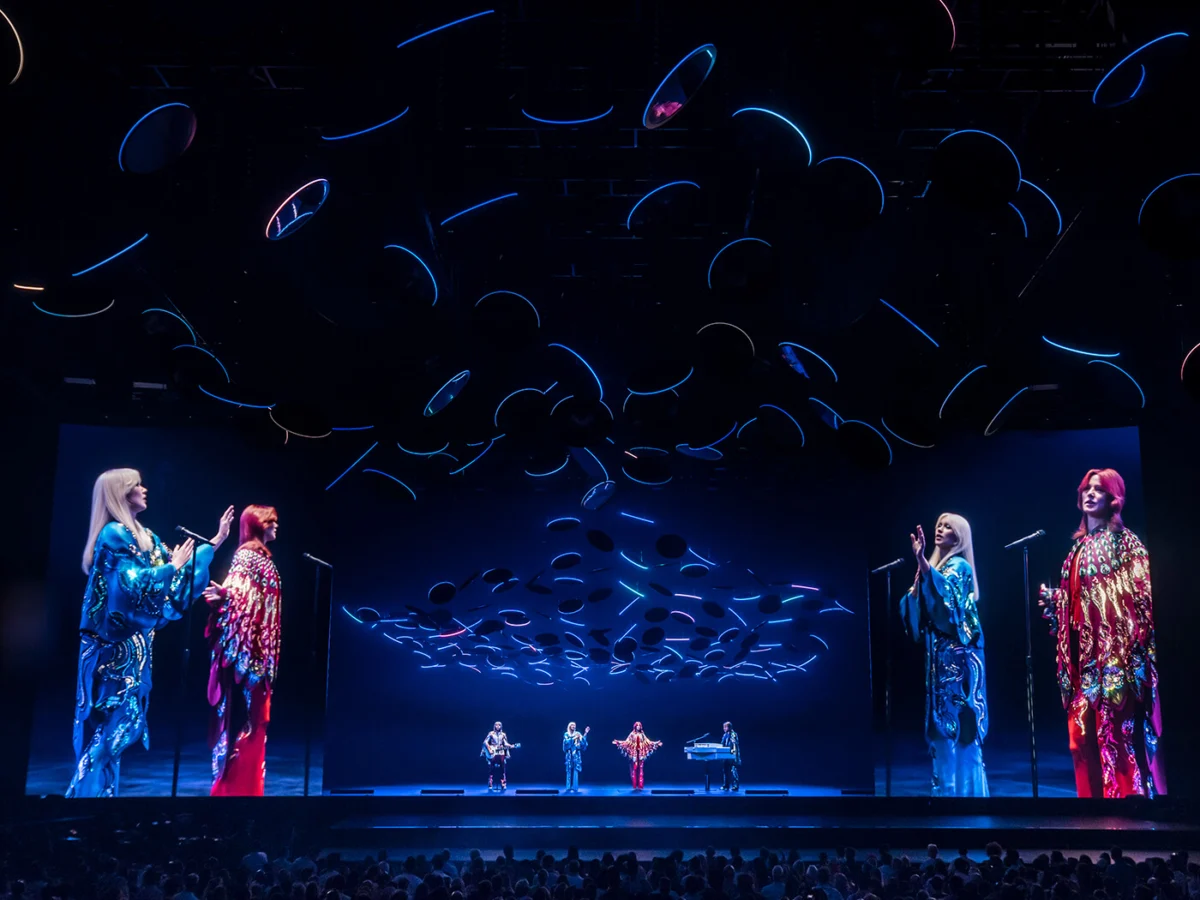
The ABBA Voyage concert experience stands as a groundbreaking fusion of cutting-edge technology and unparalleled musical artistry, resurrecting the iconic sound of one of the 1970s’ most beloved pop groups, ABBA. Far from a mere tribute, this pioneering residency, held in a purpose-built arena in London, presents digital avatars of the Swedish quartet performing alongside a live 10-piece band, a critical component that breathes authentic life into the timeless repertoire. At the heart of this intricate musical machinery are guitarists Fernando Sanchez and Christian Mendoza, entrusted with the meticulous task of replicating the intricate guitar parts that define ABBA’s legendary recordings.
The Genesis of a Digital Phenomenon and ABBA’s Enduring Legacy
ABBA, comprising Agnetha Fältskog, Björn Ulvaeus, Benny Andersson, and Anni-Frid Lyngstad, disbanded in 1982, leaving behind a monumental legacy of chart-topping hits and a profound influence on global pop music. Their catalogue, characterized by lush arrangements, intricate harmonies, and infectious melodies, has remained a cultural touchstone for generations. The group’s unexpected reunion in 2021 for the album Voyage marked a significant moment, delighting fans worldwide and proving their enduring appeal. This album served as a prelude to the even more ambitious ABBA Voyage concert, which premiered in May 2022.
The technological marvel at the core of ABBA Voyage involves "ABBA-tars"—digital representations of the band members created through sophisticated motion capture techniques. This advanced process, spearheaded by Industrial Light & Magic (ILM), the visual effects powerhouse behind cinematic blockbusters from Star Wars to Jurassic Park, distinguishes these digital performers from conventional holograms. The ABBA-tars are not projections but fully realized digital characters, rendered with astonishing realism, whose movements and expressions were captured from the actual band members performing for weeks in motion-capture suits. This allows for a seamless, immersive experience where the digital performers interact dynamically with the stage environment and the live band, creating an illusion of the original members performing in their prime.
The ABBA Arena, a bespoke 3,000-capacity venue located in Stratford, East London, was designed specifically to host this unique spectacle. Its innovative architecture and advanced sound and lighting systems are integral to the immersive quality of the show, providing a canvas for the digital magic while ensuring the live band’s performance is heard with pristine clarity.

The Human Element: Crafting the Sonic Tapestry
Despite the advanced digital components, the ABBA Voyage experience is firmly grounded in live musicianship. A 10-piece band, positioned subtly on stage, provides the essential human energy and sonic depth. This ensemble is tasked with the demanding challenge of bringing ABBA’s memorable music to life nightly for 21st-century audiences, ensuring that the blend of digital and live elements is indistinguishable.
The twin guitar team of Fernando Sanchez and Christian Mendoza shoulders a particularly intricate responsibility: to reproduce, with unwavering fidelity, the distinctive guitar arrangements from ABBA’s original studio recordings. This is not a platform for personal interpretation or improvisation but a rigorous exercise in sonic reconstruction, demanding precision, historical awareness, and exceptional technical skill.
"We try to stick as much as we can to the original part and to the arrangements that we’ve been told to play," explains Sanchez, who joined the Voyage band after auditioning in June 2025 and made his live debut in December of the same year. He acknowledges the natural inclination for musicians to subtly embellish over repeated performances. "However, because we’re playing every night and doing a lot of shows, you are in this little bubble and so, you start adding a little note here, and adding on something there. But when I do that personally, the next day I try to go back to the original so I don’t lose track of what I’m supposed to be playing. We know as musicians we can do other things and maybe embellish it or do something, but I always try to go back to the original the next day." This disciplined approach underscores the production’s commitment to authenticity.
Mendoza, now in his third season with the Voyage troupe, having first auditioned in December 2023 and debuted in April 2024, echoes this sentiment, emphasizing the sanctity of ABBA’s catalogue. "I would say that this is not a job for me to put much of a stamp on what I want or what I would think would be needed," he states. "These are timeless classics and to go and change like a lead part because I want to do something, is not on. I think the purpose of us is to recreate this music and have people hear these lines and be excited that they’re hearing the stuff that they were excited about when they were young or first heard it." This philosophy highlights the deep respect the musicians hold for the source material, positioning themselves as conduits for ABBA’s original artistic vision.
The Art of Sonic Reconstruction
From the outset, the modus operandi for all musicians involved in ABBA Voyage has been the meticulous reconstruction of the original recordings’ sonic aspects. This process involved detailed charts provided to the musicians, outlining every nuance of the parts.

"It’s not necessarily a gig where you have to read music, but it is obviously a massive plus if you do," Sanchez elaborates. "I do read music. So, in my case, I got sent the charts and I had to learn the songs before we went into rehearsals. And then in rehearsals we have our MD [Musical Director] who is guiding us through it, so if we’re playing a part that is not being played correctly, he will come and let you know what we’re supposed to be basically doing." This structured learning environment ensures a unified, faithful performance across the entire band.
Crucially, the musicians also received direct guidance from ABBA’s own piano maestro, Benny Andersson, during early rehearsals. His presence underscored the production’s dedication to absolute fidelity. "When I joined, Benny was at some of the rehearsals and there were a few things like if he heard something that he maybe wanted more closer to on the record, he would mention it," Mendoza recalls. He shares a specific anecdote about the lead line in "Knowing Me, Knowing You": "It was funny because he said, ‘I don’t know what’s on the paper as it doesn’t matter, because what’s on the record is this’. And he then sang the line to us." This incident perfectly illustrates Andersson’s unwavering commitment to the original recordings, even over written charts, and the profound respect given to the sonic identity of ABBA’s music. Mendoza notes Andersson’s graciousness, suggesting that the musicians were already largely aligned with the intended performance, making such interventions rare but impactful.
The Unique Challenges of Analog Rhythms in a Digital Age
One of the most significant and unexpected difficulties faced by both guitarists and the entire live band stems from the inherent characteristics of ABBA’s original recordings. Produced in the pre-digital era, many of these tracks were laid down without the aid of click tracks—a ubiquitous tool today for maintaining perfect tempo consistency. This means the original recordings often possess subtle, organic fluctuations in tempo.
"Some of the tracks are not exactly to the grid," Sanchez observes. "People record to a click track today, but some of the avatar’s instruments are not to a click so, we have to pay attention." He cites "Chiquitita" as a prime example. "There’s a part where Christian and I are playing the exact same thing and we need to listen to the track intently because it kind of moves around the click. And if we are not playing accurately to that part, it’ll just sound a bit messy."
Mendoza further elaborates on this challenge: "There’s a click in our tracks, but they [ABBA] didn’t put the music to a grid, so it’s going to move. In ‘Chiquitita’, because everything goes quiet at one point, the click obviously is louder in our ears than normally, but because the piano part is slower, we kind of have to ignore the click in that part at the beginning and just play to the piano, even though the click is still there." This requires an almost intuitive musicality, forcing the live musicians to synchronize with the organic ebb and flow of the original recordings rather than a rigid metronome.

Another instance arises in "Thank You for the Music," where "the click is only given to us in the intro and then we don’t have a click. So, the drummer has to play to the vocals and we have to match his beats to the vocals. But that’s a lot easier to feel, as you’re playing in time following the drums," Mendoza explains. These challenges highlight the high level of musicianship and adaptability required to perform in a show that masterfully blends fixed digital elements with fluid live performance.
The Tools of Authenticity: Gear Selection
Perhaps surprisingly, given the high-tech nature of the ABBA Voyage production, both guitarists opt for real tube amplifiers for their sound. This decision underscores the pursuit of authentic tonal replication, as tube amps are renowned for their warm, dynamic, and organic sound that digital emulations often struggle to perfectly capture. Both Mendoza and Sanchez employ Mesa/Boogie California Tweed amplifiers, known for their versatility and classic American clean and overdriven tones, which align well with the sonic palette of ABBA’s music.
Mendoza primarily utilizes a Fender Telecaster for the majority of the concert, switching to a Fender Stratocaster for a few select numbers. The Telecaster, with its bright, punchy, and articulate sound, is a workhorse guitar perfectly suited for the rhythmic and lead parts often found in ABBA’s songs. The Stratocaster, with its smoother tones and tremolo system, offers different sonic textures when needed. Sanchez, on the other hand, relies exclusively on a Fender Stratocaster for his entire performance, leveraging its iconic versatility.
The selection of guitar tones is equally crucial, requiring precise matching to the original recordings. Mendoza meticulously built his pedalboard with specific overdrives to achieve the nuanced sounds. "I built my pedalboard to what I knew and also after hearing the music, certain overdrives because the gig doesn’t really necessarily need much distortion," he explains. "I try to get close to it with just an overdrive tone, not so much 80s distortion or whatever. I got a Phase 90 too because of the funky parts and all that kind of stuff." He recounts an audition experience where a guitarist with a heavier, more metal-oriented tone was asked to dial back the drive, highlighting the strict adherence to stylistic context.
Sanchez faced a different challenge, inheriting a pedalboard from the previous guitarist. "I got given the pedalboard that the previous guitarist had chosen for the gig," he interjects. "So, for me, the challenge was to rearrange the way I wanted to use the pedal board, because obviously the other guitarist was using it in a different way. So that might have affected the tone. I had to try to change a few things, but it was a conversation that we had to have with the guys, so that I didn’t change the tone much because it’s a very specific thing for the show." This collaborative approach ensures that the guitar tones remain consistent with the production’s exacting standards.

Navigating Performance Demands and the "Road Dog" Mentality
With multiple performances per week, sometimes including two shows in a single day, the physical and mental demands on the musicians are substantial. Maintaining the highest level of precision and energy night after night requires profound dedication and a deep love for live performance.
Sanchez finds his motivation in the direct interaction with the audience. "Because it’s a live band and we’re on stage all the time, for me that gets me buzzing with the audience," he affirms. "It’s not like other stage shows where you are sat in a pit and it’s very small. I get excited if I’m going on stage to play to 3,000 people every night and even though we’re playing the same thing, there are fantastic arrangements, and the band that we’re playing with is amazing. And we have certain freedom to interact with each other on stage, too, which makes it more interesting." The ability to connect with a live audience, even within the structured confines of the show, provides an invaluable source of energy and engagement.
Mendoza, describing himself as a "road dog," thrives on the rigorous schedule. "I’m more than happy for me as a musician personally. A day played, is better than a day you have not played," he states, drawing on a lifetime of performing. "And I started out with my first paid gig, when I was 15 years old playing weddings with my parents. My parents are musicians and I played clubs five days a week and three one-hour sets back in my home country of Mexico. So, I’m used to very late nights and playing and that’s just what I live for." This extensive background in demanding live performance environments has instilled in him the discipline and resilience necessary for the ABBA Voyage residency.
A New Paradigm for Live Music
The ABBA Voyage concert has not only captivated millions of attendees but also set a new precedent for immersive live entertainment. Its commercial success has been immense, consistently selling out performances and generating significant revenue, demonstrating a viable model for legacy artists to extend their careers and reach new audiences in innovative ways. The critical acclaim for the show has been equally robust, praising its technological ambition and the seamless integration of digital and live elements.
The broader implications of ABBA Voyage extend beyond its immediate success. It showcases how technology can be harnessed to preserve and reinterpret cultural heritage, allowing generations to experience iconic performances in a truly unique format. This production proves that even in an era dominated by digital spectacle, the irreplaceable warmth, spontaneity, and energy of live musicians remain absolutely vital. The dedication of individuals like Fernando Sanchez and Christian Mendoza, who tirelessly work to honor the original sonic integrity of ABBA’s music, ensures that the ABBA Voyage is not merely a technological demonstration, but a profoundly authentic and moving musical experience. It stands as a testament to the enduring power of ABBA’s music and the boundless possibilities when human artistry meets cutting-edge innovation.
