

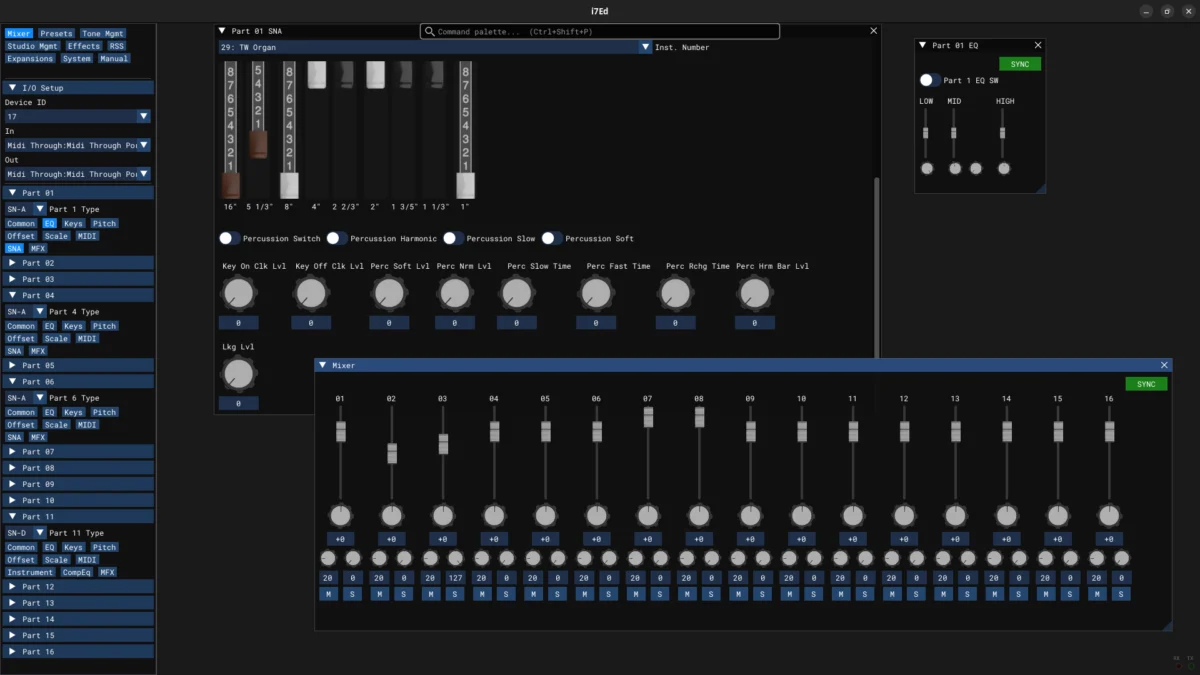
The release of the Integra-7 Editor, commercially known as i7Ed, marks a significant milestone for users of the Roland Integra-7 SuperNATURAL Sound Module, offering a sophisticated third-party software solution designed to streamline the complex workflow associated with the flagship rackmount unit. Developed to bridge the gap between hardware limitations and modern digital audio workstation environments, i7Ed provides a native interface for both Windows and Linux operating systems. By utilizing direct MIDI and System Exclusive (SysEx) communication, the editor allows musicians and sound designers to bypass the often-cumbersome front-panel navigation of the hardware, granting immediate access to the unit’s vast internal architecture, which includes over 6,000 sounds and a sophisticated multi-effects engine.
The Roland Integra-7, since its introduction in late 2012, has remained a cornerstone in professional studios due to its "SuperNATURAL" acoustic and synth engines and its inclusion of all 12 SRX expansion boards. However, the depth of its menu system has historically been a point of friction for users. The i7Ed software addresses these ergonomic challenges by consolidating Studio Set settings, individual part parameters, and system-level configurations into a cohesive visual environment. Priced at €59.00, the editor is positioned as a critical utility for power users seeking to maximize the utility of their hardware investment without the constraints of official, often platform-restricted, legacy software.
Historical Context and the Evolution of Roland Sound Modules
To understand the necessity of the i7Ed, one must examine the lineage of Roland’s rackmount synthesizers. The Integra-7 was designed as the "greatest hits" of Roland’s sound library, succeeding legendary units such as the JV-1080, XV-5080, and the Fantom series. When it was released, it represented a shift toward high-fidelity behavioral modeling through the SuperNATURAL engine, which sought to replicate not just the sound of acoustic instruments, but their performance characteristics.
Despite its sonic prowess, the physical interface of the Integra-7—a 2U rack unit with a relatively small backlit LCD—was never optimized for the deep sound design required by modern producers. Roland initially addressed this by releasing an iPad editor, but this solution required specific hardware dongles or wireless setups and was subject to the volatility of iOS updates. As the years progressed, the lack of a robust, native desktop editor for Windows and Linux became a significant gap in the product’s ecosystem. The emergence of i7Ed represents a community-driven response to this professional demand, ensuring that the hardware remains viable and accessible in an era where "in-the-box" software control is the industry standard.
Technical Architecture of the i7Ed Software
The i7Ed is not a simple MIDI CC mapper; it is a comprehensive SysEx-based application that mirrors the internal state of the Integra-7. The software communicates bi-directionally, meaning that changes made on the software interface are reflected instantly on the hardware, and in many cases, hardware adjustments can be captured by the software. This synchronization is crucial for maintaining "Studio Sets," which are the Integra-7’s equivalent of multi-timbral patches containing 16 parts, each with its own effects chain, routing, and MIDI channel assignments.
The editor provides dedicated modules for the different synthesis types found within the unit. This includes the SuperNATURAL Acoustic tones, which feature specific parameters for instrument behavior (such as staccato or legato articulations), and the SuperNATURAL Synth engine, which offers a more traditional three-oscillator subtractive synthesis architecture. Additionally, the editor supports the legacy PCM Synth and PCM Drum kits, which comprise the bulk of the unit’s 6,000+ presets. By laying these parameters out on a single screen, i7Ed eliminates the "menu-diving" that has traditionally slowed down the creative process for Integra-7 owners.
Comprehensive Control and Feature Set
The feature set of i7Ed is designed to cover nearly every editable parameter within the Integra-7’s operating system. Key functionalities include:

- Studio Set Management: Users can load, save, and organize Studio Sets, which manage the complex routing of the 16 internal parts. This includes the ability to assign any of the 12 virtual SRX expansion slots, which were a hallmark of the Integra-7’s design.
- Tone Editing: Full access to SuperNATURAL Synth, SuperNATURAL Acoustic, SuperNATURAL Drum, PCM Synth, and PCM Drum tones. This includes envelope generators, filter cutoffs, LFO assignments, and resonance settings.
- Effects Processing: The Integra-7 features a robust multi-effects (MFX) engine for each of its 16 parts, along with global chorus and reverb. The i7Ed provides a visual interface for tweaking these effects, which is significantly more intuitive than adjusting numerical values on the hardware’s screen.
- Master EQ and System Settings: Beyond individual sounds, the editor allows for the adjustment of the Master EQ and system-wide settings, such as MIDI clock sync and global tuning, ensuring the unit is properly integrated into the studio’s signal chain.
The inclusion of Linux support is particularly noteworthy. While Windows and macOS often receive priority in the pro-audio world, the Linux community has a dedicated segment of audio engineers and hobbyists who utilize the Jack Audio Connection Kit (JACK) and Advanced Linux Sound Architecture (ALSA). The availability of a native i7Ed for Linux provides these users with a professional-grade tool that was previously unavailable.
Chronology of Development and Market Release
The development of third-party editors for Roland gear has a long history, often spurred by the manufacturer’s transition to newer product lines and the subsequent cessation of software updates for older units. The Integra-7, while still a part of Roland’s current catalog in some regions, has seen a slowdown in official software support.
- 2012: Roland Integra-7 is launched to critical acclaim.
- 2013-2015: Roland releases an official iPad editor and a limited VST plug-in for specific DAWs, but these tools face compatibility issues as operating systems evolve.
- 2018-2022: The rise of third-party developers filling the void for aging hardware modules. Various "Ctrlr" panels and MIDI maps appear, but few offer a complete, native standalone experience.
- 2024: The formal release of i7Ed (Integra-7 Editor) by Beasty Bobs, providing a stable, high-performance alternative for the two most prominent desktop operating systems used in technical and creative environments.
Industry Implications and Analysis
The release of i7Ed highlights a broader trend in the music technology industry: the "hybridization" of the studio. While software instruments (VSTs) are more powerful than ever, many professionals still prefer the sound of dedicated hardware processors and synthesizers. However, the expectation is now that hardware must behave like software in terms of ease of use.
From an economic perspective, the €59.00 price point reflects the specialized nature of the software. Developing a SysEx editor for a machine as complex as the Integra-7 requires hundreds of hours of reverse engineering and MIDI mapping. For professional composers working on tight deadlines—such as those in film or game scoring—the time saved by using a visual editor rather than front-panel buttons justifies the cost. Furthermore, by extending the usability of the Integra-7, i7Ed helps maintain the resale value of the hardware, as potential buyers are more likely to invest in a module that has a modern, functional software interface.
User Reactions and Community Integration
Initial feedback from the synthesizer community has been largely positive, particularly regarding the software’s stability and low CPU overhead. Because i7Ed is a native application rather than a browser-based tool or a resource-heavy wrapper, it runs efficiently alongside a DAW. Users have noted that the ability to visualize the entire 16-part Studio Set at once allows for better orchestration and mixing within the hardware itself, reducing the need for external processing.
There is also a significant "preservation" aspect to this release. As hardware ages, the physical buttons and rotary encoders can fail. By moving the control surface to a computer screen, i7Ed reduces the physical wear and tear on the Integra-7 unit, potentially extending its operational lifespan by years.
Pricing, Availability, and Final Specifications
The Integra-7 Editor (i7Ed) is currently available for purchase and download via the official Beasty Bobs website. It is compatible with Windows 10 and 11, as well as modern Linux distributions. The purchase includes the standalone application, which requires a standard MIDI interface or a USB connection to the Integra-7 unit to function.
As the music production landscape continues to evolve, the arrival of i7Ed ensures that the Roland Integra-7 remains a centerpiece of the modern studio. By providing a bridge between 2012 hardware and 2024 software standards, the editor solves the primary bottleneck of one of the most powerful sound modules ever created, offering a refined, efficient, and professional workflow for the global community of Roland users.
