

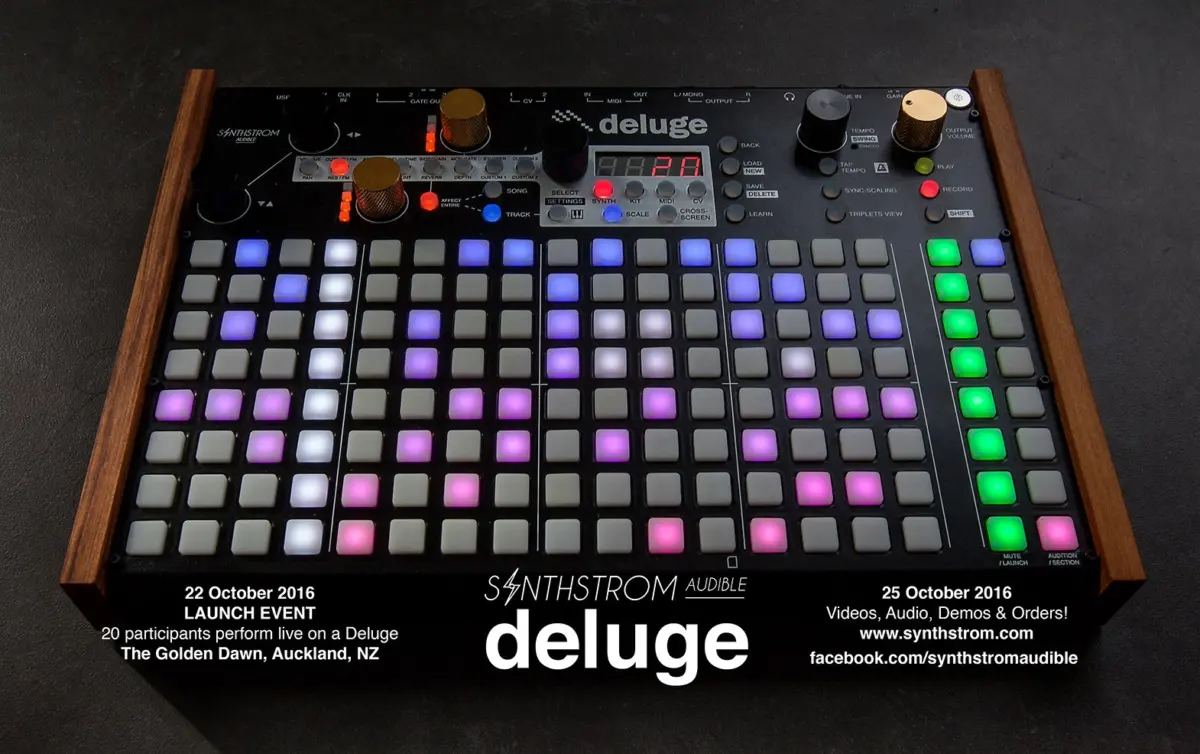
The release of the Deluge 1.3 "Derbyshire" firmware on November 4 represents a significant milestone in the lifecycle of the New Zealand-manufactured standalone synthesizer, sampler, and sequencer. This update, developed through the collective efforts of the Deluge community following the manufacturer’s decision to open-source the instrument’s code, brings extensive upgrades to the internal sound engine, sequencing logic, MIDI/CV integration, and the overall user interface. Named in honor of electronic music pioneer Delia Derbyshire, the firmware iteration seeks to modernize the hardware’s capabilities, ensuring its continued relevance in a competitive market of portable production environments.
The Evolution of the Deluge and the Open-Source Paradigm
The Synthstrom Audible Deluge first entered the market in 2016 as a boutique alternative to mainstream grooveboxes. Its unique grid-based interface and "all-in-one" philosophy garnered a dedicated following. However, the most transformative event in the instrument’s history occurred in May 2023, when Synthstrom Audible made the unprecedented move to release the device’s firmware source code under a non-commercial open-source license. This transition allowed a global network of volunteer developers to contribute directly to the machine’s operating system.
The "Derbyshire" update is the latest fruit of this collaborative model. By leveraging the expertise of software engineers who are also active users of the instrument, the community has been able to address long-standing feature requests and technical bottlenecks that might have been beyond the scope of a small independent manufacturer. This release follows previous community iterations, each building upon the hardware’s internal ARM processor capabilities to extract more performance and utility without requiring physical hardware modifications.
Significant Advancements in the Internal Sound Engine
The 1.3 update focuses heavily on expanding the sonic palette of the Deluge’s internal subtractive and FM synthesis engines. Traditionally limited by a fixed number of modulation sources, the new firmware introduces two additional Low-Frequency Oscillators (LFOs) and two additional envelopes per voice. This effectively doubles the modulation potential for complex sound design, allowing users to create evolving textures that were previously impossible without external processing.
In addition to increased modulation slots, a new "Warble" LFO type has been implemented. This specialized modulation source is designed to simulate the organic pitch instability found in vintage analog hardware and tape machines. This is complemented by the introduction of the "Warbler" effect, a dedicated processor for adding vibrato, wow, and flutter to any internal or external audio source.
The spatial and temporal effects suite has also seen a major overhaul. The "Dimension" effect—a spatial enhancer likely inspired by classic bucket-brigade device (BBD) choruses—and a new Digital Reverb algorithm have been added to the master and track-level processing chains. Furthermore, the "Grain" effect, which facilitates granular synthesis, has been completely reworked. The optimization of the granular engine allows for more simultaneous grains and smoother playback, reducing the CPU overhead that previously limited the use of this feature in dense arrangements.
Enhanced Sequencing Logic and Arp 2.0
The Deluge has long been praised for its "infinite" sequencer canvas, but the 1.3 update introduces a level of algorithmic complexity typically found in high-end modular systems or dedicated sequencers like those from Elektron. The centerpiece of these changes is "Arp 2.0." This expanded arpeggiator allows for sophisticated pattern generation across synth, kit, MIDI, and CV tracks.
Key to this new sequencing power is the decoupled control of note probability, iteration, and fill. In previous versions, these functions were often rudimentary; now, they can operate independently or in tandem. For example, a user can program a drum hit to occur only on the fourth iteration of a loop (iteration) while simultaneously giving it a 50% chance of triggering (probability). This allows for "generative" compositions where the sequence evolves over time without manual intervention.
A new Randomizer menu further supports this workflow, providing options for velocity spread and probability randomization. This feature is particularly useful for humanizing mechanical-sounding MIDI patterns. Additionally, the ability to save these generated patterns as standalone files or import patterns directly from external MIDI files streamlines the transition between studio composition and live performance.
Performance Optimizations and User Interface Refinements
The "Derbyshire" update addresses the physical limitations of the Deluge’s hardware, specifically regarding the OLED screen introduced in later hardware revisions. The firmware now includes horizontal menus optimized for the OLED display, making navigation through the instrument’s deep sub-menus more intuitive and visually clear.
Responsiveness has been a primary focus for the community developers. Improvements in sample loading and caching mechanisms have been implemented to ensure that even large multi-sample libraries load with minimal latency. This is a critical update for live performers who rely on the Deluge to switch between complex projects seamlessly.
For users integrating the Deluge into a larger studio ecosystem, the update provides enhanced MIDI clock stability and the introduction of MIDI device definition files. These files allow users to name and assign Continuous Controller (CC) controls for external hardware, transforming the Deluge into a more capable "brain" for a hardware studio. The implementation of interpolated CC and CV automation ensures that parameter changes are smooth and free of "zipper noise" or stepping, which is vital for professional-grade recording.
Timeline of Development and Release
The journey toward the 1.3 "Derbyshire" release followed a rigorous testing phase:
- May 2023: Synthstrom Audible open-sources the Deluge firmware.
- Late 2023 – Early 2024: Community developers release version 1.1 and 1.2, focusing on foundational stability and UI improvements.
- Mid-2024: The "Derbyshire" feature set is finalized, entering an intensive "beta" testing period where users provide feedback on the new effects and Arp 2.0 logic.
- November 4, 2024: Official public release of the 1.3 "Derbyshire" firmware.
This timeline illustrates the speed at which community-driven development can operate when compared to traditional corporate product cycles, where such a massive overhaul might take years to reach the public.
Technical Data and System Requirements
The 1.3 firmware is compatible with all Deluge hardware units, including the original non-OLED models, although certain UI features are specifically tailored for the newer screens.
- File Size: Approximately 2MB (firmware binary).
- Distribution: Free download via the Deluge Community website.
- Core Improvements: 2x LFO increase, 2x Envelope increase, 3 new effect algorithms, 40% improvement in sample indexing speed (estimated based on community benchmarks).
The firmware is installed by placing the binary file on the Deluge’s SD card and holding the ‘Shift’ and ‘Start’ buttons during boot-up, a process that has remained consistent since the device’s inception.
Implications for the Boutique Music Hardware Industry
The success of the Deluge 1.3 "Derbyshire" release serves as a case study for the music technology industry. By open-sourcing their firmware, Synthstrom Audible has effectively extended the commercial life of their hardware indefinitely. In an era where "planned obsolescence" is a common consumer grievance, the community-led model offers a sustainable alternative.
Industry analysts suggest that this move could pressure other boutique manufacturers to adopt similar strategies. When a community takes ownership of the software, the manufacturer is freed to focus on hardware production and supply chain management, while the users ensure the software remains cutting-edge. The "Derbyshire" update proves that volunteer developers can implement sophisticated features—such as tempo automation in Arranger View and complex MIDI definitions—that rival the software development teams of much larger corporations.
Official Response and Community Reception
While Synthstrom Audible maintains a supportive but hands-off approach to the community firmware, the company has expressed its approval of the "Derbyshire" release, noting that the community’s work aligns with the original vision of the Deluge as a versatile and "future-proof" instrument. Lead developers within the community have noted that the "Derbyshire" release is not the end of the road; rather, it sets the stage for version 1.4, which is expected to explore further optimizations of the internal FM engine and expanded multi-track recording capabilities.
Users across forums and social media have responded with overwhelming positivity, particularly regarding the new Digital Reverb and the Arp 2.0 features. The consensus among the user base is that the update feels like receiving a new piece of hardware for free, reinforcing the loyalty of the Deluge community.
Conclusion
The Deluge 1.3 "Derbyshire" firmware update is more than just a software patch; it is a comprehensive evolution of a beloved instrument. Through the addition of advanced modulation, refined sequencing logic, and significant performance optimizations, the community has elevated the Deluge to new heights of functionality. As the instrument continues to evolve under the stewardship of its users, it stands as a testament to the power of open-source collaboration in the world of professional music production.
