

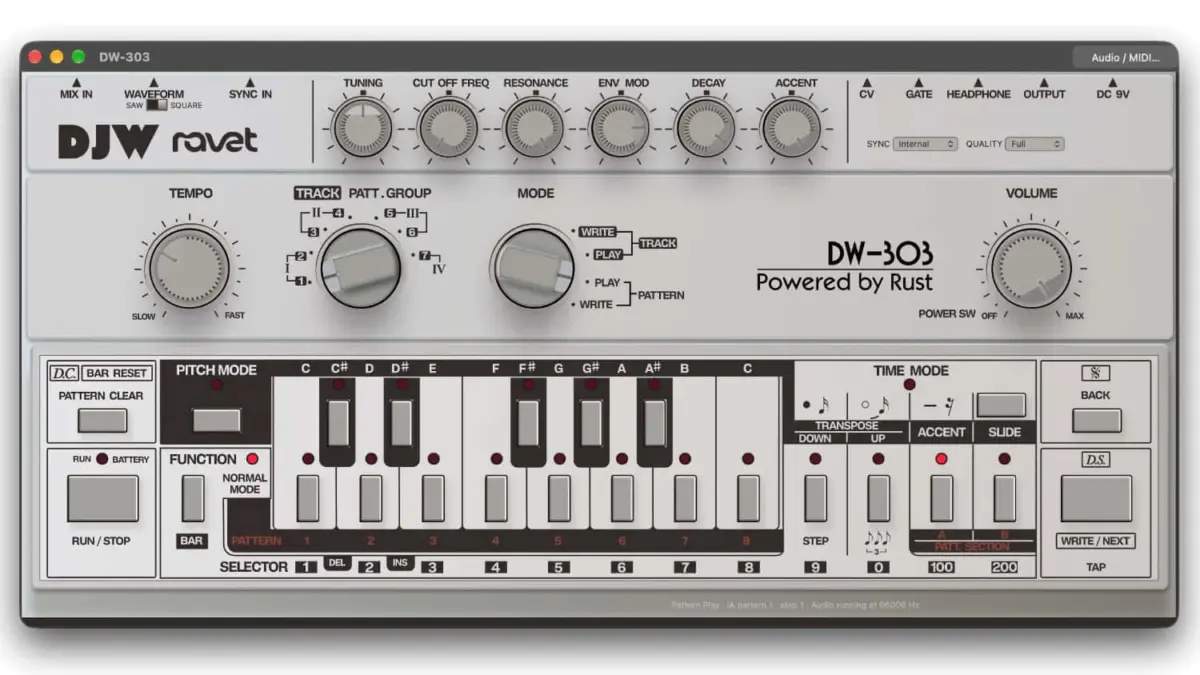
The landscape of digital music production has seen a significant addition with the release of the DW-303 by UK-based developer DJW Audio, a high-fidelity, open-source software emulation of the legendary Roland TB-303 Bass Line synthesizer. This new entry into the virtual instrument market distinguishes itself not only through its cost-free availability but also through its rigorous approach to component-level modeling, aimed at capturing the idiosyncratic behavior of the original hardware that defined the sound of acid house and electronic dance music. Available for macOS, Windows, and Linux, the DW-303 represents a convergence of vintage analog aesthetics and modern software engineering, offering a comprehensive suite of features that cater to both purists and contemporary producers.
Technical Foundation and Component-Level Modeling
At the core of the DW-303 is a sophisticated simulation engine that departs from standard virtual-analog techniques. While many software synthesizers utilize generic digital filters and oscillators to approximate the "303 sound," DJW Audio has employed component-level modeling. This process involves translating the original 1982 circuit schematics into mathematical algorithms that represent each individual resistor, capacitor, and transistor in the signal path.
The developer notes that the software recreates the TB-303’s unique signal flow stage by stage. This includes the initial waveform generation, the distinctive resonant ladder filter, the envelope modulation circuitry, and the final amplifier stage. By modeling the circuit at this granular level, the DW-303 is able to replicate the non-linearities and "organic" imperfections of the hardware. Specifically, the modeling was refined by comparing the digital output against physical measurements of original TB-303 hardware. This empirical approach ensured that the software accurately mimics the complex interactions between the filter resonance, the accent circuit, and the slide functionality—elements that are notoriously difficult to capture in the digital domain.
To accommodate different production environments, DJW Audio has included two processing modes. The "Full" quality mode utilizes the complete circuit simulation, providing the highest level of sonic accuracy at the expense of higher CPU consumption. For users working on complex projects with multiple plugin instances, an "Economy" mode provides a streamlined processing option that maintains the essential character of the instrument while reducing the computational load.
Historical Context: The Legacy of the Silver Box
To understand the significance of the DW-303 release, one must look at the history of the instrument it seeks to emulate. The Roland TB-303 was originally released in 1981 as a tool for guitarists to practice with a "bass accompaniment." However, its unrealistic tone and difficult programming interface led to its commercial failure and eventual discontinuation in 1984.
The instrument’s second life began in the mid-to-late 1980s when producers in Chicago and Detroit discovered the TB-303 in pawn shops and second-hand stores. By pushing the machine beyond its intended use—specifically by cranking the resonance and utilizing the "Accent" and "Slide" functions—artists created a squelching, psychedelic sound that became the foundation of the Acid House genre. Over the decades, the TB-303 has transitioned from a discarded practice tool to a holy grail of electronic music, with original units now fetching thousands of dollars on the vintage market.
The DW-303 enters a market where "303 clones" are numerous, ranging from Roland’s own boutique hardware and Cloud-based software to Behringer’s hardware recreations and D16 Group’s Phoscyon. The decision by DJW Audio to release an open-source version provides a transparent, community-driven alternative to these commercial offerings, ensuring that the "303 sound" remains accessible to all musicians regardless of their financial resources.
The 16-Step Sequencer and Programming Workflow
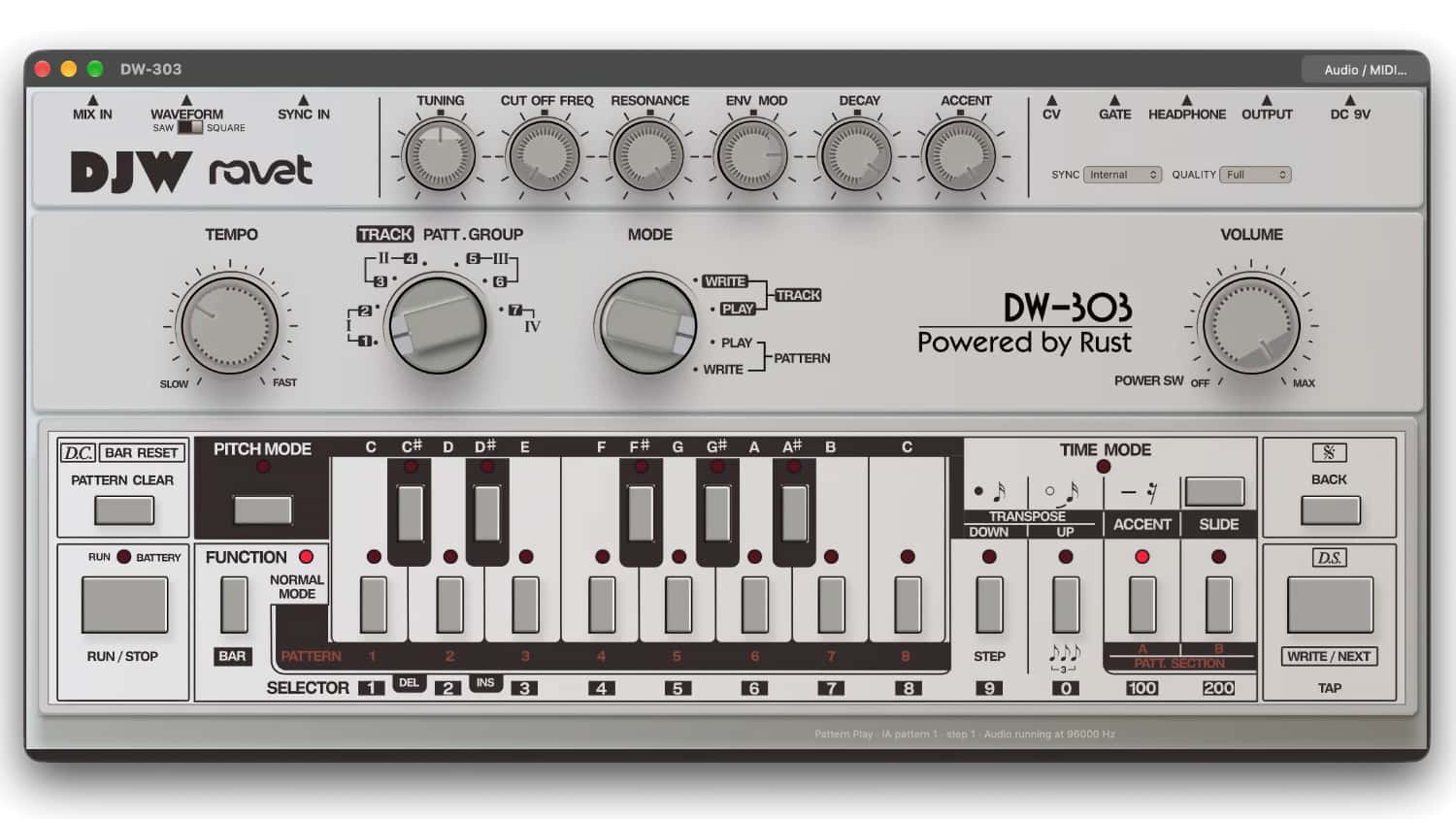
A critical component of the TB-303’s charm is its notoriously idiosyncratic sequencer. The DW-303 faithfully recreates this 16-step programming workflow, which is responsible for the rhythmic "feel" associated with acid basslines. Unlike modern piano-roll editors, the 303 workflow separates pitch entry from rhythmic timing.
In the DW-303, users enter notes in "Pitch Mode," defining the melodic sequence. This is followed by "Time Mode," where the user assigns the rhythmic value of each step—whether it be a note, a tie, or a rest. This separation often leads to "happy accidents," where the resulting pattern differs from what the producer originally envisioned, a phenomenon that is central to the history of the genre.
The DW-303 also supports the critical modifiers that give the 303 its expressive power:
- Slides: Creating a smooth portamento between notes.
- Accents: Increasing the volume and opening the filter cutoff for specific steps.
- Transposition: Shifting patterns across octaves in real-time.
While the plugin can operate as a standalone instrument, its integration with Digital Audio Workstations (DAWs) is seamless. When synced to a host, the internal sequencer follows the host’s tempo and transport controls. Furthermore, patterns are saved directly within the project session, eliminating the need for external pattern management.
Technical Specifications and Platform Compatibility
DJW Audio has ensured that the DW-303 is accessible across the entire spectrum of modern computing. The plugin supports an impressive array of formats, making it one of the most versatile 303 emulations available today.
Supported Formats:
- VST3: The industry standard for Windows and macOS.
- AU (Audio Units): Optimized for macOS and Logic Pro users.
- AAX: Compatible with Avid Pro Tools.
- CLAP (CLever Audio Plugin): A modern, open-standard plugin format that is gaining traction for its performance and extensibility.
- LV2: The primary format for Linux-based audio production.
The software is compatible with macOS 11 (Big Sur) or later, Windows 10 and 11, and Linux x86_64 distributions. The inclusion of a standalone application allows users to experiment with the synthesizer without opening a DAW, making it a portable tool for live performance or sound design.
The Significance of the Open-Source Model
Perhaps the most impactful aspect of the DW-303 release is its licensing. The project is licensed under the GPL-3.0-or-later license, and the source code is publicly available on GitHub. In an industry often dominated by proprietary software and restrictive Digital Rights Management (DRM), DJW Audio’s approach is a notable outlier.
The open-source nature of the DW-303 offers several advantages:
- Longevity: Because the source code is public, the community can maintain and update the plugin even if the original developer ceases support.
- Education: Aspiring DSP (Digital Signal Processing) engineers can study the code to understand how component-level modeling is implemented.
- Collaboration: Developers can contribute bug fixes or new features, potentially leading to community-driven forks or enhancements.
By removing the requirement for license keys or activation servers, DJW Audio has lowered the barrier to entry for high-quality synthesis, aligning with the "DIY" ethos that originally propelled the TB-303 to stardom.
Industry Reaction and Market Implications
The release of the DW-303 has been met with positive early feedback from the electronic music community. Many users have noted that while free plugins are common, free plugins that utilize sophisticated circuit modeling are rare. The inclusion of Linux support and the CLAP format has also been highlighted as a forward-thinking move that supports the diversification of the audio software ecosystem.
From a market perspective, the DW-303 poses an interesting challenge to commercial developers. While premium emulations like the Roland Cloud TB-303 or D16 Phoscyon 2 offer expanded feature sets—such as built-in distortion, delay, and advanced pattern generators—the DW-303 focuses on the "pure" experience of the original hardware. For producers seeking the raw, unfiltered sound of the 1982 unit, the DW-303 provides a compelling alternative that costs nothing.
Furthermore, the DW-303’s success could encourage other independent developers to adopt open-source models for specialized DSP projects. As computing power continues to increase, the ability to run complex circuit simulations in real-time becomes more accessible, potentially leading to a new era of high-fidelity "freeware" that rivals expensive commercial products.
Conclusion: A New Standard for Free Software
The DJW Audio DW-303 is more than just another synthesizer plugin; it is a testament to the current state of software engineering and the strength of the open-source community. By combining meticulous historical recreation with modern cross-platform compatibility, DJW Audio has provided a valuable tool for the global music production community.
Whether used to create the classic bubbling basslines of acid house or to provide a gritty, resonant foundation for modern techno and pop, the DW-303 stands as a highly capable instrument. Its release ensures that the legacy of the "Silver Box" will continue to evolve, powered by a new generation of producers who now have access to its iconic sound without the prohibitive costs of vintage hardware or expensive software subscriptions. The project remains available for download on the official DJW Audio website, with the source code open for inspection and contribution on GitHub, marking a significant milestone in the democratization of music technology.
