

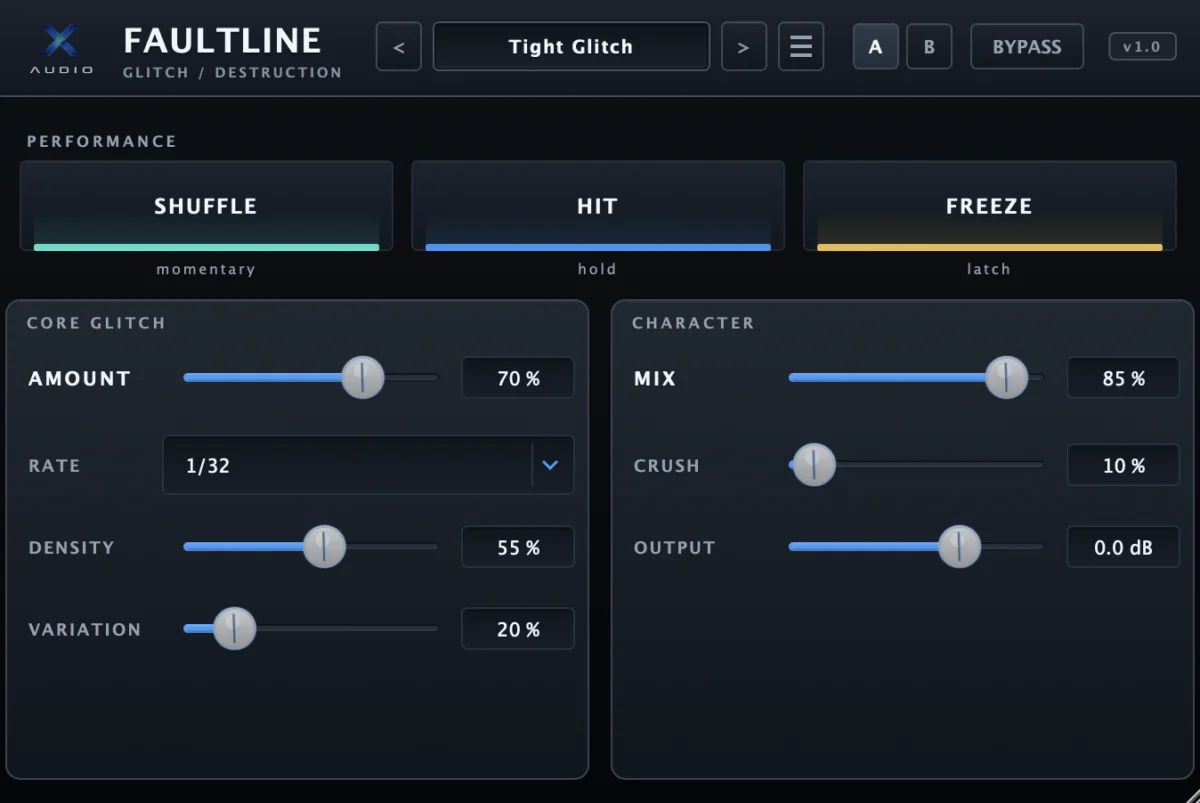
X-Audio has officially announced the release of FAULTLINE, a specialized glitch effect plugin designed to provide music producers and sound designers with a sophisticated toolkit for rhythmic audio destruction. Available for both macOS and Windows platforms, the plugin is being offered as a free download, positioning it as a highly accessible alternative to premium multi-effect sequencing tools. FAULTLINE integrates five distinct processing modules—beat repeat, freeze, shuffle, hit, and bitcrushing—into a unified interface designed for both studio composition and live performance. By focusing on a deterministic engine, X-Audio ensures that complex, randomized-sounding effects remain consistent across project bounces and playback sessions, addressing a common pain point in the world of experimental audio processing.
Technical Architecture and Core Processing Modules
The fundamental appeal of FAULTLINE lies in its ability to deconstruct incoming audio signals in real-time while maintaining strict synchronization with the host Digital Audio Workstation (DAW) tempo. The plugin utilizes a buffer-based system to capture audio fragments, which are then manipulated through various algorithmic layers. Unlike many vintage glitch tools that rely on unpredictable internal clocks, FAULTLINE’s architecture is built on a "deterministic" framework. In the context of digital signal processing (DSP), this means that for any given set of parameters and MIDI input, the resulting audio output will be identical every time it is played. This feature is critical for professional workflows where a producer may need to export multiple stems or re-render a track without the glitch patterns shifting unexpectedly.
The suite of effects included in FAULTLINE covers the essential vocabulary of modern glitch music. The "Beat Repeat" module allows users to loop small subdivisions of audio, creating the stuttering effects popularized in IDM (Intelligent Dance Music) and modern dubstep. The "Freeze" function sustains a momentary slice of audio indefinitely, often used to create tonal drones or rhythmic "hangs" in a sequence. "Shuffle" reorders the sequence of audio slices within a defined timeframe, introducing syncopation and rhythmic complexity. The "Hit" parameter functions as a triggered accent or momentary burst of processing, while the "Bitcrushing" module provides the characteristic digital grit associated with lower sample rates and bit depths. By combining these five processes, FAULTLINE allows for a wide spectrum of textures, from subtle rhythmic jitter to complete sonic disintegration.
The Evolution of Glitch Effects in Digital Music Production
The release of FAULTLINE marks a continuation of a decades-long evolution in "glitch" as both a genre and a production technique. The aesthetic of digital failure—skipping CDs, buffer underruns, and software crashes—first gained prominence in the late 1990s through the work of artists on labels like Warp Records and Mille Plateaux. Early practitioners often achieved these sounds through painstaking manual editing, cutting individual waveforms in a DAW or using hardware circuit-bending techniques.
As the 2000s progressed, software developers began to automate these processes. The arrival of plugins such as dblue Glitch and later, more advanced tools like Sugar Bytes Effectrix and iZotope Stutter Edit, revolutionized the workflow by allowing producers to trigger complex sequences of effects via MIDI. However, many of these professional-grade tools come with significant price tags. X-Audio’s decision to release FAULTLINE for free reflects a broader trend in the audio industry where high-quality DSP tools are increasingly democratized. By offering a streamlined, deterministic engine at no cost, X-Audio is lowering the barrier to entry for experimental sound design, enabling a new generation of producers to explore complex rhythmic manipulation without the need for expensive software suites.
Determinism and the Professional Mixing Workflow
One of the most significant features highlighted by X-Audio is the deterministic nature of FAULTLINE. In traditional analog gear or early digital "chaos" plugins, the element of randomness was often a double-edged sword. While it provided organic variation, it made the mixing and mastering process difficult. If a "perfect" glitch occurred during a live playback but could not be replicated during the final render (or "bounce") of the track, the producer would lose that specific creative moment.
FAULTLINE solves this by tying its internal logic strictly to the DAW’s timeline. Because the plugin calculates its effects based on the position of the playhead and the specific tempo of the project, the "shuffles" and "repeats" occur at the exact same millisecond every time the track is played. This reliability is essential for modern electronic music production, where precise timing and phase coherence are paramount. It allows engineers to apply FAULTLINE to a drum bus or vocal track and be confident that the processing will remain stable throughout the various stages of production, from initial arrangement to final delivery.
Market Context and Industry Implications
The release of FAULTLINE comes at a time when the "freemium" model and high-quality free releases are shaping the competitive landscape of the VST (Virtual Studio Technology) market. Developers often release powerful free tools to build brand loyalty and establish a user base for future paid products. For X-Audio, FAULTLINE serves as a demonstration of their DSP capabilities.

Supporting data from industry reports suggests that the global music production software market is expanding, driven by the rise of home studios and independent content creation. Within this market, there is a high demand for "one-knob" or "instant-vibe" plugins that can radically transform sound with minimal effort. FAULTLINE fits this niche by providing a curated set of controls that avoid the "analysis paralysis" often associated with more complex modular environments like Max/MSP or Reaktor.
Industry analysts note that free releases like FAULTLINE also put pressure on established developers to innovate. When a free plugin provides professional-grade results, paid alternatives must justify their cost through superior user interfaces, deeper modulation matrices, or extensive preset libraries. X-Audio’s entry into this space with a polished, cross-platform tool suggests a high level of confidence in their software architecture.
User Interface and Accessibility
X-Audio has designed FAULTLINE with a focus on visual feedback, which is crucial when dealing with destructive audio effects. The interface is built to be intuitive for both beginners and seasoned professionals. By providing clear visual indicators of which modules are active and how they are interacting with the tempo grid, the plugin demystifies the process of glitching.
For many producers, the challenge of using glitch effects is maintaining musicality. Excessive randomization can quickly turn a track into unlistenable noise. FAULTLINE’s tempo-synced approach ensures that even the most aggressive bitcrushing or shuffling remains "on the grid," making it easier to integrate these sounds into genres like techno, house, and trap, where rhythmic consistency is the foundation of the track.
Compatibility and Availability
FAULTLINE is designed to be highly compatible with modern computing environments. It supports both Windows and macOS, including native support for Apple Silicon (M1/M2/M3 chips), ensuring low-latency performance on the latest hardware. The plugin is available in standard formats (likely VST3, AU, and AAX), making it usable in all major DAWs, including Ableton Live, FL Studio, Logic Pro, Cubase, and Pro Tools.
The installation process is straightforward, with X-Audio offering the download directly through their online store. By removing the financial barrier, X-Audio has ensured that FAULTLINE can be adopted by a wide range of users, from hobbyists to professional sound designers working in the film and gaming industries.
Future Implications for Sound Design
The introduction of FAULTLINE suggests a growing interest in "controlled chaos" within digital audio. As music production continues to move toward more automated and AI-assisted workflows, tools that allow for intentional, rhythmic "breaking" of audio offer a humanistic counterpoint. The ability to "freeze" or "shuffle" audio in a repeatable way allows for a level of micro-editing that was previously the domain of specialists.
Furthermore, the deterministic nature of the plugin hints at potential applications beyond music. Sound designers for video games often require sounds that are complex yet predictable for implementation in game engines. A tool that provides consistent results every time a specific trigger is hit is highly valuable in a non-linear media environment.
In summary, X-Audio’s FAULTLINE represents a significant addition to the landscape of free audio software. By combining essential glitch processes with a stable, deterministic engine, it provides a professional-grade solution for rhythmic audio manipulation. Its release highlights the ongoing democratization of high-end production tools and offers a versatile new resource for creators looking to push the boundaries of conventional sound. As the plugin finds its way into the toolkits of producers worldwide, it is likely to influence the sonic character of upcoming releases across various electronic and experimental genres.
