

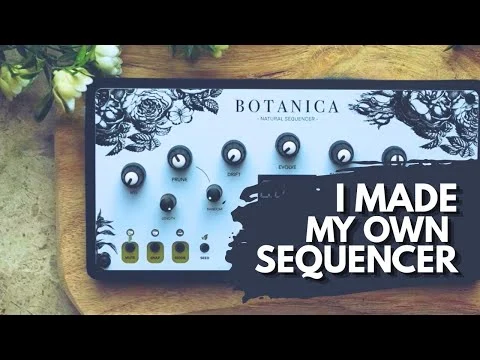
The landscape of modern electronic music production is currently witnessing a significant shift toward tactile, hardware-centric workflows. Within this evolving ecosystem, Dutch synthesist and developer Chris van der Linden, operating under the moniker Human Motives, has officially introduced his latest endeavor: the Botanica hardware MIDI sequencer. This project represents a convergence of traditional musical composition and modern engineering, aiming to provide musicians with a tool capable of transforming rudimentary melodic patterns into complex, expressive performances.
The announcement of Botanica comes at a time when the "DAW-less" movement—a subset of music production that eschews Digital Audio Workstations in favor of standalone hardware—continues to gain momentum. Van der Linden’s project is positioned not merely as a utility for note triggering, but as a specialized instrument designed to breathe life into digital and analog synthesizers through nuanced MIDI manipulation.
The Vision Behind Botanica
The primary objective of the Botanica project is to bridge the gap between the rigid nature of traditional step sequencing and the fluid, often unpredictable nature of human performance. While many modern sequencers focus on high-density grid layouts and mathematical precision, Botanica is being developed with a focus on "expressive sequences."
According to the project’s documentation, the core philosophy revolves around taking simple, foundational patterns and applying layers of variation and modulation. This approach allows a performer to maintain a recognizable melodic or rhythmic theme while introducing organic shifts in timing, velocity, and gate length. By doing so, the sequencer acts as a collaborative partner rather than a static playback device, enabling synthesists to explore generative-adjacent territories without losing control over the underlying musical structure.
Technical Evolution and Design Journey
The development of Botanica is as much a story of personal technical growth as it is about musical innovation. Chris van der Linden’s journey into the realm of hardware design began with a fundamental curiosity regarding the internal mechanics of electronic instruments. To bring Botanica to fruition, van der Linden undertook an intensive period of self-study, mastering the complexities of electronics, circuit design, and Printed Circuit Board (PCB) layout.
This transition from a musician and sound designer to a hardware engineer is a hallmark of the contemporary "boutique" synthesizer industry. The accessibility of high-quality PCB fabrication and the proliferation of open-source microcontrollers have empowered individual creators to design sophisticated instruments that were once the exclusive domain of large corporations. Van der Linden’s process involved multiple iterations of prototypes, moving from breadboard experiments to professional-grade surface-mount technology (SMT) designs.
In his initial project reveal, van der Linden highlighted the challenges of balancing a user-friendly interface with deep functional capabilities. The physical layout of Botanica is designed to encourage real-time interaction, featuring tactile controls that allow for immediate adjustments during a live performance or studio session.
The Role of MIDI in Modern Hardware Integration
At its core, Botanica is a MIDI-centric device. The Musical Instrument Digital Interface (MIDI) protocol, despite being over four decades old, remains the universal language of electronic music. By focusing on MIDI, Botanica ensures compatibility with a vast array of equipment, from vintage analog synthesizers equipped with MIDI-to-CV converters to modern polyphonic digital powerhouses and software instruments.
The sequencer’s ability to handle polyphonic data and CC (Continuous Controller) messages is critical for its expressive goals. In the context of modern synthesis, "expression" often refers to the modulation of parameters such as filter cutoff, resonance, or envelope shapes in sync with the sequence. Botanica is designed to manage these data streams efficiently, allowing for the automation of complex timbral shifts that feel integrated into the musical phrasing.
Contextualizing Botanica Within the Boutique Market
The emergence of Botanica occurs within a highly competitive market for hardware sequencers. Established brands like Arturia, Squarp Instruments, and Polyend have set high benchmarks for what a standalone sequencer can achieve. However, there is a growing niche for boutique devices that offer a more focused or idiosyncratic workflow.
Devices in this category often succeed by prioritizing a specific "flavor" of sequencing. While some sequencers are designed for orchestral complexity, others—like Botanica—appear to focus on the "humanization" of electronic patterns. This trend is supported by data suggesting that modern producers are increasingly seeking tools that help them break away from the "grid-locked" sound of computer-based production.
Chronology of Development
The timeline of the Botanica project reflects a methodical approach to product development:
- Conceptualization (Early Phase): Van der Linden identified a need for a sequencer that prioritized expression over sheer pattern density.
- Technical Acquisition: A period of learning dedicated to electronic engineering, specifically focusing on ARM-based microcontrollers and the C++ programming language for firmware development.
- Prototyping: The creation of the first functional units to test the logic of the sequencing engine. This phase focused on timing stability and the responsiveness of the user interface.
- Hardware Refinement: The transition to custom PCB designs. This stage involved optimizing the signal path and ensuring the physical durability of the unit.
- Public Reveal (Current Phase): The first public demonstrations of the hardware in action, showcasing its ability to manipulate MIDI data in real-time.
Functional Implications for the Electronic Musician
For the end-user, the arrival of a device like Botanica offers several practical advantages. In a studio setting, it can serve as a central "brain," coordinating multiple synthesizers and drum machines while providing a unified interface for performance. The "simple to complex" workflow means that a musician can start a session with a basic four-bar loop and, through the use of Botanica’s expressive tools, evolve that loop into a full composition without ever touching a computer mouse.
Furthermore, the hardware nature of the device addresses the issue of "latency" and "jitter" often associated with software-based MIDI sequencing. Dedicated hardware sequencers typically offer superior timing stability, which is essential for genres of music that rely on precise rhythmic interplay.
Broader Industry Impact and the Maker Movement
The Botanica project is emblematic of the "Maker Movement" within the music technology sector. This movement has democratized instrument design, leading to a surge in innovative, niche products that cater to specific creative needs. As van der Linden continues to share his progress through the Human Motives platform, he contributes to a community of practice where knowledge regarding PCB design and firmware optimization is frequently exchanged.
From an industry perspective, the success of independent developers like van der Linden serves as a "proof of concept" for larger manufacturers. It demonstrates that there is a viable market for instruments that prioritize specialized workflows over "all-in-one" feature sets. It also highlights the importance of transparency in the development process; by sharing the "first look" and the challenges of the design phase, van der Linden builds a rapport with potential users that is often missing in corporate marketing.
Future Outlook and Project Status
Currently, Botanica remains in the active development and testing phase. While a formal release date and pricing have yet to be finalized, the project has already generated significant interest within the synthesist community. The next steps for Human Motives involve finalizing the firmware, conducting rigorous stress tests to ensure MIDI timing accuracy, and determining the logistics of production.
Van der Linden has indicated that further updates will be provided via the official Human Motives website. As the project moves toward a potential commercial release, it will likely undergo further refinements based on community feedback. The transition from a personal project to a market-ready product is a significant hurdle, involving regulatory certifications (such as CE and FCC) and supply chain management for components.
Conclusion
The Botanica hardware MIDI sequencer represents a sophisticated blend of art and engineering. By focusing on the expressive potential of MIDI patterns, Chris van der Linden is addressing a core desire of the modern electronic musician: the need for tools that feel like instruments rather than utilities. As the project progresses, it stands as a testament to the power of the independent developer in the contemporary music technology landscape. Whether used as the centerpiece of a DAW-less live rig or as a creative catalyst in the studio, Botanica is poised to offer a fresh perspective on the act of sequencing, reminding the industry that even the simplest patterns can become profound when given the right room to grow.
