

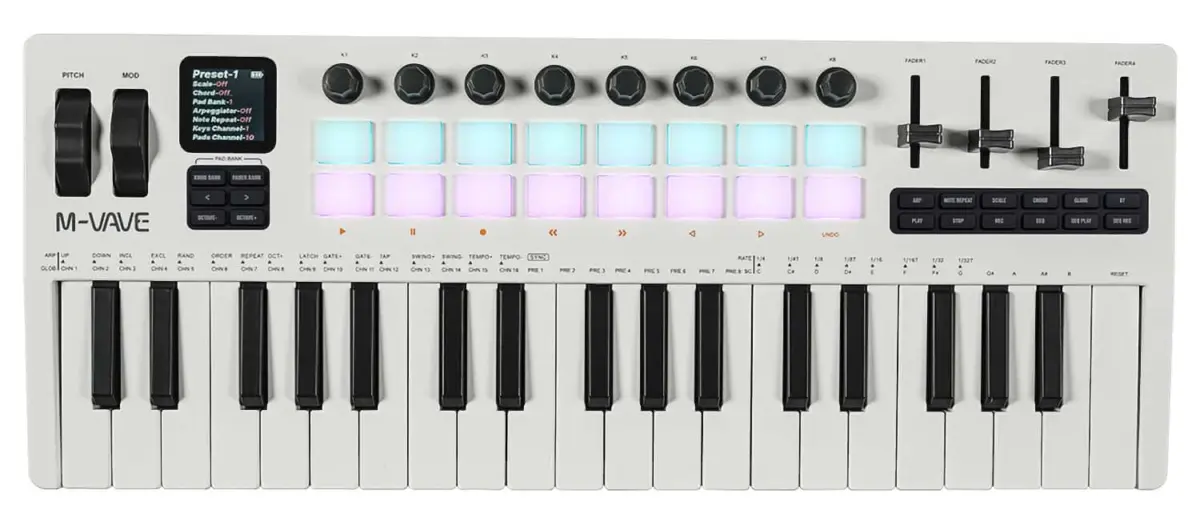
The landscape of affordable music production hardware is undergoing a significant transformation as independent developers begin to unlock the latent potential of budget-friendly hardware through custom firmware. A recent development in this niche sector involves the M-Vave SMK-37, a 37-key MIDI controller and synthesizer that has become the latest subject of a sophisticated firmware porting project. Developer Genkigenki has successfully begun migrating alternate firmware originally designed for the M-Vave FM-1—specifically the Makkuro37 and Snoop37 variants—to the SMK-37 platform. This move represents a pivotal moment for users of entry-level gear, as it transitions a relatively simple MIDI controller into a more versatile and customizable synthesis engine, effectively bridging the gap between low-cost consumer electronics and professional-grade boutique instruments.
The M-Vave SMK-37 has occupied a specific segment of the market since its release, catering to mobile producers and hobbyists who require a compact, battery-powered solution with Bluetooth MIDI capabilities. While the stock unit provides basic synthesizer functions and standard MIDI control, its hardware architecture possesses untapped processing power that standard factory settings do not fully utilize. By leveraging the similarities between the internal chipsets of the FM-1 and the SMK-37, developers have found a pathway to introduce advanced synthesis features, refined user interfaces, and expanded sequencing capabilities that were previously unavailable on this specific hardware.
Technical Context and Hardware Synergy
To understand the significance of the SMK-37 firmware port, one must examine the hardware lineage of M-Vave products. M-Vave, a brand often associated with high-volume, low-margin musical electronics, has utilized a series of cost-effective microcontrollers that are surprisingly capable of handling complex digital signal processing (DSP). The FM-1, a compact FM synthesizer from the same manufacturer, became a cult favorite among the "maker" community due to its open-ended nature and the subsequent release of community-driven firmware.
The SMK-37 shares enough architectural DNA with the FM-1 to make firmware porting viable. Both units rely on efficient digital architectures that handle MIDI input/output, polyphony, and oscillator management. However, the SMK-37 offers a distinct advantage over the FM-1: its physical interface. With 37 velocity-sensitive keys, a pitch bend/modulation touch strip, and a set of assignable knobs, the SMK-37 provides a much more robust "performance" platform than the smaller, button-heavy FM-1. The porting of Snoop37 and Makkuro37 firmware essentially grants the SMK-37 a "brain transplant," replacing the stock sounds with more sophisticated FM (Frequency Modulation) algorithms and specialized tracking features.
Chronology of Development
The development of custom firmware for M-Vave devices has followed a rapid timeline, driven by a global community of developers sharing resources via platforms like GitHub and YouTube.
- Early 2023: The M-Vave FM-1 gains popularity as a low-cost FM synth. Developers begin poking at the factory firmware, discovering that the hardware could support more complex envelopes and modulation matrices than the factory presets allowed.
- Mid 2023: The "Makkuro" and "Snoop" firmware projects for the FM-1 are launched. These projects focused on optimizing the user interface and adding features such as improved sequencers and more stable MIDI clock synchronization.
- Late 2023: As the SMK-37 became more widely available on global marketplaces like Amazon and AliExpress, users began to inquire whether the FM-1’s custom software could be adapted for the larger keyboard format.
- Early 2024: Developer Genkigenki began the formal process of mapping the SMK-37’s unique physical controls—such as the 37-key matrix and the specific CC (Continuous Controller) assignments for its knobs—to the Makkuro and Snoop codebases.
- Current Status: The firmware has reached a demonstrable state, as shown in recent technical demonstrations. While still considered experimental, the port allows the SMK-37 to run the alternate engines, effectively doubling the instrument’s utility for those willing to engage in the "flashing" process.
Features of Snoop37 and Makkuro37
The alternate firmwares being ported are not merely cosmetic updates; they represent a fundamental shift in how the device generates sound and interacts with other gear.
Makkuro37 focuses heavily on a streamlined, "blacked-out" aesthetic logic that prioritizes workflow efficiency. In its original FM-1 incarnation, it offered a more logical menu structure for deep FM editing, allowing users to manipulate operators and carriers with greater precision. On the SMK-37, this translates to a more professional synthesis experience where the physical knobs can be mapped to critical synthesis parameters like feedback, ratio, and algorithm selection, turning the budget controller into a dedicated FM hardware synth.
Snoop37 is often characterized by its investigative and diagnostic features, as well as its expanded sequencing capabilities. For the SMK-37, this firmware version introduces more robust MIDI monitoring and the ability to handle more complex internal routing. It is designed for the power user who wants to use the SMK-37 as the "brain" of a small mobile setup, controlling other hardware via MIDI while simultaneously running its internal sound engine.
Market Implications and the Budget Synthesis Ecosystem
The availability of custom firmware for a $135 device like the SMK-37 has significant implications for the musical instrument industry. Historically, deep synthesis and high levels of customizability were reserved for instruments costing $500 or more. The "democratization" of hardware hacking means that the barrier to entry for sophisticated electronic music production is lower than ever.
Industry analysts note that this trend puts pressure on established manufacturers like Korg, Arturia, and Akai. While these companies offer polished, supported products, the "open-source" nature of modified M-Vave gear appeals to a growing demographic of "synth-hackers" who value flexibility and the ability to "unbrick" or modify their gear. The SMK-37’s low price point—approximately $135 USD—makes it a "low-risk" platform. Unlike a $2,000 workstation, a $135 controller can be experimented upon with minimal financial consequence, encouraging a culture of innovation and technical exploration.
Safety and Technical Considerations
While the porting of Snoop37 and Makkuro37 firmware is a breakthrough for the community, it is not without risks. Journalistic integrity requires noting that installing third-party firmware typically voids manufacturer warranties. The process of "flashing" a device involves connecting the hardware to a computer and overwriting the factory-installed BIOS/firmware. If the process is interrupted or if the code contains errors, the device can become "bricked"—rendered non-functional.
However, the developer community, led by figures like Genkigenki, has provided extensive documentation via GitHub to mitigate these risks. The GitHub repository for the SMK37 project includes step-by-step instructions, backup files of the original factory firmware, and troubleshooting guides. This level of transparency has contributed to the project’s success and helped build a self-sustaining ecosystem of users who assist one another in the modification process.
Broader Impact on Open Source Music Technology
The SMK-37 firmware project is part of a larger movement toward open-source music technology. From the Monome ecosystem to the recent surge in ESP32-based synthesizers, the line between "consumer" and "creator" is blurring. When a community takes a piece of mass-produced hardware and improves it, they are essentially providing a free R&D service to the user base.
This project specifically highlights the importance of hardware longevity. By providing new firmware, developers extend the life of these devices, preventing them from becoming "e-waste" as newer models are released. An SMK-37 with Makkuro37 firmware is, in many ways, a more capable instrument than it was the day it left the factory, ensuring its relevance in a studio environment for years to come.
Conclusion and Pricing Availability
The M-Vave SMK-37 remains available through major online retailers for a price hovering around $135 USD. While the manufacturer continues to market it as a standard MIDI controller with Bluetooth functionality, the work of the independent developer community has effectively transformed it into an evolving platform for digital synthesis.
As of this report, the porting of the FM-1 firmware to the SMK-37 is ongoing, with regular updates being posted to the project’s GitHub repository. Prospective users and enthusiasts are encouraged to monitor these developments closely, as the project promises to unlock even more features, including potential custom wavetable support and expanded polyphony modes. The intersection of affordable hardware and high-level software engineering continues to redefine what is possible in the world of budget-friendly music production, making the SMK-37 a standout example of the power of community-driven innovation.
