

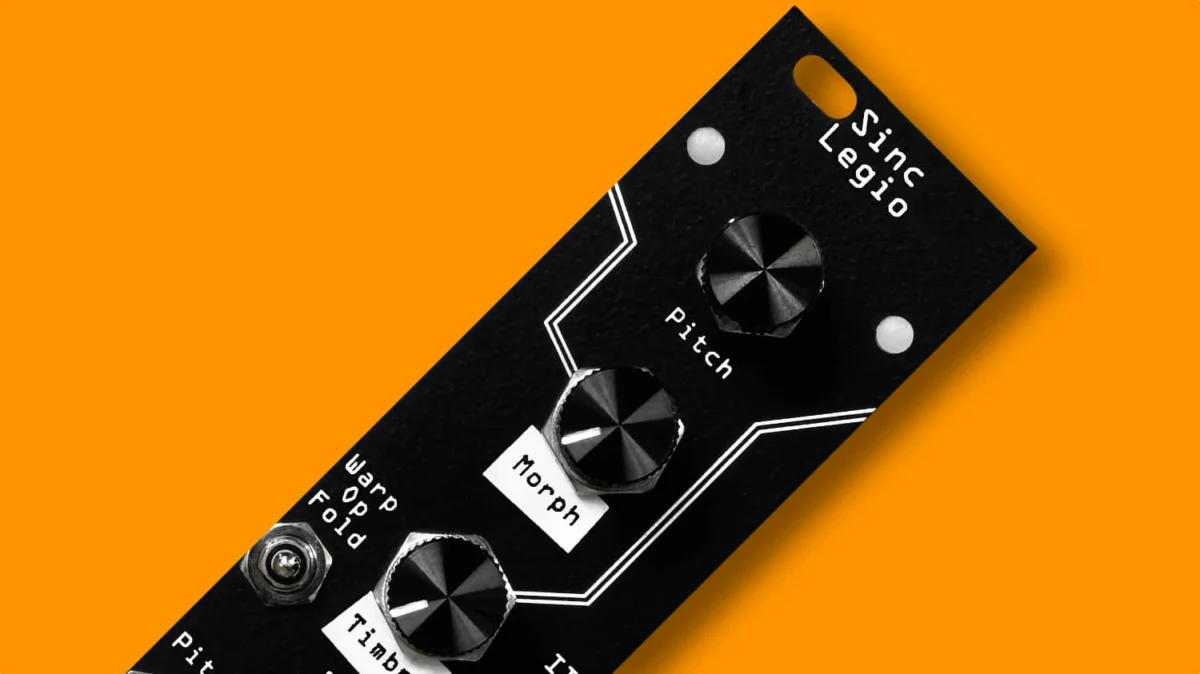
The Los Angeles-based modular synthesizer manufacturer Noise Engineering has announced a significant expansion of its Legio platform, releasing 16 new firmware options that effectively transform the hardware into a wide array of different functional modules. This release underscores a growing trend in the music technology industry toward "chameleon" hardware—devices designed with a standardized interface that can be repurposed through software updates. The Legio platform, a 6HP (horizontal pitch) Eurorack module, now stands as one of the most versatile tools in the small-format modular market, offering users the ability to switch between oscillators, dynamics processors, and distortion units at no additional cost.
The Evolution of the Legio Ecosystem
The Legio platform was first introduced by Noise Engineering in mid-2022 as a more compact alternative to its successful 10HP Versio platform. While the Versio platform focused on stereo effects processing, the Legio was designed to be a "digital Swiss Army knife" for smaller systems. The hardware itself features a stereo input and output path, an encoder, and several toggle switches and potentiometers, all of which are mapped differently depending on the firmware loaded onto the internal flash memory.
With this latest update, Noise Engineering has dramatically increased the utility of the hardware. Owners of any Legio-series module, such as the Virt Legio or the Sinc Legio, can now access a library of 23 total firmwares. This "one module, many identities" philosophy is intended to provide value to users who may have limited rack space or limited budgets, allowing a single 6HP investment to fill multiple roles in a signal chain over time.
Technical Specifications and Hardware Architecture
The Legio platform is built upon a high-performance digital signal processing (DSP) architecture. Unlike traditional analog modules that use discrete components to define their sound, the Legio utilizes an ARM-based processor capable of high-fidelity audio rates. This allows for complex algorithms, such as wavetable synthesis, physical modeling, and advanced dynamics processing, to be executed within a very small physical footprint.
Key technical specifications of the Legio hardware include:
- Width: 6HP
- Depth: 30mm
- Power Consumption: Approximately 140 mA on the +12V rail and 10 mA on the -12V rail.
- Interface: Two CV (Control Voltage) inputs, two audio inputs (L/R), two audio outputs (L/R), and a USB port for firmware swapping.
- Controls: Two primary knobs, one clickable encoder, and two three-position toggle switches.
The firmware swapping process is handled via the Noise Engineering Customer Portal. Users connect the module to a computer via a micro-USB cable located on the back of the module. The web-based flash tool detects the hardware and allows the user to select and install any available firmware from the Legio library. This process typically takes less than a minute, making it feasible for users to reconfigure their systems between studio sessions or live performances.
A Chronology of Noise Engineering’s DSP Platforms
To understand the significance of the 16-firmware release, it is necessary to look at the timeline of Noise Engineering’s development of swappable firmware platforms:
- 2020: The Launch of Versio. Noise Engineering released the Desmodus Versio, a stereo reverb. Shortly after, they announced that the Versio was a platform, releasing firmwares like Imitor Versio (delay) and Ruina Versio (distortion).
- 2021: Platform Maturity. The Versio library expanded to include granular processors and filters, proving that a single hardware layout could support radically different audio tasks.
- 2022: Introduction of Legio. Recognizing the demand for smaller modules, the company launched the Legio platform with Virt Legio, a stereo oscillator.
- 2023: Targeted Releases. Throughout the year, specialized firmwares such as Librae Legio (a dynamics processor) and Sinc Legio (an oscillator) were released as standalone modules, though they remained cross-compatible with the platform.
- 2024: The Massive Expansion. The release of 16 new firmwares simultaneously represents the largest single software drop in the company’s history, effectively tripling the options available to Legio owners.
Breakdown of the New Firmware Categories
While the specific names of the 16 new firmwares often draw from Noise Engineering’s penchant for Latin-inspired nomenclature, they can be categorized into four primary functional groups:
1. Stereo Oscillators and Sound Sources
Building on the success of the Virt Legio, several new firmwares provide different flavors of synthesis. These include additive synthesis, FM (frequency modulation), and noise generation. Because the Legio is natively stereo, these oscillators provide a wide sonic image that is often difficult to achieve with traditional monophonic Eurorack oscillators without additional panning modules.
2. Dynamics and Utility
One of the most praised aspects of the Legio platform is its ability to act as an "end-of-chain" processor. New firmwares include advanced limiters, compressors, and noise gates. These utilities are essential for managing the high-energy signals typical of modular synthesis, and having them available in a 6HP format is a significant space-saver.
3. Distortion and Waveshaping
Noise Engineering is widely known for its aggressive, digital distortion algorithms. The new firmware drop includes several variations of wavefolders and multiband saturators. These modules allow users to add harmonic complexity to simple waveforms or completely mangle incoming audio signals.
4. Filters and Spatial Effects
The update also introduces new filtering options, ranging from classic low-pass gates to experimental multi-mode filters that utilize the platform’s stereo architecture for binaural movement and frequency-dependent panning.
Economic and Environmental Implications
The move toward firmware-swappable hardware carries significant implications for the modular synthesizer market. Traditionally, Eurorack is a hardware-intensive hobby where each new sound or function requires the purchase of a new physical module. This leads to high costs for the consumer and a larger environmental footprint due to the manufacturing and shipping of PCBs, faceplates, and electronic components.
By providing 16 new firmwares for free to existing owners, Noise Engineering is challenging the traditional "planned obsolescence" model. A user who purchased a Legio module in 2022 for a specific purpose now finds that their module has gained 16 additional personalities in 2024. This increases the longevity of the hardware and reduces "GAS" (Gear Acquisition Syndrome), as the need to buy a new module for a specific task is often mitigated by simply reflashing the Legio.
Furthermore, this strategy serves as a hedge against supply chain volatility. By focusing on a standardized hardware platform, Noise Engineering can streamline its manufacturing process, focusing on producing large quantities of a single hardware SKU rather than managing the production of twenty different niche modules.
Industry Response and Market Context
The modular community has generally reacted with enthusiasm to the "platform" concept. Industry analysts note that Noise Engineering’s approach mirrors similar movements by companies like Expert Sleepers (with the Disting series) and Monome (with the Crow and Teletype). However, Noise Engineering distinguishes itself by maintaining a highly tactile interface; while a module like the Disting relies on deep menus and small screens, the Legio remains focused on immediate, knob-per-function performance.
Critics of the platform approach often point to the "blank faceplate" problem. When a Virt Legio (an oscillator) is reflashed into a Librae Legio (a compressor), the labels on the faceplate no longer match the functions of the knobs. Noise Engineering has addressed this by offering replacement faceplates for sale and providing printable overlays, though many power users report that they simply memorize the layouts or use temporary labels.
Future Outlook for Programmable Modular Gear
The release of 16 firmwares for the Legio platform suggests that Noise Engineering is doubling down on the software-defined hardware model. As DSP chips become more powerful and affordable, the distinction between "software" and "hardware" in the modular world continues to blur.
Looking forward, the industry may see further integration of open-source communities with these platforms. While Noise Engineering currently maintains a proprietary library, the hardware’s use of standard ARM architecture opens the door for potential third-party development or "community firmwares" in the future, similar to what has been seen with the ElectroSmith Daisy platform.
In conclusion, the expansion of the Legio platform is more than just a software update; it is a statement on the future of musical instrument design. By decoupling the function of a module from its physical form, Noise Engineering has provided a sustainable, cost-effective, and highly creative toolset for the modern synthesist. As the library of available firmwares continues to grow, the Legio is poised to remain a staple in Eurorack systems, regardless of the changing trends in synthesis and sound design.
