

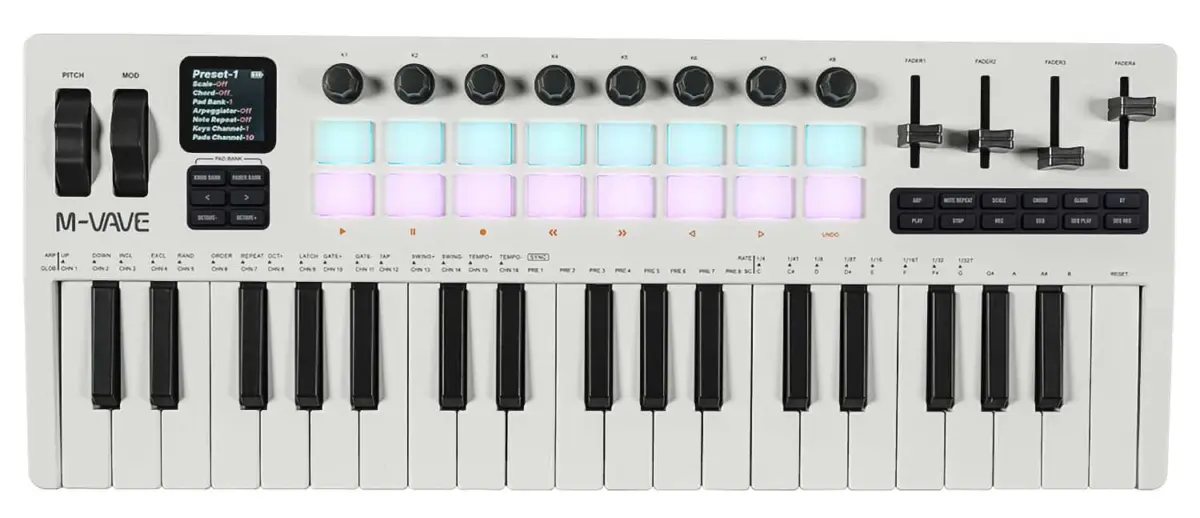
The landscape of affordable music production hardware is undergoing a significant shift as independent developers begin to unlock the latent potential of budget-friendly devices through custom firmware. Recently, the developer known as genkiginko has successfully initiated the porting of alternate firmware—originally designed for the M-Vave FM-1—to the M-Vave SMK-37, a 37-key MIDI controller and integrated synthesizer. This development, highlighted through a series of technical demonstrations and the release of documentation on GitHub, marks a pivotal moment for users of the SMK-37, transforming a relatively simple entry-level controller into a more versatile and customizable synthesis platform. The project, which includes the Makkuro37 and Snoop37 firmware variants, leverages the accessible hardware architecture of the M-Vave ecosystem to provide features previously unavailable in the stock factory software.
Technical Overview of the M-Vave SMK-37 Hardware
To understand the impact of these firmware ports, it is necessary to examine the hardware foundation of the M-Vave SMK-37. Currently retailing for approximately $135 USD, the SMK-37 is positioned as a portable solution for mobile and home studio producers. It features 37 velocity-sensitive keys, which is a significant step up from the more common 25-key configurations found in the ultra-portable category. The device is equipped with two touch strips for pitch bend and modulation, eight backlit velocity-sensitive pads, and a series of assignable knobs and buttons.
Under the hood, the SMK-37 utilizes an ARM-based microcontroller architecture that, while proprietary in its initial configuration, offers enough computational overhead to support secondary synthesis engines. The device includes a built-in rechargeable lithium-ion battery and supports Bluetooth MIDI, making it a wireless-capable unit. However, the factory firmware is often cited by users as being functional but limited in scope, particularly regarding the internal sound engine’s depth and the flexibility of the MIDI routing. The introduction of the Makkuro37 and Snoop37 firmwares aims to address these limitations by overwriting the factory code with optimized, community-driven instructions.
The Evolution of the M-Vave Firmware Ecosystem
The porting of firmware to the SMK-37 did not occur in a vacuum; it is the direct result of successful experimentation with the M-Vave FM-1, a compact FM synthesis module. The FM-1 became a favorite in the "maker" and "synth-hacker" communities due to its extremely low price point and surprisingly robust hardware. Developer genkiginko originally created the Makkuro and Snoop firmwares for the FM-1 to expand its synthesis capabilities and improve the user interface logic.
The transition from the FM-1 to the SMK-37 represents a logical progression in the development timeline. While the FM-1 is a headless module, the SMK-37 provides a full physical interface with keys and pads. By porting the existing codebases, the developer is essentially giving the SMK-37 a "brain transplant," allowing the controller to function as a standalone instrument with more sophisticated sound generation than the basic General MIDI or simple subtractive tones found in the original unit. This chronology of development suggests a growing ecosystem where M-Vave hardware serves as a standardized "shell" for a variety of open-source or community-developed synthesis engines.
Detailed Analysis of Makkuro37 and Snoop37 Firmware
The two primary firmware options being ported offer distinct advantages depending on the user’s requirements. While the specific feature sets continue to evolve as the porting process nears completion, initial data from the GitHub repository and demonstration videos provide a clear picture of their functionality.
Makkuro37: Enhanced Synthesis and Minimalist Design
The Makkuro37 firmware is designed with a focus on streamlined performance and advanced synthesis. In the context of the FM-1, Makkuro introduced a more intuitive way to handle frequency modulation parameters. For the SMK-37 port, this translates to:
- Expanded Sound Engines: The firmware likely introduces new oscillator models or refined FM algorithms that utilize the SMK-37’s processing power more efficiently than the stock software.
- Improved Pad Response: Users have noted that custom firmware often recalibrates the velocity curves of the drum pads, making them more responsive for finger drumming.
- Optimized UI Logic: By remapping the function buttons, Makkuro37 allows for quicker access to internal parameters without the need for external software editors.
Snoop37: MIDI Monitoring and Advanced Routing
The Snoop37 variant appears to be more focused on the utility and MIDI control aspects of the device. In professional studio environments, the ability to monitor and manipulate MIDI data streams is crucial. Snoop37 aims to provide:
- Real-time MIDI Diagnostics: Utilizing the device’s LEDs to indicate MIDI traffic and clock sync, which is invaluable for troubleshooting complex setups.
- Custom Mapping Layers: Allowing for deeper customization of the CC (Continuous Controller) messages sent by the knobs and touch strips.
- Advanced Arpeggiator Functions: Enhancing the built-in arpeggiator with more patterns and swing options that are not present in the factory settings.
Implications for the Budget Synthesizer Market
The emergence of third-party firmware for M-Vave products has broader implications for the music technology industry. Historically, the "budget" end of the market was defined by "black box" devices—hardware that performed a specific, limited task and could never be updated or improved. The work of developers like genkiginko is challenging this paradigm by treating hardware as a platform rather than a fixed product.
This trend mirrors the "jailbreaking" or "rooting" movements in the smartphone industry. When a $135 controller can be updated to perform like a much more expensive boutique synthesizer, it shifts the value proposition for the consumer. It also places pressure on established manufacturers like Akai, Arturia, and Korg to either open their platforms to developers or provide more frequent and substantial official updates to justify their higher price points.
Furthermore, the availability of these mods increases the "street life" of the hardware. Rather than becoming electronic waste when a user outgrows the basic factory sounds, the SMK-37 can be flashed with new firmware to serve a new purpose in a studio, such as a dedicated algorithmic sequencer or a specialized FM drone machine.
Community Reception and Developer Motivations
While official statements from M-Vave regarding third-party firmware are non-existent, the community response has been overwhelmingly positive. On platforms such as Reddit’s r/synthesizers and various music technology forums, users have expressed a high level of interest in "unboxing" the full potential of their Chinese-manufactured budget gear. The primary motivation for developers in this space is rarely financial; instead, it is a combination of technical curiosity and the desire to improve tools for the creative community.
The developer, genkiginko, has maintained an open-source approach by hosting the project on GitHub. This allows other programmers to contribute to the code, fix bugs, and potentially port the firmware to even more devices in the M-Vave lineup. This collaborative model ensures that the firmware remains free and accessible, though it does come with the standard caveat that "modding" a device usually voids its warranty and carries a risk of "bricking" the hardware if the flashing process is interrupted.
Risk Assessment and Technical Considerations for Users
For musicians considering the switch to Makkuro37 or Snoop37, there are several technical factors to weigh. Flashing alternate firmware is a non-trivial process that involves connecting the device to a computer and using specialized software tools to overwrite the internal memory.
- Warranty and Support: Once the factory firmware is removed, the manufacturer is no longer obligated to provide technical support or honor warranty claims.
- Stability: While community firmwares are often more feature-rich, they may not undergo the same level of rigorous "beta testing" as official releases, leading to potential bugs in live performance settings.
- Reversibility: A key concern for many users is whether the device can be restored to its factory state. Most M-Vave devices allow for a factory reset or a re-flashing of the original firmware, provided the user has backed up the original "bin" file.
Despite these risks, the "risk-free" nature of a $135 investment makes the SMK-37 an ideal candidate for such experimentation. Unlike a $2,000 workstation, the SMK-37 is affordable enough that many hobbyists are willing to take the chance in exchange for significantly enhanced functionality.
Future Outlook and Conclusion
The porting of Makkuro37 and Snoop37 firmware to the M-Vave SMK-37 is a testament to the ingenuity of the modern music technology community. By bridging the gap between low-cost hardware and high-level software functionality, independent developers are democratizing access to sophisticated synthesis tools. As the project continues to mature, it is likely that we will see even more specialized firmwares emerge, perhaps focusing on granular synthesis, generative sequencing, or enhanced integration with specific Digital Audio Workstations (DAWs).
The SMK-37, already a solid value as a MIDI controller, is now positioned to become a cult classic in the synth world—a "chameleon" device that can be whatever the user’s firmware choice dictates. This movement underscores a larger shift toward sustainable, adaptable, and community-driven technology in the arts, where the limitations of a device are defined not by its price tag, but by the creativity of its users and the code they write. For the professional producer or the bedroom hobbyist, the SMK-37 with custom firmware represents a unique opportunity to explore the frontiers of digital synthesis without the financial barrier to entry typically associated with such endeavors.
