

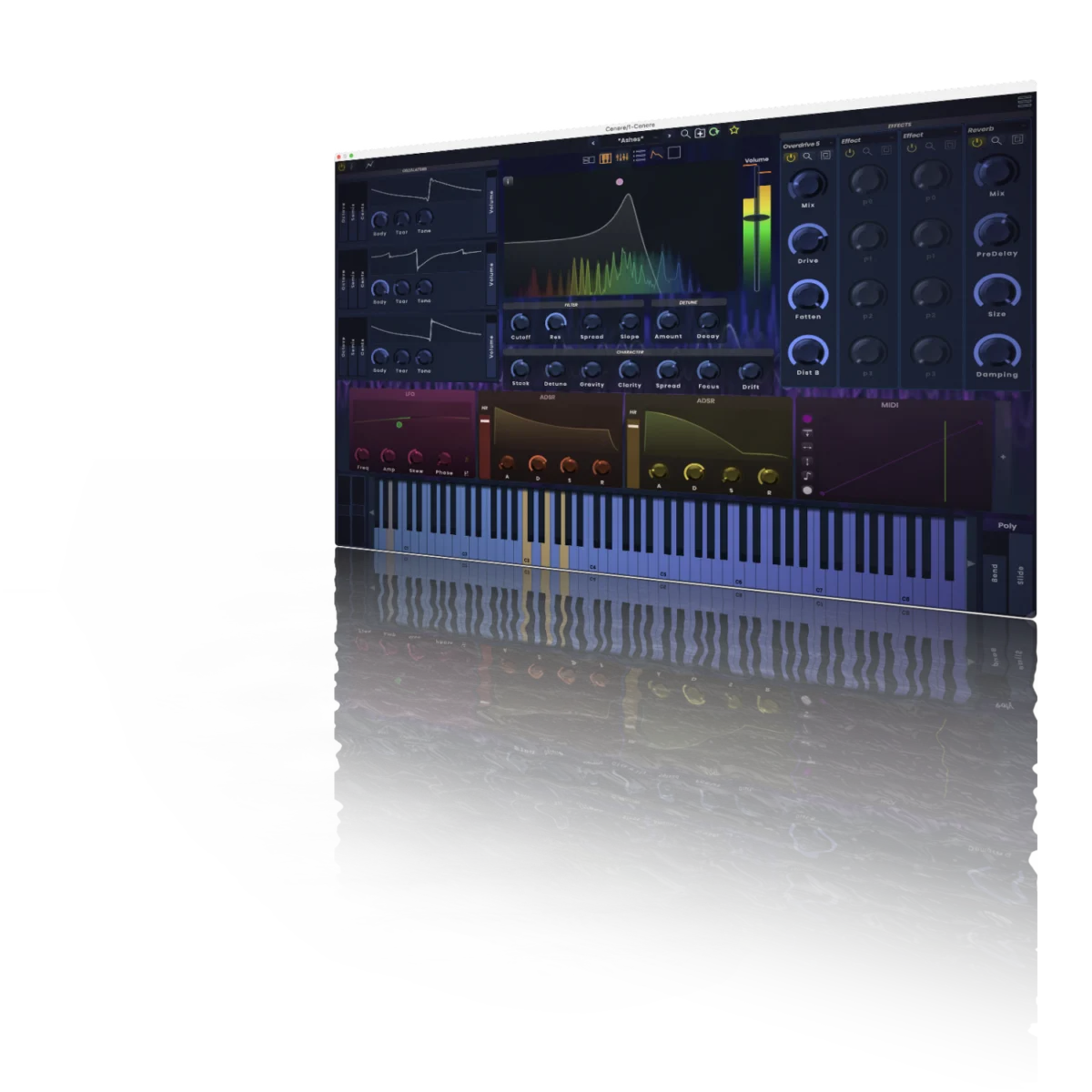
Stagecraft Software has officially released Cenere, a sophisticated subtractive synthesizer designed to bridge the gap between the tactile, organic feel of vintage hardware and the precision of modern digital wavetable technology. Available for both Windows and macOS, Cenere enters a highly competitive market of software instruments by offering a unique feature set centered on high-fidelity audio-rate automation and dense unison stacking. The instrument is priced at $200 USD, positioning it as a premium tool for professional sound designers, electronic music producers, and cinematic composers seeking a balance between classic subtractive synthesis and contemporary sonic flexibility.
The release of Cenere marks a significant milestone for Stagecraft Software, a developer known for creating intuitive yet powerful audio plugins that emphasize visual feedback and high-performance DSP. With Cenere, the company aims to address a common criticism of digital synthesizers: the perceived "thinness" or "static" nature of software-generated sound. By incorporating specialized drift and detune algorithms across up to nine unison layers, Cenere attempts to replicate the inherent instability and "living" quality of voltage-controlled oscillators found in legendary hardware synthesizers from the 1970s and 1980s.
Technical Architecture and Synthesis Engine
At its core, Cenere utilizes a subtractive synthesis architecture, which is the foundational method used in most iconic synthesizers like the Minimoog and the Prophet-5. In this model, a harmonically rich waveform is generated and then shaped by "subtracting" frequencies through filters. However, Cenere enhances this traditional workflow by utilizing modern wavetables as its primary sound source. Unlike standard oscillators that are limited to basic shapes like sine, square, or sawtooth waves, wavetables allow for complex, evolving timbres that can be scanned or modulated in real-time.
The synthesizer’s most touted feature is its ability to handle automation at audio rate. In most digital audio workstations (DAWs) and software instruments, parameter automation occurs at a "control rate," which is significantly slower than the actual sample rate of the audio. This can sometimes lead to "stepping" or artifacts when modulating parameters rapidly. By supporting audio-rate automation, Cenere allows every parameter—from filter cutoff to wavetable position—to be modulated with the same precision as the audio signal itself. This capability opens the door for advanced sound design techniques, such as frequency modulation (FM) effects created through the high-speed manipulation of filter parameters.
The Pursuit of Analog Realism
A primary design goal for Stagecraft Software was to ensure that Cenere did not sound like a sterile digital instrument. To achieve this, the developers focused heavily on the "Unison" section. Cenere allows users to stack up to nine voices per note. While many synthesizers offer unison, Cenere includes specific "drift" and "detune" controls intended to simulate the thermal instability of analog circuits.
In vintage hardware, components like resistors and capacitors would heat up during operation, causing the pitch of the oscillators to fluctuate slightly. This "drift" is often what gives classic records their warmth and thickness. Cenere’s algorithms are designed to push the digital engine to its limits, creating a dense, phasing wall of sound that mimics analog gear being "pushed to the max." This makes the synthesizer particularly adept at creating "growling, aggressive leads" and lush, cinematic pads that feel expansive and non-repetitive.
Complementing the oscillators is a suite of analog morphing filters. These filters are designed to emulate the non-linear characteristics of hardware ladder filters and state-variable filters. The "morphing" capability allows users to transition smoothly between different filter types—such as low-pass, high-pass, and band-pass—without the clicks or pops often associated with digital switching. This allows for more organic movement within a patch, making the filter an expressive tool rather than just a corrective one.
Historical Context and Development Philosophy
Stagecraft Software has spent several years refining its DSP (Digital Signal Processing) framework. The company’s previous offerings, which include a variety of effects and simpler synthesizers, served as the groundwork for Cenere. The developer’s philosophy has consistently centered on the idea that software should be as powerful as hardware while taking advantage of the visual and computational benefits of the modern computer.
The development of Cenere comes at a time when the "analog revival" in music production is at its peak. While many producers are returning to hardware, there is an equally strong demand for software that can provide those same textures within a convenient, recallable digital environment. Stagecraft Software appears to be targeting the "prosumer" and professional market—users who are willing to invest $200 for an instrument that offers a specific character and a high degree of control.
Market Position and Comparative Analysis
In the current landscape of Virtual Studio Technology (VST), Cenere faces stiff competition from industry giants. It enters a space occupied by Xfer Records’ Serum, which is the current standard for wavetable synthesis, and Arturia’s Pigments, known for its multifaceted synthesis engines. Additionally, the rise of free or low-cost powerful synthesizers like Vital has changed the expectations of many bedroom producers.
However, Cenere’s price point and feature set suggest it is carving out a niche. While Serum focuses on clinical precision and complex modulation routing, and Pigments focuses on being an "all-in-one" workstation, Cenere focuses on the "character" of the sound. The emphasis on audio-rate automation and analog-style drift suggests that Stagecraft Software is prioritizing the "feel" of the instrument.
Industry analysts suggest that the $200 price point reflects the high cost of developing custom DSP that can handle nine layers of unison at audio rate without overloading modern CPUs. For professional composers working on film scores or high-end electronic productions, the ability to achieve a "hardware sound" without the maintenance or cost of actual vintage synthesizers represents a significant value proposition.
Integration and User Experience
Stagecraft Software has designed Cenere to be a versatile workhorse within any modern DAW. It is compatible with major hosts such as Ableton Live, Logic Pro, FL Studio, and Cubase. The user interface follows Stagecraft’s signature aesthetic: clean, dark, and focused on visual feedback. The UI is designed to help users understand how the sound is being shaped in real-time, with visualizers for wavetables and filter curves.
The inclusion of an onboard effects suite further extends the synthesizer’s utility. Rather than relying on external plugins, users can process their sounds through built-in delays, reverbs, and distortion modules that are specifically tuned to complement Cenere’s oscillator engine. This "all-in-one" approach to the signal chain ensures that the character intended by the developers is maintained from the initial waveform to the final output.
Statements and Anticipated Industry Reaction
While formal reviews from major trade publications are still forthcoming, early reactions from the sound design community have highlighted the synthesizer’s "weight" and "presence." Beta testers have noted that the instrument excels in "sweet, light organ" sounds as much as it does in "aggressive" lead roles, suggesting a wide dynamic range.
A spokesperson for Stagecraft Software noted during the launch phase that Cenere was built for "producers who are tired of the ‘plastic’ sound of many modern VSTs." The company emphasizes that the synthesizer is intended to be an instrument that users "play" and "automate," rather than just a box of presets. This focus on performance and automation aligns with the broader industry trend toward more expressive and "morphic" software instruments.
Conclusion and Future Outlook
The launch of Cenere represents a bold step for Stagecraft Software. By pricing the instrument at $200, they are signaling a move into the upper echelon of software synthesis. The success of Cenere will likely depend on how well its "analog-style" marketing translates to actual user experience in a crowded market.
As music production continues to move toward a hybrid model—where the lines between "digital" and "analog" are increasingly blurred—instruments like Cenere play a vital role. They provide the sonic pallet of the past with the technological advantages of the present. Whether Cenere becomes a staple in the studios of top-tier producers remains to be seen, but its technical specifications and design philosophy certainly make it a significant contender in the ongoing evolution of software synthesis.
Cenere is currently available for purchase directly from the Stagecraft Software website. It supports VST, AU, and AAX formats, ensuring compatibility with virtually all professional audio software on the market today. As the software matures, users can likely expect further wavetable expansions and potential updates to its already robust modulation matrix, further solidifying its place in the modern producer’s toolkit.
