

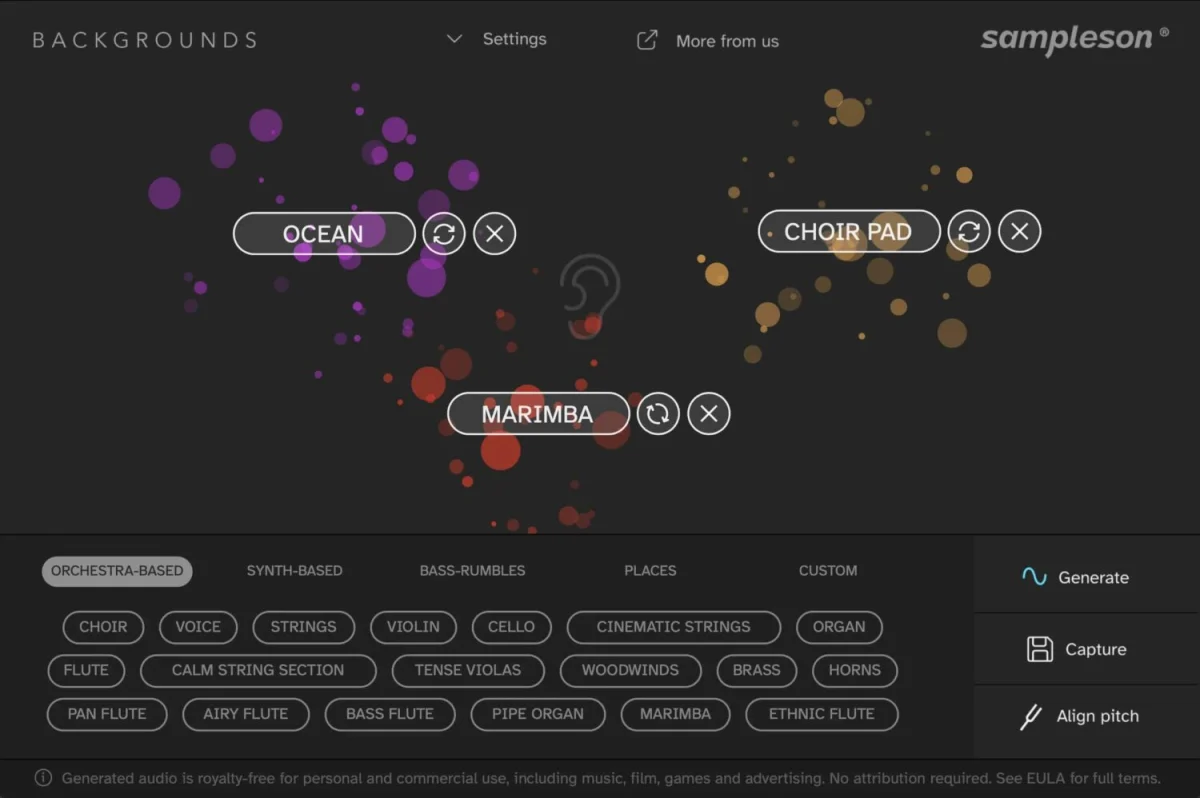
Sampleson has officially released Backgrounds, a sophisticated soundscape creation tool designed to bridge the gap between linguistic concepts and high-fidelity audio generation. By utilizing a proprietary semantic audio retrieval system, the software allows composers, sound designers, and multimedia producers to transform written words and abstract ideas into evolving cinematic atmospheres. Unlike traditional sample libraries that require manual searching through nested folders, Backgrounds provides a visual canvas where users drag and drop keywords to influence the sonic environment in real-time. The application represents a significant shift in the music technology landscape, moving away from static sample playback toward a more fluid, intent-based creative process.
The Architecture of Semantic Audio Retrieval
At the core of Sampleson Backgrounds is a massive database comprising more than 22,000 individual audio cells. These cells are not merely tagged with basic metadata; they are integrated into a complex network of 11,000 local embeddings. This architecture allows the software to understand the relationship between different concepts, such as the proximity of "thunder" to "tension" or "strings" to "elegance." When a user inputs a keyword or drags a concept onto the canvas, the engine performs a semantic search to find audio components that mathematically align with the desired mood or texture.
The semantic approach addresses a long-standing "friction point" in the sound design industry: the search phase. Historically, a composer looking for a "melancholic rain-drenched street" atmosphere would need to layer multiple recordings of rain, footsteps, and distant city hum, manually adjusting filters and volumes to achieve the right emotional resonance. Backgrounds automates this synthesis by allowing the user to place "Rain," "Melancholy," and "Urban" on the canvas. The engine then identifies the most relevant audio cells and weaves them together, ensuring that the resulting soundscape is cohesive and dynamically evolving rather than a simple loop.
Local Processing and Technical Specifications
One of the most distinctive features of Sampleson Backgrounds is its commitment to local processing. In an era where many AI-driven creative tools rely on cloud-based servers and subscription-based token systems, Backgrounds operates entirely on the user’s hardware. This design choice has several critical implications for professional workflows. First, it ensures zero latency during the creative process, as the software does not need to communicate with a remote server to generate or retrieve audio. Second, it guarantees privacy and data security, a paramount concern for film and game studios working on sensitive intellectual property. Finally, the absence of a subscription model or "per-generation" cost provides a predictable financial framework for freelance creators.
The software is compatible with both macOS and Windows environments. It is delivered as a standalone application for dedicated sound design sessions and as a VST3 and AU plug-in for seamless integration into Digital Audio Workstations (DAWs) like Ableton Live, Logic Pro, FL Studio, and Cubase. This dual-format availability allows users to generate atmospheres in isolation or automate the parameters of the soundscape directly within a musical project, syncing the evolution of the background noise to the timeline of a film or a song.
The Evolution of the Sampleson Ecosystem
Sampleson has built a reputation in the music software industry for developing "out-of-the-box" instruments that focus on spectral modeling and unique user interfaces. Their previous successes, such as the AkustiX acoustic enhancer and various modeled electric pianos, have often prioritized character and ease of use over complex, multi-gigabyte sample sets. Backgrounds marks an ambitious expansion of this philosophy. By moving into the realm of environmental and atmospheric sound, Sampleson is targeting a broader demographic, including podcasters, game developers, and installation artists, in addition to their traditional base of music producers.
The development of Backgrounds follows a period of intense research into how humans describe sound. The team at Sampleson recognized that while musicians might speak in terms of "frequencies" and "decibels," most creative directors and filmmakers speak in terms of "feelings" and "scenarios." The semantic engine is the technological bridge intended to translate those qualitative descriptions into quantitative audio data.
Workflow and User Interface Design
The user interface of Backgrounds is centered around a minimalist canvas metaphor. This design encourages experimentation by removing the technical barriers often found in modular synthesizers or complex granular engines. Users are presented with a searchable palette of concepts which can be dragged into the central workspace. The spatial positioning of these keywords on the canvas dictates the balance and intensity of the associated sounds. For example, placing a "Bass" node closer to the center of the focus area will result in a more prominent low-end presence, while moving "Wind" to the periphery will create a subtle, ethereal texture.
This "spatial mixing" approach allows for the creation of non-linear soundscapes. Because the 22,000 audio cells are triggered and modulated based on the semantic relationships defined by the user, the output is rarely repetitive. The software includes randomization features and the ability to save "snapshots" of specific word-based configurations, allowing users to quickly toggle between different atmospheric states during a live performance or a scoring session.
Pricing Strategy and Market Positioning
Sampleson has positioned Backgrounds as an accessible tool for both entry-level creators and seasoned professionals. The software launched with an introductory price of $39 USD, a significant discount from its regular retail price of $59 USD. This pricing strategy places it in direct competition with high-end atmospheric libraries from companies like Spitfire Audio or Orchestral Tools, which often cost hundreds of dollars and require massive amounts of disk space.
By offering a lightweight, computationally efficient alternative that focuses on "semantic" rather than "static" audio, Sampleson is tapping into a growing market for "smart" plugins. These are tools that use machine learning or advanced data structures to simplify complex tasks, making high-quality production more attainable for those who may not have years of training in traditional sound synthesis.
Implications for the Creative Industry
The introduction of tools like Backgrounds signals a broader trend in the democratization of cinematic sound design. As the demand for high-quality audio content grows across platforms like YouTube, Twitch, and indie gaming, there is an increasing need for tools that can produce professional results with minimal setup time. Backgrounds addresses this by providing a "curated randomness" that ensures the output always sounds polished, regardless of the user’s technical background.
For professional film composers, the tool serves as a "mood setter." Many composers start their projects by creating a "drone" or an "ambient bed" to establish the emotional foundation of a scene. Backgrounds allows this foundation to be built in seconds through descriptive language, which can then be layered with traditional orchestral or electronic elements. This efficiency is crucial in an industry where turnaround times are increasingly compressed.
Future Prospects and Generative Audio
While Sampleson Backgrounds is not a "generative AI" in the sense that it creates audio from scratch using neural networks (like some recently popularized text-to-music models), it represents a more controlled and musically useful application of similar concepts. By using a curated library of high-quality audio cells, Sampleson avoids the "uncanny valley" and artifacts often associated with fully synthetic AI audio. The result is a tool that feels "human-made" but is "machine-organized."
Looking forward, the success of Backgrounds could lead to specialized expansions or "thematic packs" focusing on specific genres, such as sci-fi, horror, or historical period atmospheres. The underlying semantic engine is flexible enough to accommodate different datasets, suggesting that this could be the first in a series of language-driven creative tools from the developer.
Chronology of Soundscape Tools
To understand the impact of Sampleson Backgrounds, it is helpful to look at the timeline of atmospheric sound creation:
- The Analog Era: Soundscapes were created using field recordings on tape, manipulated via physical splicing, speed changes, and hardware reverb units.
- The Early Digital Era (1990s): The advent of hardware samplers allowed for the triggering of atmospheric loops, though storage was limited.
- The ROMpler Era (2000s): Software like Spectrasonics Atmosphere (the precursor to Omnisphere) introduced massive libraries of pre-rendered pads and textures.
- The Granular Era (2010s): Tools like Output Portal and various Max for Live devices allowed users to shatter samples into tiny "grains" to create evolving textures.
- The Semantic Era (Current): Tools like Sampleson Backgrounds introduce the ability to navigate these textures using natural language and conceptual mapping, marking the latest stage in the evolution of the medium.
Conclusion
Sampleson Backgrounds stands as a testament to the evolving relationship between language and sound. By leveraging 22,000 audio cells and a local semantic engine, it provides a powerful, private, and affordable solution for modern creators. As the music production industry continues to grapple with the role of artificial intelligence and automated tools, Backgrounds offers a compelling middle ground: a system that uses advanced data retrieval to empower the user’s creativity rather than replacing it. Whether used for a subtle background in a podcast or a massive, evolving wall of sound in a feature film, Backgrounds provides a new vocabulary for the modern sound designer.
