

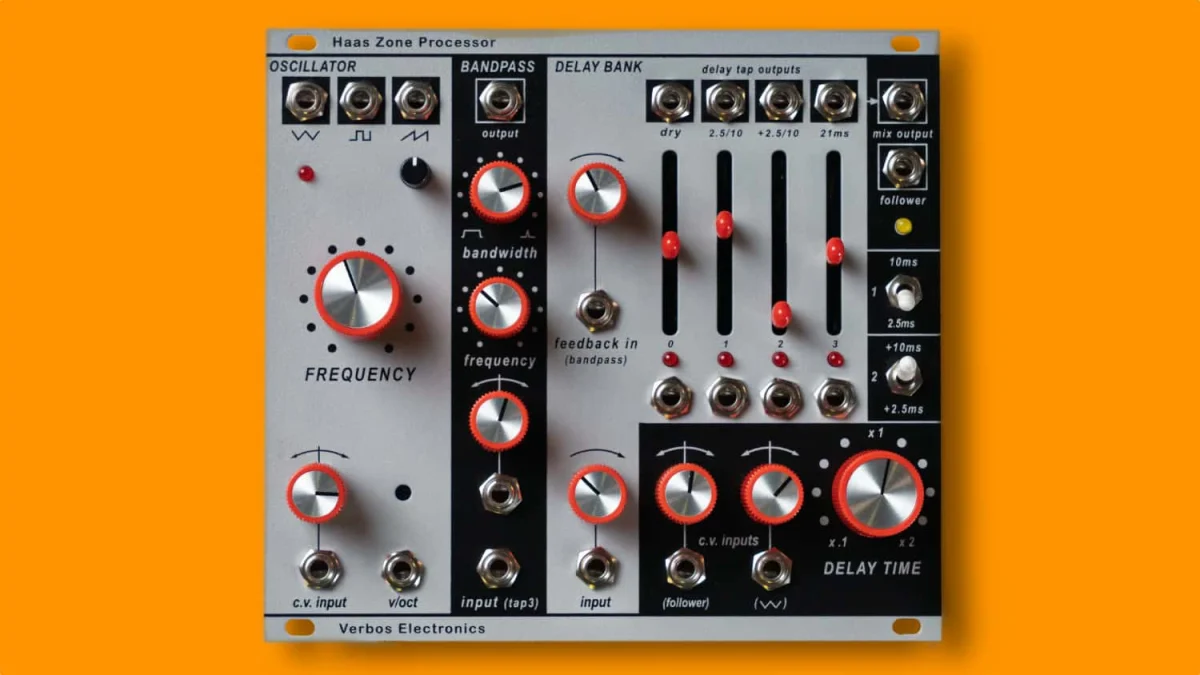
Defining the Haas Effect in Sound Synthesis
To understand the functional intent of the Verbos Electronics Haas Zone Processor, one must first examine the psychoacoustic phenomenon from which it takes its name. The Haas Effect, also known as the precedence effect, was described by German physicist Helmut Haas in his 1949 doctoral dissertation. Haas discovered that when two identical sounds are heard from different locations with a delay between them of approximately 5 to 40 milliseconds, the human brain perceives them as a single sound coming from the direction of the first arriving source.
In the context of modern audio production, the Haas Zone is the critical range where the ear ceases to hear a distinct echo and instead perceives an increase in "spaciousness," "width," or "thickness." By operating within these ultra-short delay times, the Haas Zone Processor allows users to manipulate the perceived physical dimensions of a sound source without relying on traditional reverb or long-form delays. This makes it an essential tool for creating "Automatic Double Tracking" (ADT), realistic stereo widening, and the metallic, comb-filtering textures that define much of industrial and experimental electronic music.
The Legacy of the Marshall Time Modulator
The architectural DNA of the Haas Zone Processor is largely influenced by the Marshall Time Modulator (MTM), a high-end studio processor developed by Stephen St. Croix in the 1970s. The MTM was renowned for its ability to produce uncanny, organic-sounding modulations that defied the capabilities of standard analog delays of the era. It was used extensively by high-profile artists such as Stevie Wonder and Donald Fagen to achieve unique vocal thickening and "shimmering" instrumental textures.
Mark Verbos has distilled the core philosophy of the MTM—specifically its multi-tapped delay structure and aggressive modulation capabilities—into a modern Eurorack format. However, while the original MTM relied on early bucket-brigade device (BBD) technology, the Haas Zone Processor utilizes a high-fidelity digital delay bank to achieve the necessary precision for micro-delays while maintaining a noise floor suitable for modern professional recording environments.
A Deep Dive into the Multi-Tapped Delay Bank
At the center of the Haas Zone Processor is a sophisticated, multi-tapped digital delay bank. Unlike standard delay modules that offer a single output of a delayed signal, the Verbos design provides three distinct taps, each serving a specific role in the creation of complex acoustic environments.
- Tap 1: This tap is designed for the shortest intervals, ranging from less than 1 millisecond up to 20 milliseconds. This range is critical for phase-based effects and flange-like textures. Because the delay is so short, adjusting this tap often results in dramatic changes to the harmonic content of the sound rather than a rhythmic repetition.
- Tap 2: Chained directly from the output of Tap 1, this tap adds another 1 to 20 milliseconds of delay. By chaining these taps, the module allows for cumulative delay times that can reach up to 40 milliseconds, effectively covering the entire span of the Haas Zone.
- Tap 3: This tap operates independently within a range of 9 to 42 milliseconds. This range is particularly useful for creating "doubling" effects and the initial stages of a discrete echo.
Each of these three taps features its own dedicated full-volume output, allowing the user to route them to different parts of a modular system for spatial processing. Furthermore, all three taps are integrated into a voltage-controlled mixer, where they can be blended with the original "dry" input signal. This level of control allows for the creation of intricate comb filters and resonant peaks that can be swept in real-time.
Integrated Modulation and Filtering Capabilities
The Haas Zone Processor is more than a simple delay line; it is a self-contained sound-shaping environment. To facilitate movement within the delay taps, Verbos has included a high-performance Voltage Controlled Oscillator (VCO). This oscillator is modeled after the modulation section of the renowned Verbos Complex Oscillator, offering Triangle, Square, and Sawtooth waveforms.
The frequency range of this VCO is exceptionally broad, spanning from extremely slow cycles (more than one minute per cycle) for subtle, evolving shifts, all the way up into the audible range. Because the oscillator tracks volt-per-octave (V/Oct), it can be played as a pitched sound source or used to create frequency modulation (FM) effects on the delay times themselves. This capability transforms the module from a spatial processor into a unique type of waveshaper or even a standalone voice.
Complementing the delay and modulation sections is a dedicated Bandpass filter. This filter is constructed from a 2-pole high-pass filter followed by a 2-pole low-pass filter. The bandwidth of this filter is fully adjustable, allowing it to sweep from a very narrow, resonant peak to a wide-open, full-spectrum signal. The frequency of the filter can be swept across the entire audio range and is fully voltage-controllable via a bipolar attenuator, enabling complex rhythmic filtering when paired with external sequencers.
Architecture and Signal Flow Normalization
One of the hallmarks of Verbos Electronics modules is their "normalled" signal paths, which allow for immediate functionality without the need for extensive patch cables, while still offering the flexibility to override those paths. In the Haas Zone Processor, the signal flow is intelligently pre-routed to maximize its utility as an effect:
- Envelope Follower: The input stage includes an envelope follower that tracks the amplitude of the incoming signal. Both the envelope follower and the triangle output of the internal VCO are normalled to the control voltage (CV) inputs of the delay times. This means the delay times will automatically respond to the dynamics of the input signal or the internal modulation source.
- Filter Routing: The output of Tap 3 is normalled to the input of the Bandpass filter. This allows the longest delay tap to be processed for frequency content before it is reintroduced to the mix.
- Feedback Loop: The output of the Bandpass filter is normalled to the Feedback In. By routing the filtered delay back into the input, users can create complex resonance points. By tweaking the delay times, oscillator frequency, and filter frequency simultaneously, the module can produce "ringing" metallic tones or self-oscillating textures.
The Verbos Electronics Design Philosophy
The release of the Haas Zone Processor reinforces Mark Verbos’s commitment to "West Coast" synthesis principles. Unlike the "East Coast" school, which typically focuses on subtractive synthesis (oscillators through filters), the West Coast approach—pioneered by Don Buchla—emphasizes additive synthesis, waveshaping, and complex modulation.
Verbos Electronics has carved a niche by creating modules that are aesthetically reminiscent of vintage Buchla gear while offering modern reliability and Eurorack compatibility. The Haas Zone Processor follows this tradition by prioritizing the harmonic complexity that arises from modulating short-time delays. It is a module designed for the "performer-composer," offering tactile controls and a wide range of "sweet spots" that encourage live experimentation.
Market Availability and Industry Reception
The Verbos Electronics Haas Zone Processor was officially announced and demonstrated by Mark Verbos in a comprehensive video showcase, detailing its various functions and sonic potential. The module is currently available through authorized Verbos Electronics dealers worldwide.
The "street price" for the unit is approximately $800 USD. While this positions the Haas Zone Processor in the premium tier of Eurorack modules, its price reflects the high component quality, the complexity of its multi-tap digital architecture, and its dual-nature as both a processor and a sound generator. Initial reactions from the modular synthesizer community have been positive, with many praising the module for its ability to provide a "finished" studio sound—traditionally achieved through expensive rack-mounted outboard gear—directly within a portable modular system.
Future Implications for Eurorack Sound Design
The introduction of the Haas Zone Processor signals a growing trend in the modular industry toward specialized psychoacoustic tools. As modular systems become more central to professional studio workflows, there is an increasing demand for modules that do more than generate raw waveforms; there is a need for tools that can handle the nuances of spatial positioning and acoustic depth.
For the professional synthesist, the Haas Zone Processor offers a solution to the "flatness" often associated with purely electronic signals. By manipulating the Haas Zone, users can place sounds in a virtual 3D space, create the illusion of multiple performers, or generate aggressive, harmonically rich timbres that are impossible to achieve with standard filters. As Verbos Electronics continues to expand its catalog, the Haas Zone Processor stands as a testament to the brand’s ability to take complex scientific concepts and translate them into musical, highly playable hardware.
In summary, the Haas Zone Processor is a multi-faceted tool that combines the history of studio signal processing with the flexibility of modern modular synthesis. Whether used for subtle stereo enhancement, vintage-style flanging, or as a chaotic source of self-oscillating noise, it provides a unique set of functions that are rare in the current Eurorack landscape. Its release marks a significant milestone for Verbos Electronics and offers a new horizon for sound designers looking to master the temporal dimensions of audio.
