

In the late 1980s, a period of creative resurgence for George Harrison following the massive success of his 1987 album Cloud Nine and the formation of the Traveling Wilburys, the former Beatle remained a prolific songwriter and a generous collaborator. In 1989, Harrison offered four of his newly written compositions to his longtime friend and fellow guitar legend Eric Clapton. These songs were intended for Clapton’s eleventh studio album, Journeyman, a project that would eventually be hailed as a return to form for the "Slowhand" guitarist. While the two icons shared a storied history of musical partnership dating back to the Beatles’ "While My Guitar Gently Weeps," the selection process for Journeyman resulted in a curious distribution of Harrison’s material. Ultimately, Clapton chose to include the track "Run So Far," which featured Harrison on guitar and backing vocals. However, three other songs from the Harrison sessions were shelved, including a mid-tempo, lyrically evocative track titled "That Kind of Woman."
The journey of "That Kind of Woman" serves as a fascinating case study in the interconnected circles of British and Irish rock royalty. Although Eric Clapton’s studio recording of the song remained locked in the vaults for over thirty-five years, the composition found its way into the hands of Irish virtuoso Gary Moore. It was Moore’s interpretation that would first reach the public ear, appearing on his seminal 1990 album Still Got the Blues. This transition of the song from Harrison to Moore via the Clapton sessions highlights not only the mutual respect between these musicians but also the specific aesthetic shifts occurring in guitar-driven music at the dawn of the 1990s.
The Genesis of a Lost Classic and the Journeyman Sessions
The year 1989 represented a pivotal moment for Eric Clapton. After a decade of varying commercial and critical success in the 1980s, Clapton sought to create an album that balanced contemporary production with his blues-rock roots. Produced by Russ Titelman, Journeyman featured an elite roster of guest musicians, including Robert Cray, Phil Collins, Chaka Khan, and George Harrison. Harrison’s contribution was viewed as a cornerstone of the project, yet the decision to omit "That Kind of Woman" from the final tracklist remains a subject of discussion among music historians.
"That Kind of Woman" is characterized by Harrison’s signature lyrical style—a blend of romantic idealism and observational simplicity. The lyrics describe a woman of enigmatic charm and steadfast character: "She’s that kind of woman / No doubt about how she feels / She’s holding promises / Her eyes won’t tell / Her lips are sealed." The imagery of a woman "standing in the doorway with the sunlight in her hair" evokes the gentle, pastoral folk-rock sensibilities that Harrison had perfected during his solo career. Despite the strength of the composition, the track was deemed surplus to requirements for the original 1989 release of Journeyman, likely due to the album’s already dense 12-track runtime and the inclusion of other high-profile collaborations.
Gary Moore and the Still Got the Blues Transformation
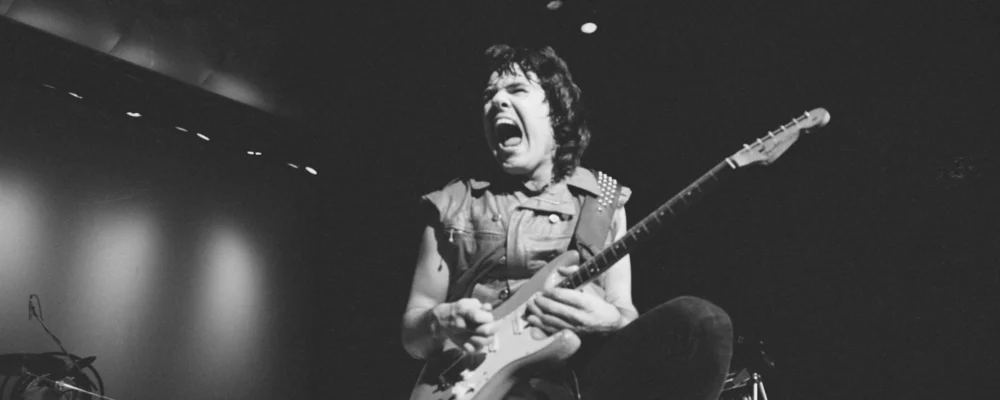
While Clapton’s version sat in storage, Gary Moore was undergoing a radical career transformation. Moore, who had spent much of the 1980s as a celebrated figure in the hard rock and heavy metal scenes with hits like "Out in the Fields," decided to return to his first love: the blues. This pivot resulted in Still Got the Blues, an album that would become the most successful of his career, moving over three million copies worldwide.
The inclusion of Harrison’s "That Kind of Woman" on Moore’s album was a masterstroke of sequencing. Moore’s version featured a slightly more aggressive guitar tone than what was typical of Harrison’s own recordings, yet it maintained the melodic integrity of the song. The collaboration extended beyond mere songwriting; Harrison’s influence was felt throughout the record’s production. By releasing the song in 1990, Moore provided a home for a "lost" Harrison track, ensuring it became part of the era’s musical canon.
The Neighborly Bond: Harrison and Moore’s Personal Connection
The professional link between George Harrison and Gary Moore was underpinned by a genuine personal friendship. During the late 1980s, Moore moved to a residence near Harrison’s estate, Friar Park, in Henley-on-Thames. This proximity led to frequent social and musical interactions. In a 1990 interview, Harrison reflected on their relationship, noting that while he had known of Moore for years, their bond deepened significantly once they became neighbors.
"Gary lives by me, he is my neighbor, and he has been around for a long time," Harrison recalled. "I’ve known him for just about four or five years now, since he moved and lived near me." Harrison’s admiration for Moore went beyond social pleasantries; he viewed Moore as one of the preeminent technicians of the instrument. This respect culminated in Moore being invited to contribute to the Traveling Wilburys’ second project (titled Vol. 3), where he performed the lead guitar solo on the 1990 single "She’s My Baby."

Harrison explained the decision to bring Moore into the Wilburys’ fold with characteristic humility: "When we did that song [‘She’s My Baby’], I just thought, ‘Well, it has to have a guitar solo put on it.’ I could just imagine me or Jeff Lynne trying to figure out a guitar solo that would not really be in that style. I thought, ‘Well, why not just get Gary to play it?’ He came along; it took him five minutes. It’s brilliant, great player."
Technical Mastery and the "Skiffler" Comparison
George Harrison’s praise for Gary Moore provides significant insight into how the "Quiet Beatle" viewed his own place in the pantheon of guitarists. Despite being a member of the most influential band in history and a pioneer of the slide guitar, Harrison often spoke of his own playing in modest terms. He famously described himself as a "skiffler" when comparing his abilities to Moore’s technical prowess.
"He is, actually, one of my favorite guitarists," Harrison stated in 1990. "I don’t know if from his records yet, if that’s come across, but I’ve had the privilege of seeing him playing just in a little room quietly, and he is incredible." Harrison was particularly impressed by Moore’s ability to balance speed with emotional resonance and technical precision. "Apart from the fact that he is fast, it’s not just the speed that impresses me, but he’s got a great sense of melody and improvisation and also pitch. When he bends those strings, he goes straight to the note. It’s not all flapping about like a lot of players."
This assessment highlights a specific technical attribute of Moore’s playing—his "pitch-perfect" string bending. In the blues and rock genres, the ability to bend a string to a precise microtonal frequency is the hallmark of a master. For Harrison, who valued the "right note" over the "most notes," Moore’s accuracy was a revelation.
Chronology of "That Kind of Woman" and Related Releases
To understand the full scope of this musical exchange, one must look at the timeline of events that led from the song’s inception to its eventual archival release:
- Early 1989: George Harrison writes a series of songs, including "That Kind of Woman" and "Run So Far," intended for Eric Clapton.
- 1989 (Journeyman Sessions): Clapton records "That Kind of Woman" with Harrison’s involvement, but the track is omitted from the final album release in November 1989.
- Early 1990: Gary Moore records Still Got the Blues. Given his friendship with Harrison and the song’s availability, he records his own version.
- March 1990: Still Got the Blues is released, featuring the first public version of "That Kind of Woman."
- October 1990: The Traveling Wilburys release Vol. 3, featuring Gary Moore’s solo on "She’s My Baby."
- February 2011: Gary Moore passes away at the age of 58 in Estepona, Spain.
- 2025: After decades of anticipation from fans and collectors, Eric Clapton’s original 1989 recording of "That Kind of Woman" is officially released as a bonus track on the Journeyman: Deluxe Edition.
Broader Impact and the Archival Renaissance
The 2025 release of Clapton’s version of "That Kind of Woman" is part of a broader trend in the music industry toward comprehensive archival preservation. For legacy artists like Clapton and the Harrison estate, these "Deluxe Editions" serve multiple purposes: they satisfy the demand of hardcore fans for "new" historical material, provide a more complete narrative of an artist’s creative process, and allow for the high-fidelity restoration of tracks that may have been previously available only as low-quality bootlegs.
The contrast between Moore’s 1990 version and Clapton’s 1989 version offers a rare opportunity for comparative analysis. Moore’s rendition is steeped in the "Gary Moore Blues" aesthetic—high-gain, sustain-heavy, and emotionally searing. Clapton’s version, as revealed in the 2025 reissue, reflects the smoother, more polished production values of the late-80s Titelman era, emphasizing the song’s pop-rock sensibilities and Harrison’s rhythmic influence.
Furthermore, the story of "That Kind of Woman" reinforces the narrative of George Harrison as a "musician’s musician." While his solo career was marked by periods of retreat from the spotlight, his influence permeated the work of his peers. His willingness to hand over high-quality material to friends like Clapton and Moore demonstrates a lack of ego that was rare among superstars of his stature. As Harrison himself noted, he felt like a "skiffler" in the presence of virtuosic speed, yet it was his melodic blueprint and lyrical vision that provided the foundation upon which those virtuosos built their performances.
In the end, "That Kind of Woman" stands as a testament to a specific era of guitar excellence. It bridges the gap between the melodic innovations of the 1960s, represented by Harrison and Clapton, and the technical heights of the 1990s blues revival, spearheaded by Gary Moore. The song’s thirty-six-year journey from a 1989 studio floor to a 2025 deluxe reissue completes a circle of collaboration that remains a highlight of rock history.
