

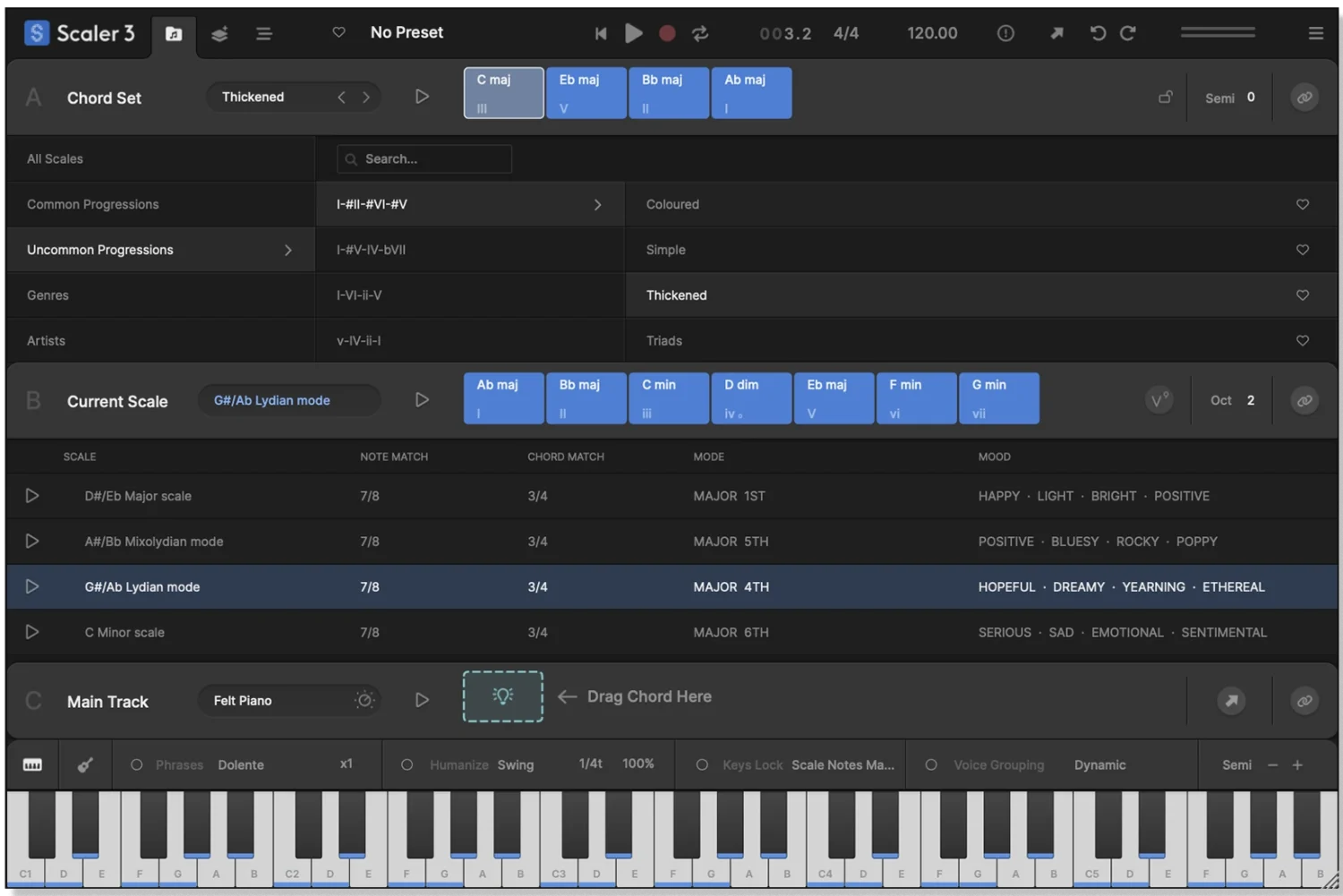
The release of Scaler 3 for iPad marks a significant milestone in the evolution of mobile music production, effectively bridging the gap between professional desktop environments and the increasingly powerful iPadOS ecosystem. Developed by Scaler Music, the software has long been regarded as a premier "music theory workstation" on macOS and Windows, providing composers, producers, and hobbyists with a sophisticated engine for chord progression building, harmonic analysis, and melodic inspiration. With this latest launch, Scaler Music has delivered the full feature set of the desktop version to the iPad, utilizing the Audio Units v3 (AUv3) standard to ensure seamless integration with modern mobile Digital Audio Workstations (DAWs) such as Logic Pro for iPad, Cubasis, AUM, and Beatmaker 3.
The arrival of Scaler 3 on the iPad is not merely a port of a legacy tool but a comprehensive adaptation designed to leverage the tactile nature of touchscreen interfaces. The application serves as a central hub for harmonic exploration, allowing users to detect the key and scale of existing audio or MIDI, explore thousands of chord sets curated by professional musicians, and apply complex performances that turn simple triads into intricate musical arrangements. By offering the complete desktop experience on a mobile platform, Scaler Music is addressing a growing demand for "pro-level" tools that do not compromise on functionality when moved from the studio to the road.
Technical Specifications and Integration
At its core, Scaler 3 for iPad functions as both a standalone application and an AUv3 plugin. The AUv3 format is critical for mobile producers, as it allows the software to run inside a host DAW, sharing MIDI data and synchronized timing with other virtual instruments and sequencers. This integration enables a workflow where Scaler 3 can act as a MIDI effect, driving other synthesizers or samplers within the iPad environment, or as a sound source itself, thanks to its internal library of high-quality instrument sounds.
The feature set is extensive, mirroring the version 3 update recently seen on desktop platforms. This includes the advanced "Suggestion Engine," which utilizes artificial intelligence and music theory heuristics to recommend chords that follow a user’s current progression. Furthermore, the software includes a vast array of "Performances," "Phrases," and "Rhythms" that can be applied to any chord progression. These features are designed to help users move past "writer’s block" by providing rhythmic and melodic variations that would otherwise require deep knowledge of piano performance or music theory.
Chronology of the Scaler Ecosystem
The journey toward Scaler 3 for iPad began several years ago with the original release of Scaler 1, which established the concept of a dedicated music theory assistant. At the time, MIDI utility plugins were often rudimentary, focusing on simple scale locking or basic chord triggers. Scaler disrupted this market by offering a comprehensive database of chords and a user interface that encouraged education alongside creation.
In 2020, the release of Scaler 2 represented a major leap forward, introducing audio-to-MIDI detection, more complex modulation suggestions, and a significantly expanded library of content. It became one of the best-selling plugins in its category, frequently cited by professional film composers and electronic music producers as a staple in their template.
The transition to Scaler 3, and its subsequent arrival on iPad, represents the third generation of this technology. The focus of version 3 has been on refining the user interface and expanding the "intelligent" aspects of the software. The iPad version was highly anticipated by the mobile music community, which has seen a surge in professional-grade software releases following Apple’s launch of M-series chips in the iPad Pro and iPad Air lines. The release of Scaler 3 for iPad on the App Store concludes a development cycle aimed at platform parity, ensuring that a project started on a desktop can be continued on an iPad without losing any harmonic data or functionality.
Supporting Data and Market Context
The mobile music production market has seen exponential growth over the last five years. According to industry reports, the "app economy" for music creation has benefited from the increasing processing power of mobile devices, which now rival many mid-range laptops. The decision to price Scaler 3 for iPad at an introductory rate of $14.99 USD (with a standard price of $19.99 USD) positions it as a highly competitive offering. In comparison, the desktop version typically retails for approximately $59.00 USD, making the iPad version an attractive entry point for users who may be new to the Scaler ecosystem.
Furthermore, the integration of AUv3 is a data point of significant interest. Unlike the older Inter-App Audio (IAA) standard, AUv3 allows for multiple instances of a plugin to run simultaneously, each with its own state saved within the host project. This technical capability is what allows Scaler 3 to handle complex multi-track arrangements on an iPad, a feat that was technically challenging just a few years ago.
Industry Impact and Professional Implications
The implications of Scaler 3 for iPad extend beyond the individual bedroom producer. Professional composers who frequently travel find that the ability to sketch out harmonically complex ideas on a tablet is a major productivity booster. The software’s "MIDI Capture" feature allows users to record the output of Scaler’s performances and export them as MIDI files, which can then be imported into high-end desktop DAWs like Pro Tools, Ableton Live, or Logic Pro for final arrangement and mixing.
Industry analysts suggest that the release of such a feature-rich tool on iPadOS signals a shift in how software developers view mobile platforms. No longer are iPad apps viewed as "lite" companions; they are increasingly seen as primary work environments. The inclusion of the "Edit Mode" in Scaler 3, which allows for per-note adjustment of velocity, timing, and length, provides a level of granular control that was previously reserved for desktop environments.
Official Positioning and User Experience
While official statements from Scaler Music emphasize the "uncompromised" nature of the iPad version, the user experience has been tailored for touch. The "Chord Pads" are optimized for finger tapping, and the navigation menus have been streamlined to fit the smaller screens of the iPad Mini while still being expansive enough for the 12.9-inch iPad Pro. The software also supports external MIDI controllers, allowing users to play the Scaler engine using a physical keyboard, which further blurs the line between a mobile app and a professional studio workstation.
The "Humanize" and "Quantize" functions within the app allow for a more natural feel, addressing one of the common criticisms of MIDI-based composition: that it can sound "robotic." By applying slight variations in timing and velocity, Scaler 3 mimics the nuances of a live performer, a feature that is particularly effective when used with the app’s internal acoustic piano and orchestral string sounds.
Broader Harmonic and Educational Value
Beyond its utility as a composition tool, Scaler 3 for iPad serves an educational purpose. It visualizes the relationships between scales, modes, and chords, providing a real-time theory lesson for the user. As a user selects a chord, the app displays the notes on a virtual fretboard or keyboard, showing how the chord fits within the selected scale. This "learning-by-doing" approach has made Scaler a popular tool in music education settings, where students can experiment with complex harmonic structures without the barrier of advanced instrumental technique.
The "Modulation" page in Scaler 3 is particularly noteworthy for its educational depth. It suggests ways to transition from one key to another using pivot chords, dominant sevenths, or neo-Riemannian transformations. Having access to this level of musicological data on a portable device like an iPad allows for study and experimentation in environments outside the traditional studio or classroom.
Conclusion and Future Outlook
The launch of Scaler 3 for iPad at the introductory price of $14.99 USD represents a significant value proposition in the music technology market. By providing the full power of its music theory engine in a mobile format, Scaler Music has set a new standard for what producers can expect from AUv3 plugins. The move reflects a broader trend in the software industry toward platform-agnostic tools that empower creators to work whenever and wherever inspiration strikes.
As iPadOS continues to evolve with better file management and improved support for external hardware, the role of applications like Scaler 3 will only become more central to the creative process. For the music production community, this release is a clear indication that the future of composition is not tied to a desk, but is instead increasingly mobile, intelligent, and accessible. The success of Scaler 3 on the iPad will likely encourage other major plugin developers to bring their flagship products to the mobile space, further enriching the ecosystem for creators worldwide.
