

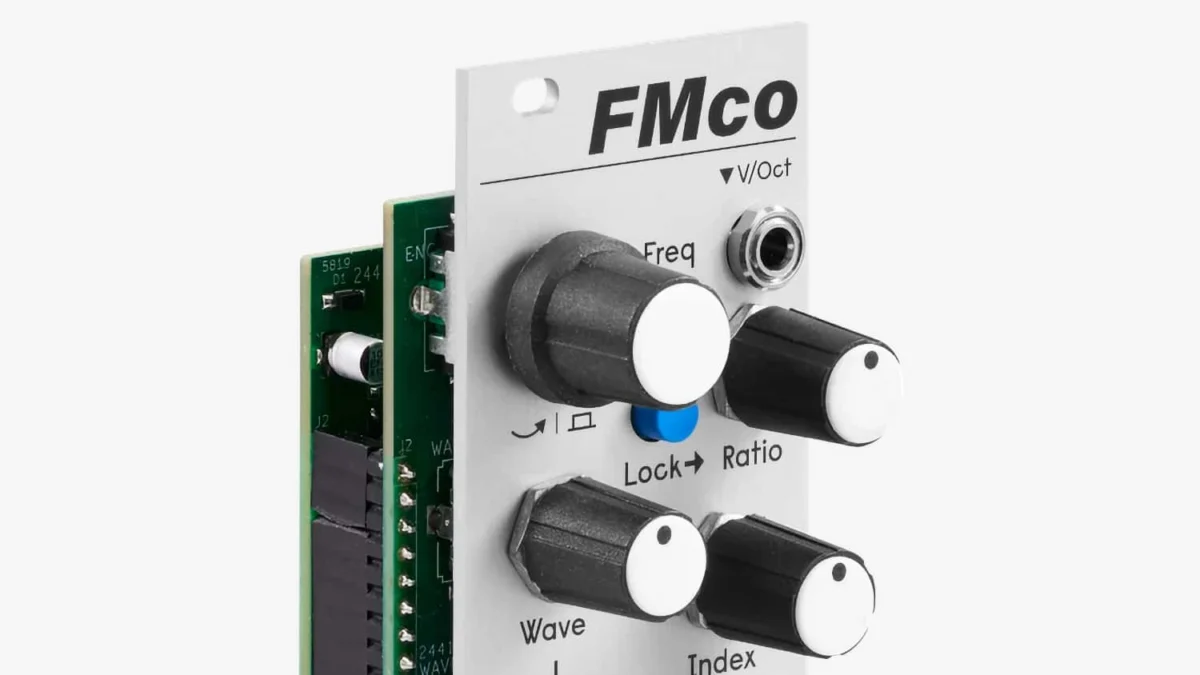
ALM/Busy Circuits has officially announced the release of the FMco, a sophisticated and compact frequency modulation (FM) synthesis-based voltage-controlled oscillator (VCO) and complete synth voice module. This new addition to the ALM product line is designed to provide users with a streamlined yet powerful approach to FM synthesis, fitting within the space-constrained environments of modern Eurorack modular systems. Priced at $271 USD, the FMco represents a significant step in the evolution of digital synthesis modules, offering a 2-operator engine that balances ease of use with deep sonic flexibility. The module is available immediately through authorized retailers and the official Busy Circuits online storefront.
The FMco is built upon an original 2-operator FM synthesis implementation, which the manufacturer states has been meticulously tuned for immediate playability and a contemporary sonic character. Unlike traditional FM synthesizers that often require navigating complex menus and numerous operators, the FMco distills the essence of FM into a manageable set of controls. It features both manual and voltage control over the FM Index, Ratio, and a curated selection of classic operator waveforms. This architecture allows synthesists to move fluidly from simple harmonic tones to the complex, metallic, and percussive textures that are hallmarks of frequency modulation.
Technical Specifications and Core Synthesis Engine
At the heart of the FMco is a 2-operator digital engine. In FM synthesis, one oscillator (the modulator) changes the frequency of another oscillator (the carrier). The FMco provides direct access to this relationship through its Ratio and Index controls. The Ratio control determines the frequency relationship between the two operators, which is fundamental in defining the harmonic or inharmonic structure of the resulting sound. By modulating the Ratio via external control voltage (CV), users can achieve dynamic, shifting timbres that are difficult to replicate with standard subtractive synthesis.
The FM Index control determines the depth of the modulation—essentially how much the modulator is affecting the carrier. As the Index increases, the sidebands of the sound expand, creating richer and more aggressive tones. ALM has implemented a voltage-control system for this parameter, allowing for expressive performance capabilities when paired with sequencers, LFOs, or envelope generators. Furthermore, the inclusion of classic operator waveforms—ranging from sine waves to more complex shapes—ensures that the module can emulate vintage FM hardware while maintaining the clarity expected of modern digital components.
Integrated Synth Voice Capabilities
One of the defining features of the FMco is its ability to function as a standalone synth voice. Typically, in a modular setup, a VCO requires an external envelope generator and a voltage-controlled amplifier (VCA) to create a shaped sound. The FMco simplifies this signal chain by including a built-in decay envelope. This internal envelope is intelligently routed to both the FM depth (the Index) and the output level (the VCA).
When a trigger signal is received at the module’s trigger input, the decay envelope is initiated, allowing the FMco to produce percussive hits, plucks, and stabs without the need for additional modules. This integration makes the FMco an ideal choice for compact "skiff" setups or for users looking to add dedicated FM percussion and bass voices to their systems. The internal routing ensures that the timbre of the sound evolves alongside its volume, mimicking the natural acoustic behavior of struck objects where the initial impact has more high-frequency content that decays over time.
Advanced Features: Chords, Tuning, and Stereo Width
Beyond its standard monophonic FM capabilities, the FMco introduces several advanced features that expand its utility in a musical context. Most notably, the module includes a CV-controlled four-voice chord mode. This allows the FMco to generate harmonically rich polyphonic textures from a single module. The ability to shift between different chord inversions or types via external CV adds a layer of compositional depth, making it suitable for ambient pads, stabs, and melodic progressions.
To address the common challenge of precision tuning in digital modules, ALM has equipped the FMco with an encoder-based tuning system. This system provides high-resolution control over the pitch, ensuring that the module can be quickly and accurately tuned to other instruments in a performance. This is particularly crucial for FM synthesis, where even slight deviations in pitch between operators can lead to significant changes in the harmonic output.
Furthermore, the FMco features a stereo-widened output. While many Eurorack modules are monophonic, the FMco utilizes internal processing to create a sense of spatial depth. This stereo enhancement makes the module sound "larger" in a mix and provides a more immersive experience for the listener, particularly when using the chord modes or high-index FM settings.
Historical Context and Market Position
The release of the FMco comes at a time when FM synthesis is experiencing a resurgence in the modular world. Originally popularized in the 1980s by the Yamaha DX series, FM synthesis was known for its steep learning curve and digital complexity. In recent years, companies like ALM/Busy Circuits have sought to "demystify" this form of synthesis by creating interfaces that are more tactile and intuitive.
ALM has a long history of developing unique digital modules, such as the Akemie’s Castle and Akemie’s Taiko, which utilized vintage Yamaha FM chips to provide authentic "gritty" FM sounds. The FMco appears to be a modern evolution of this lineage, moving away from specialized vintage chips toward a custom-coded implementation that offers higher fidelity and more contemporary features while maintaining the compact form factor (HP) for which ALM is known.
The price point of $271 USD positions the FMco as a mid-range module that offers significant value by combining a VCO, an envelope generator, a VCA, and a chord generator into a single unit. In the current Eurorack market, where "all-in-one" voices are highly sought after for their space efficiency, the FMco is expected to compete with other digital voices from manufacturers like Mutable Instruments (now discontinued but still influential), Noise Engineering, and Qu-Bit Electronix.
Design Philosophy and User Interface
ALM/Busy Circuits is recognized for its distinct aesthetic—often characterized by minimalist silver panels, clear labeling, and a focus on utility. The FMco follows this design language. The interface is organized to provide immediate access to the most critical parameters, with knobs for Ratio and Index taking center stage. The use of an encoder for tuning suggests a move toward more reliable and repeatable performance settings, a feature often requested by professional touring musicians.
The module’s compact size—though the exact HP width was not specified in the initial announcement, it follows the "compact" branding of the ALM "co" series—makes it an attractive option for users who have reached the limits of their rack space. By consolidating multiple functions into a single module, ALM continues its trend of creating "workhorse" modules that provide maximum functionality per square inch.
Implications for the Modular Ecosystem
The introduction of the FMco reflects a broader shift in the synthesizer industry toward hybridizing synthesis techniques. By providing a 2-operator engine that is easy to modulate, ALM is encouraging users to explore the sonic territory between traditional analog-style waveforms and complex digital textures. The inclusion of stereo widening and chord modes also highlights the increasing demand for modules that can provide a "finished" sound directly from the rack, reducing the need for extensive outboard processing.
Industry analysts suggest that the FMco will likely find a home in both professional studios and live performance rigs. Its ability to serve as a primary melodic voice or a dedicated percussion source makes it versatile. Furthermore, the "immediate" nature of its FM implementation lowers the barrier to entry for newcomers to modular synthesis who might otherwise be intimidated by the mathematical complexity of frequency modulation.
Pricing and Availability
The ALM FMco is officially available for purchase as of the date of this announcement. It is stocked by major modular synthesizer retailers globally, including those in North America, Europe, and Asia. The suggested retail price of $271 USD is consistent with ALM’s commitment to providing high-quality, UK-designed hardware at accessible price points.
As part of the launch, ALM has released a demonstration video showcasing the module’s range, from clean sine-wave bass to aggressive, modulated lead sounds and expansive chords. This transparency in demonstrating the module’s capabilities is a staple of the Busy Circuits brand, ensuring that potential buyers understand the sonic signature of the device before purchase.
In conclusion, the ALM FMco is a significant addition to the digital Eurorack landscape. By combining a refined 2-operator FM engine with integrated voice architecture and modern features like stereo widening and encoder-based tuning, ALM has created a tool that is both powerful and accessible. Its release reinforces the company’s position as a leader in the development of innovative, musician-centric modular hardware. For synthesists looking to expand their palette with the unique textures of FM synthesis without sacrificing significant rack space, the FMco presents a compelling and versatile solution.
