

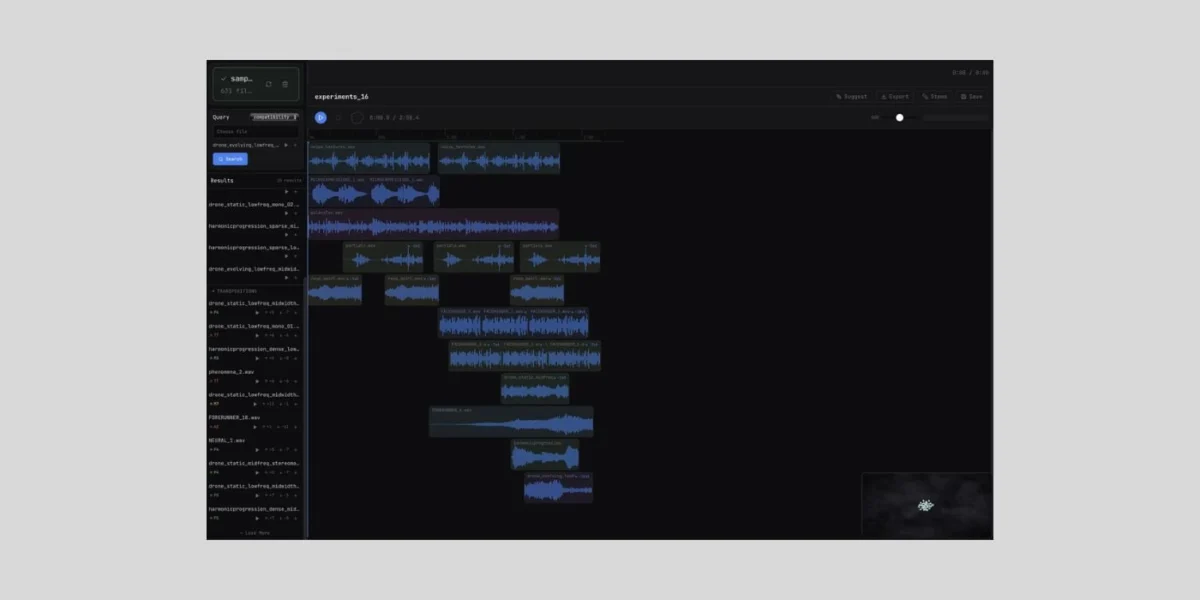
Composer and software engineer Austin Rockman has officially released Reflector, a free, open-source interactive audio workstation meticulously designed for advanced sample discovery and harmonic arrangement. This innovative software aims to redefine how musicians interact with their personal sound libraries, offering a unique approach that leverages machine learning to unearth harmonically compatible audio assets. The launch, marked by its availability as a free macOS application, signals a significant development in the realm of music production tools, emphasizing intelligent assistance over automated generation.
The genesis of Reflector stems from a clear vision to address a pervasive challenge faced by modern music producers: navigating vast, often unwieldy, digital sample libraries. In an era where gigabytes, and even terabytes, of audio samples are commonplace, the traditional methods of organization and discovery—relying on manual tagging, genre classifications, or simple filename searches—have become increasingly insufficient. Austin Rockman, with his dual expertise as a composer and software engineer, identified a critical gap: the absence of a tool that could intuitively understand and suggest samples based on their underlying harmonic relationships. This frustration with existing limitations likely fueled the development of Reflector, positioning it not as a replacement for a Digital Audio Workstation (DAW), but as a crucial "idea-building space" that precedes and complements it.
Technological Foundation: Machine Learning and Ethical AI Implementation
At its core, Reflector distinguishes itself through its innovative application of machine learning (ML). Unlike many contemporary AI-powered music tools that focus on generating new audio content, Reflector’s ML algorithms are specifically engineered to analyze a user’s existing sample library locally. This analysis centers on the harmonic characteristics of each audio file, allowing the software to build an intricate map of relationships within the user’s collection. When a user queries Reflector with a particular sample, the system can then intelligently suggest other sounds from their library that either harmonically complement the query or share significant sonic resemblances. This capability extends to proposing transpositions, indicating when a sample might fit more cohesively after being pitch-shifted, thereby expanding creative possibilities that might otherwise be overlooked.
A cornerstone of Reflector’s design philosophy is its commitment to privacy and ethical AI. The software operates entirely locally on the user’s machine, ensuring that all audio files and usage data remain private and never leave the user’s computer. This stands in stark contrast to many cloud-based AI solutions, addressing growing concerns within the creative community regarding data security and intellectual property. Furthermore, Austin Rockman has confirmed that the machine learning system powering Reflector was trained exclusively on synthetic audio. This deliberate choice bypasses the contentious issue of using copyrighted recordings for training data, a practice that has sparked considerable debate and legal challenges within the broader AI and creative industries. By utilizing synthetic data, Reflector sets a precedent for responsible and ethical AI development in music technology, fostering trust and transparency with its user base.
The open-source nature of Reflector further amplifies its ethical and community-oriented approach. Rockman has made the weights, model code, and training pipeline openly available. This transparency allows for community scrutiny, potential contributions, and ensures the long-term viability and adaptability of the software. For independent developers and academic researchers, this open framework provides invaluable insights into the practical application of machine learning for harmonic analysis in audio, potentially inspiring further innovation in the field.
A Novel Workflow: The "Stage Before the DAW"
Reflector’s unique workflow is conceptualized as the "stage before the DAW," serving as an indispensable creative sandbox for rapid prototyping and sound design exploration. It is not intended to replace professional music production software like Ableton Live, Logic Pro, or FL Studio. Instead, it offers a dedicated environment for initial ideation, where musicians can freely experiment with sound combinations without the complexities of a full-fledged DAW.
The software features an intuitive, DAW-like timeline where users can place selected samples and begin constructing rudimentary arrangements. The truly innovative aspect lies in Reflector’s dynamic suggestion system: as elements are added to the timeline, the software continuously analyzes the evolving arrangement and provides context-aware suggestions based on the cumulative harmonic content of the session. This interactive feedback loop transforms the often-solitary process of sample browsing into a collaborative dialogue with an intelligent assistant, helping artists overcome creative blocks and discover unexpected sonic pairings.
Another standout feature is the "Galaxy view," a visually compelling 3D spatial representation of saved sessions. This view maps arrangements based on their shared harmonic relationships, offering a macro perspective on a user’s creative output. For producers with extensive archives of unfinished sketches or large sample libraries, the Galaxy view presents a powerful tool for rediscovering forgotten connections, identifying recurring harmonic themes, and exploring new avenues for existing ideas. Imagine a producer having dozens of unfinished loops; the Galaxy view could instantly highlight which ones share a common harmonic thread, facilitating the combination or evolution of disparate projects.
It is important to note Reflector’s specific focus: it is primarily aimed at tonal and textural material. This includes a wide array of sounds such as pads, keys, strings, synthesizers, guitars, vocals, field recordings with a discernible tonal center, and sound design elements that carry harmonic information. The software does not analyze rhythm, meaning it is not designed as a beat-matching tool. This specialization allows Reflector to excel within its defined scope, delivering precise harmonic analysis without being diluted by attempts to tackle rhythmic complexities—a domain typically handled by dedicated beat-matching algorithms or manual human expertise.
Market Context and Broader Implications
The release of Reflector arrives at a time of unprecedented growth in both the digital audio sample market and the integration of artificial intelligence into creative workflows. The global market for music production software, which includes tools for sample management and sound design, has seen consistent expansion, driven by the democratization of music creation and the proliferation of independent artists. The sheer volume of digital assets available to producers, from commercial sample packs to user-generated content, necessitates more sophisticated tools for organization and discovery. Reflector directly addresses this need, providing a solution that goes beyond mere cataloging to offer genuine creative assistance.
The broader implications of Reflector for the music production landscape are multifaceted:
-
Empowering Independent Creators: By being free and open-source, Reflector lowers the barrier to entry for advanced sample discovery tools. This empowers bedroom producers, independent artists, and hobbyists with sophisticated technology that might otherwise be prohibitively expensive or proprietary. It fosters a more inclusive environment for creative exploration.
-
Shifting Paradigms in Sample Discovery: Reflector could set a new standard for how musicians interact with their sound libraries. Moving beyond static search parameters, its interactive and harmonically aware approach may influence future developments in sample managers and even DAWs, pushing them towards more intelligent and context-sensitive functionalities.
-
The Future of AI in Music: Reflector serves as a prime example of assistive AI in music—tools that augment human creativity rather than replacing it. In an industry grappling with the ethical and creative implications of generative AI, Reflector demonstrates a path where machine learning enhances the creative process by organizing, suggesting, and inspiring, without automating the core artistic decisions. This distinction is crucial for artists who value human agency in their work.
-
Contribution to the Open-Source Movement: The open-source nature of Reflector strengthens the growing movement of collaborative development within music technology. It encourages transparency, allows for community-driven enhancements, and provides educational resources for aspiring developers and sound engineers. This fosters innovation and potentially leads to a more robust ecosystem of tools.
-
Ethical AI Development Model: Austin Rockman’s commitment to local processing and synthetic training data provides a compelling model for ethical AI development in the music industry. It demonstrates that powerful AI tools can be built and deployed without compromising user privacy or infringing upon existing copyrights, addressing two of the most significant concerns surrounding AI’s expansion into creative fields.
Chronology and Accessibility
While the exact internal development timeline for Reflector is not publicly detailed, its public release on August 9, 2026, marks the culmination of Austin Rockman’s efforts to bring this vision to fruition. The initial concept likely began with Rockman identifying the aforementioned challenges in sample management, followed by a period of intensive software engineering and machine learning model development. The training of the ML models using exclusively synthetic audio would have been a significant phase, ensuring both the functional integrity and the ethical standing of the software. Prior to its official release, it can be inferred that the application underwent internal testing and refinement to iron out initial bugs and optimize performance, leading to the current stable macOS release.
Reflector is currently available as a free, signed macOS application. Given its distribution outside the Apple App Store, macOS users may need to perform a specific installation step: right-clicking the application icon and choosing "Open" the first time it is launched, to bypass security warnings for unsigned software. This is a common procedure for independent software distributed directly by developers. Austin Rockman has explicitly confirmed his intention for Reflector to remain free, reinforcing its accessibility and commitment to the open-source community. The availability of the model code and training pipeline further solidifies its long-term potential for community-driven evolution and adaptation to future operating systems or platforms, should the developer or community choose to pursue them.
In conclusion, Reflector represents a forward-thinking approach to music production challenges. By harnessing machine learning in an ethical, privacy-conscious, and open-source manner, Austin Rockman has introduced a tool that promises to significantly enhance the creative workflow for countless musicians. It is not merely a utility for organization but an interactive partner in the creative journey, designed to unlock new sonic possibilities within existing libraries. While, as with any experimental software from a solo developer, some initial rough edges may be anticipated, the foundational concept and its execution firmly position Reflector as a landmark innovation: a truly intelligent assistant that fosters creativity rather than bypassing it, offering a profoundly different and intuitive way to navigate the rich tapestry of one’s own sounds.
