

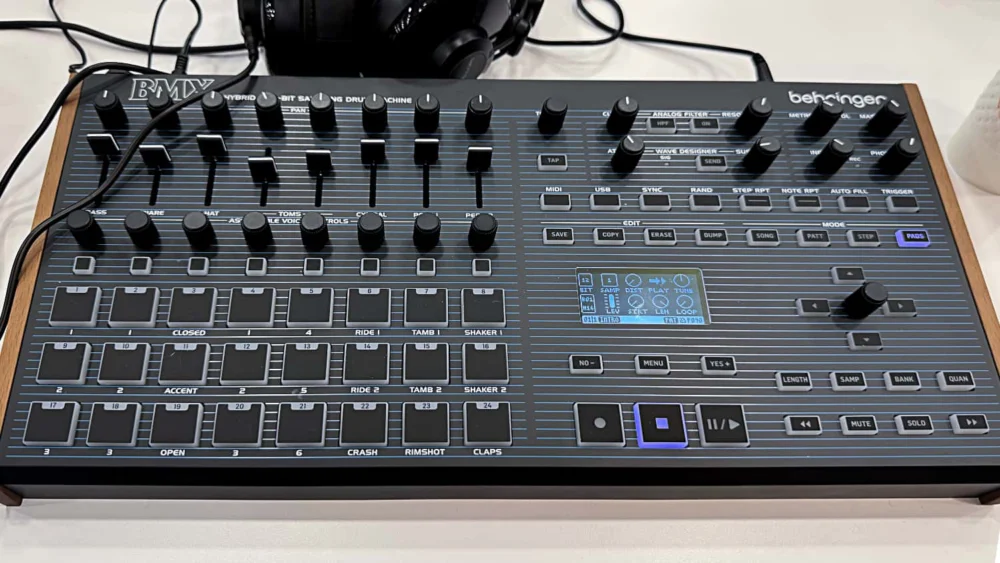
The global music technology landscape witnessed a significant development today as Behringer officially unveiled a comprehensive performance demonstration of its latest hardware offering, the BMX hybrid sampling drum machine. This release marks a pivotal moment in the company’s ongoing strategy to recreate and modernize classic electronic instruments that have historically been inaccessible to the average musician due to high vintage market prices and scarcity. The Behringer BMX, while an original hardware design in its internal architecture, draws heavy aesthetic and functional inspiration from the Oberheim DMX, a machine that defined the percussion sounds of the early 1980s. By integrating retro 8-bit and 12-bit sampling rates with modern sequencing capabilities and analog filtering, Behringer aims to bridge the gap between nostalgic sonic textures and contemporary production workflows.
Historical Context and the Legacy of the Oberheim DMX
To understand the significance of the Behringer BMX, one must examine the history of its spiritual predecessor, the Oberheim DMX. Launched in 1981, the DMX was one of the first digital drum machines available on the commercial market. At a time when most percussion synthesizers relied on analog circuits to mimic drum sounds, the DMX utilized digital samples of real drums stored on EPROM chips. This gave it a punchy, realistic, yet distinctively "crunchy" sound that became the backbone of several musical revolutions.
The original DMX was instrumental in the birth of hip-hop, famously used by artists like Run-D.M.C. and in the production of New Order’s "Blue Monday," which remains the best-selling 12-inch single of all time. However, the original unit was prohibitively expensive, retailing for approximately $2,895 in 1981—the equivalent of nearly $10,000 today when adjusted for inflation. As these vintage units aged, they became prone to hardware failure and required specialized knowledge to maintain, further cementing their status as "holy grail" items for elite studios. Behringer’s decision to develop the BMX is a direct response to a long-standing demand for a reliable, affordable alternative that captures the specific digital-to-analog conversion characteristics of that era.
Technical Specifications and Hardware Architecture
The Behringer BMX distinguishes itself through a hybrid architecture that combines digital sampling with analog processing. Unlike standard modern drum machines that utilize high-resolution 24-bit/96kHz audio, the BMX intentionally employs lower bit rates—specifically 8-bit and 12-bit—to replicate the "aliasing" and "quantization noise" that gave 1980s drum machines their character. This grit is highly sought after in genres such as lo-fi house, synthwave, and underground hip-hop.
According to the technical details revealed in the performance demo, the BMX features:
- Multi-Voice Architecture: The unit supports multiple independent voices, each with dedicated controls for tuning, level, and decay.
- Hybrid Sampling Engine: While it comes pre-loaded with a library of classic sounds, the "sampling" designation implies the ability for users to manipulate or potentially load their own samples, a significant upgrade over the original DMX’s fixed EPROM system.
- Analog Filtering: The machine includes analog filters, likely based on the classic Curtis or SSI designs Behringer has utilized in previous recreations, allowing users to sweep frequencies and add resonance to digital samples.
- Integrated Sequencer: A modern 64-step sequencer is built into the chassis, featuring polyrhythm capabilities, swing settings, and per-step automation (parameter locking), which provides significantly more flexibility than the linear sequencers of the 1980s.
- Connectivity: The rear panel is equipped with individual outputs for each drum voice, allowing for professional multi-track recording and external processing. It also includes MIDI In/Out/Thru, USB-MIDI for DAW integration, and clock synchronization for modular synthesizer setups.
Product Development Timeline and Market Strategy
The journey of the Behringer BMX from concept to reality has been tracked closely by industry observers for several years. Behringer first hinted at a DMX-style project in early 2017 as part of their broader initiative to "democratize" classic gear.
- 2017–2019: Conceptual phase where Behringer gathered feedback from social media communities regarding which vintage drum machines were most desired.
- 2021: Initial renders of the BMX (then referred to as the "RD-DMX" in some circles) were leaked, showing a layout that closely mirrored the Oberheim original but with updated buttons and a small OLED display.
- 2023: Prototypes were showcased at various private trade events, confirming the move toward a hybrid sampling engine rather than a purely static sample player.
- Late 2024: The release of the official performance demo and the announcement of the $459 USD price point.
This timeline reflects Behringer’s standard "tease-and-release" marketing cycle, which often spans several years. By announcing products early, the company gauges market interest and adjusts features based on user critiques before the final hardware enters mass production at their "Music Tribe City" manufacturing facility in Zhongshan, China.
Pricing, Availability, and Economic Impact
The Behringer BMX is priced at $459 USD for international markets. While US-specific pricing is often subject to import tariffs and shipping logistics, early listings from major US retailers indicate a matching $459 pre-order price.
This pricing strategy is aggressive. For comparison, a vintage Oberheim DMX in working condition typically sells for between $3,500 and $5,500 on the secondary market. Other modern competitors in the sampling drum machine category, such as the Elektron Digitakt II or the Roland TR-8S, retail between $700 and $1,000. By positioning the BMX under the $500 threshold, Behringer is targeting not only professional producers but also hobbyists and entry-level musicians.
Industry analysts suggest that this price point is made possible by Behringer’s vertical integration. Because the parent company, Music Tribe, owns the factories, the semiconductor manufacturing (Coolaudio), and the distribution networks, they can maintain margins that are impossible for smaller boutique manufacturers to match.
Industry Reactions and Expert Analysis
The announcement has elicited a polarized but largely enthusiastic response from the music production community. Proponents argue that Behringer is performing a service by keeping "extinct" sounds alive and accessible. "The original DMX is a museum piece at this point," noted one synthesizer historian. "Providing a hardware interface that feels like the original but functions with modern MIDI and USB reliability is a net positive for creativity."
Conversely, some critics within the industry have raised concerns regarding the ethics of "cloning" legacy designs. However, because the original Oberheim patents have long since expired and the BMX incorporates significant original engineering (such as the updated sequencer and sampling capabilities), the product occupies a legal space common in the tech industry.
From a technical standpoint, the inclusion of individual outputs is being praised by recording engineers. In a modern studio environment, the ability to send the kick drum to one outboard compressor and the snare to a different reverb unit is essential. Many affordable modern drum machines omit individual outputs to save space and cost, making the BMX a more "pro-leaning" device despite its budget price.
Broader Implications for Music Production
The release of the Behringer BMX signifies a broader trend in the music industry: the "Hardware Renaissance." Despite the power of software plugins and Digital Audio Workstations (DAWs), there is a growing movement toward tactile, hands-on instruments. The BMX caters to this by providing a physical interface where every function is accessible via a knob or button, reducing the "menu diving" often associated with modern digital gear.
Furthermore, the BMX reinforces the current industry obsession with "imperfection." In the 1990s and 2000s, the goal of digital audio was transparency and high fidelity. In the 2020s, the aesthetic has shifted toward the warmth and grit of 12-bit audio. By specifically engineering the BMX to operate at these lower resolutions, Behringer is leaning into a "lo-fi" trend that dominates current streaming charts.
Conclusion and Future Outlook
As the Behringer BMX moves toward full retail availability, it is poised to become a staple in both home studios and professional setups. Its combination of historical aesthetics, hybrid digital-analog sound, and an accessible price point makes it a formidable entry in the drum machine market.
The success of the BMX will likely influence Behringer’s future roadmap, potentially leading to more "hybrid" recreations of other rare digital classics from the 80s, such as the LinnDrum or the E-mu Drumulator. For now, the BMX stands as a testament to the enduring appeal of 1980s percussion—a sound that, forty years later, continues to define the rhythm of modern music. With pre-orders now appearing at major vendors, the "timeless grooves" Behringer promises are set to reach a new generation of creators.
