

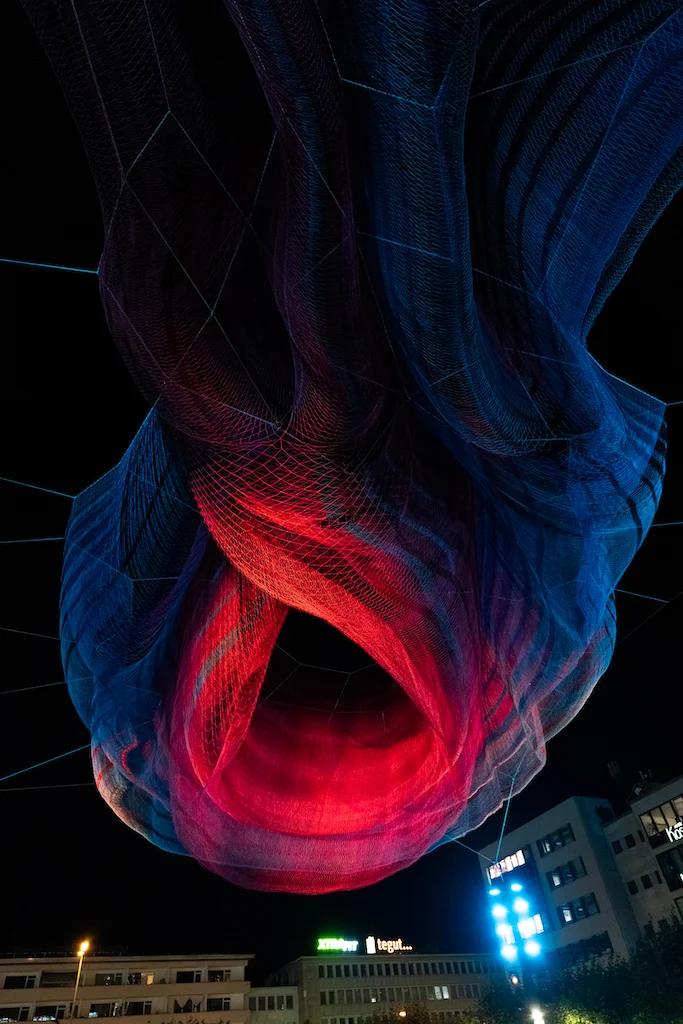
The city of Frankfurt am Main witnessed a transformative cultural event on August 11, 2026, as the Konstablerwache, one of its most prominent public squares, was bathed in a meticulously curated symphony of light and sound. The occasion marked the official debut of "A Sky Full of Hope – Earthtime 1.78 Frankfurt," a monumental net sculpture by the internationally acclaimed American artist Janet Echelman. This installation represents a significant fusion of high-level textile art and cutting-edge lighting engineering, serving as a flagship project for the World Design Capital Frankfurt RheinMain 2026. Beyond its aesthetic appeal, the project stands as a testament to the technical synergy between three key industry leaders: the lighting design experts at TLD Planungsgruppe, the technical implementation specialists at Neumann & Müller, and the lighting manufacturer Cameo.
The installation is not merely a temporary display but a semi-permanent fixture intended to grace the Frankfurt skyline for the next three years. It is only the second permanent outdoor work by Echelman in Europe, following her successful installation in Porto, Portugal. The choice of the Konstablerwache is particularly poignant; often criticized for its stark, utilitarian architecture, the square has been reimagined as an atmospheric gathering point where art serves to soften the urban landscape. The sculpture’s color palette was specifically developed to reflect the diversity of the city, incorporating hues that represent the 178 different nations that call Frankfurt home.
The Evolution of the Earthtime Series and the Frankfurt Vision
Janet Echelman’s "Earthtime" series explores the interconnectedness of human beings with the natural world and the passage of time. The number "1.78" in the title refers to a specific scientific measurement: the number of microseconds by which the Earth’s day was shortened following the 2011 Tōhoku earthquake and tsunami. This subtle shift in the Earth’s rotation serves as a metaphor for the profound, often invisible impact of global events on our collective existence.
For the Frankfurt installation, Echelman utilized high-tech fibers that are fifteen times stronger than steel by weight. These fibers are woven into a complex, multi-layered net that reacts to the slightest movements of the wind. The challenge for the lighting team was to ensure that this fluid, organic motion remained the focal point, even after sunset. The goal was to create an illumination that felt like an inherent property of the sculpture rather than an external light source being projected onto it.
The project was realized under the umbrella of the World Design Capital 2026, a designation awarded to the Frankfurt RheinMain region to recognize its use of design as a tool for social, cultural, and economic development. "A Sky Full of Hope" embodies the theme of "Design for Democracy," providing a free, accessible artistic experience to all citizens regardless of their background, thereby fostering a sense of shared identity in a multicultural metropolis.
Technical Precision and the Role of TLD Planungsgruppe
The responsibility for the lighting design and conceptualization lay with the TLD Planungsgruppe, a firm renowned for its work in architectural lighting and large-scale event production. Their involvement with Echelman’s work dates back to 2021, when they successfully illuminated "Earthtime 1.26 Munich" at the Odeonsplatz during the IAA Mobility event. This prior experience was crucial in understanding the unique demands of Echelman’s medium.
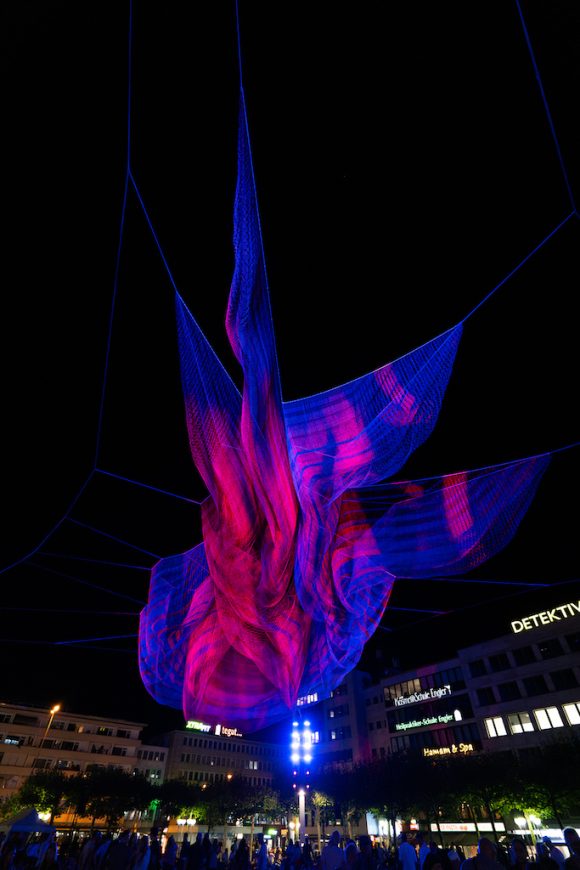
Alexander Orkisch, Senior Project Lead at TLD Planungsgruppe, emphasized the necessity of subtlety in the lighting design. The requirement was for soft, organic color transitions that mimic the natural shifts of the sky. To achieve this, the team needed luminaires that offered exceptional color mixing and ultra-smooth dimming curves. Any flickering or "stepping" during color changes would break the illusion of the sculpture being a living, breathing entity.
The design utilized 24 Cameo Zenit W600 G2 LED Wash Lights. These fixtures were strategically distributed across four custom-designed pylon structures surrounding the sculpture. By angling the lights from multiple directions, TLD was able to eliminate harsh shadows and ensure that the multi-layered depth of the netting was visible from every perspective on the ground.
Implementation and Reliability: Neumann & Müller’s Contribution
To bring the complex design to life, TLD partnered with Neumann & Müller (N&M), a leading provider of event technology. N&M recently expanded its extensive rental inventory with the Cameo Zenit W600 G2, specifically identifying it as a tool capable of meeting the rigorous demands of long-term outdoor installations.
Yvonne Schwarz, Head of the Stuttgart Event Division at Neumann & Müller, noted that illuminating a public art piece for a three-year duration presents challenges far beyond those of a standard corporate event or concert. The equipment must withstand the full spectrum of German weather—from the intense heat and UV radiation of summer to the freezing temperatures, rain, and snow of winter.
The Zenit W600 G2’s IP65 certification was a decisive factor. This rating ensures that the internal electronics are completely protected against dust and water ingress. Furthermore, the robust build quality reduces the need for frequent maintenance, which is vital for a project located in a busy public transport hub where access for heavy machinery is restricted. Schwarz highlighted that for projects of this magnitude, the reliability of the hardware is just as important as its visual performance, as the installation remains visible to the public 365 days a year.

Engineering Excellence: The Cameo Zenit W600 G2
The selection of the Zenit W600 G2 by both the designers and the equipment partners serves as a major endorsement for Cameo, a brand under the Adam Hall Group. The G2 (second generation) of the Zenit W600 was engineered specifically to bridge the gap between high-output stage lighting and precision architectural illumination.
Moritz Herdt, Field Application Engineer for Light Technology Product Management at Cameo, explained the technical advantages that made the Zenit W600 G2 suitable for Echelman’s art. One of the primary features is the fixture’s high color fidelity. The use of 40 x 15W RGBW LEDs allows for a massive spectrum of colors, ranging from deep, saturated tones to delicate pastels. This was essential for replicating the specific "178 nations" color palette required by the artist.
Furthermore, the fixture employs 16-bit technology for color mixing and dimming. This allows for thousands of individual steps in brightness, ensuring that transitions are imperceptible to the human eye. In the context of "A Sky Full of Hope," where the light must ebb and flow like water or wind, this level of precision is the difference between a mechanical light show and a piece of fine art. The integration of the Zenit series into such a prestigious project demonstrates the brand’s growing influence in the international art and architectural sectors.
Chronology of the Project: From Munich to Frankfurt
The journey toward the Frankfurt installation began years earlier, following the successful collaboration in Munich in 2021. The Munich project proved that Echelman’s ethereal nets could be successfully integrated into the dense, historic urban fabric of a German city using modern LED technology.
Following the announcement that Frankfurt RheinMain would be the World Design Capital 2026, planning for a permanent or semi-permanent centerpiece began in 2024. The site selection of Konstablerwache was finalized in early 2025, followed by a year of structural engineering assessments to ensure the square’s underground infrastructure could support the tension of the massive pylons.
The installation process commenced in July 2026, with the high-tech netting being hoisted into place over several nights to minimize disruption to the city’s light rail and pedestrian traffic. The technical rehearsal phase took place in the first week of August, during which TLD and Neumann & Müller calibrated the 24 Cameo fixtures to account for the surrounding ambient light of the city. The official premiere on August 11 served as the grand opening for the late-summer cultural season in Frankfurt.
Broader Impact and Urban Implications
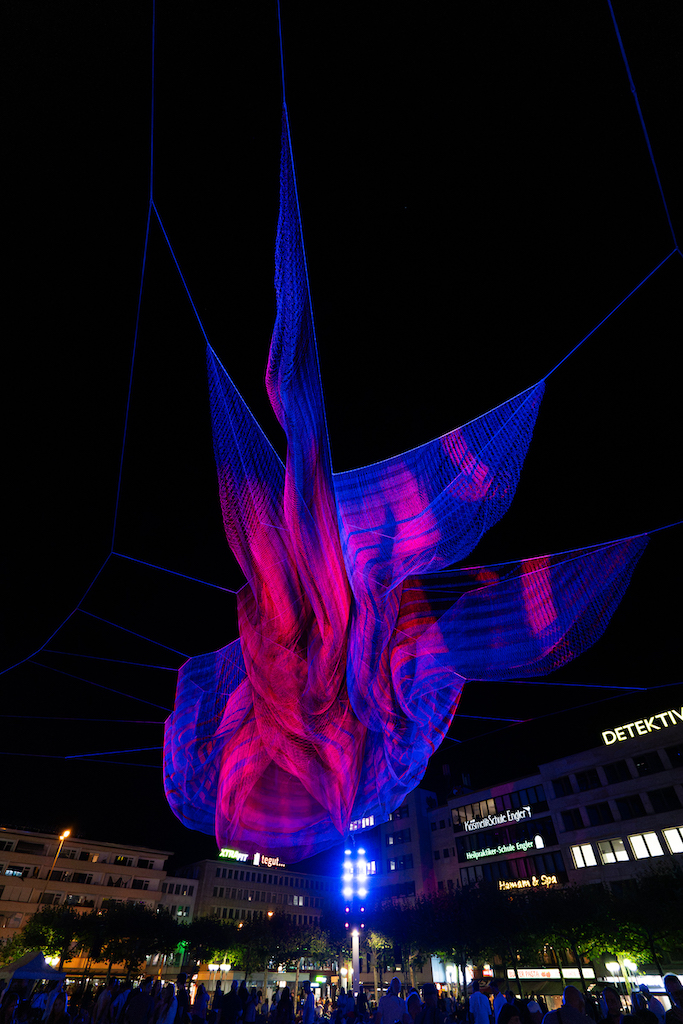
The installation of "A Sky Full of Hope – Earthtime 1.78 Frankfurt" has significant implications for urban planning and public art. Historically, the Konstablerwache has been a site of transition—a place where people catch trains or shop, but rarely a place where they linger. By introducing a monumental work of art that changes throughout the day and night, the city is successfully testing "placemaking" strategies.
Early data and public reaction suggest a positive shift in the square’s atmosphere. The installation has become a focal point for photography and social media, drawing visitors who might otherwise have bypassed the area. This increased foot traffic and "eyes on the street" are often linked to improved perceptions of public safety and community engagement.
From an industry perspective, the project highlights the blurring lines between entertainment technology and permanent architecture. As LED technology becomes more efficient and durable, artists like Janet Echelman can realize visions that were previously impossible due to the limitations of traditional lighting. The collaboration between TLD, Neumann & Müller, and Cameo serves as a blueprint for future "smart city" initiatives where art and technology are used to enhance the quality of urban life.
As the installation continues its three-year residency, it will serve as a constant reminder of the 178 nations that contribute to Frankfurt’s identity. Under the glow of the Zenit W600 G2, the net remains a symbol of hope and interconnectedness, proving that even the most rigid urban environments can be transformed into spaces of beauty and reflection through the right combination of artistic vision and technical expertise.
